Sunday, 31 October 2010

Chairman of the board

Directors (in the past known as Directors’ Bitter) allegedly took its name from a special beer set aside for the directors of the Courage brewery at Alton in Hampshire, which was then released to the public. In the late 1970s it became Courage’s contender in the “premium bitter” market, competing with the likes of Ind Coope Burton Ale, Ruddles County and Eldridge Pope Royal Oak.

For a few years in the early 1980s I lived in Surrey, where most of the pubs were tied to either Courage or Allied Breweries, so I became quite familiar with Directors. To be honest, in that section of the market I tended to prefer the drier, hoppier Burton Ale, but recognised Directors as a good beer that, while predominantly malty and fruity, did not allow itself to be overwhelmed by sweetness.

It was then brewed at the Courage brewery in Bristol, but after that closed in 2000 went to the John Smiths plant at Tadcaster, a rather unlikely location for an essentially “Southern” beer. As the international breweries sought to divest themselves of their cask beer interest, the Courage brands, including Directors’ lower-strength stablemate Courage Best, were sold to Wells & Youngs in 2007 and are now brewed at Bedford.

Directors has a strength of 4.8% ABV and comes in a brown bottle with the characteristic Wells & Youngs wide shoulders. The label is dark red, which leads you to expect a reddish beer, which indeed it is, mid-brown with a copper-red tinge. Again the picture makes it look paler than it actually is.

It has a shallow but lasting head, rather thicker and creamier than the other W&Y beers, and noticeable although not overpowering carbonation. The initial aroma is fruity, and its basic character is malty and fruity, but with a hoppy note too and a surprisingly dry aftertaste. It’s certainly not a sweet, syrupy beer and, while it drinks its strength, you can imagine having more than one.

While it won’t appeal to lovers of pale, heavily hopped beers, it’s a good example of the traditional English robust, malty strong bitter. Although I haven’t tried the current cask version, Wells & Youngs have succeeded in recreating in bottle something that retains much of the character of the beer I remember from the 80s. It’s also a distinctive beer that you might well be able to identify in a blind tasting.

Saturday, 30 October 2010

Rose tinted pubs

I see that the government have now appointed Bob Neill as Community Pubs Minister, whatever that may mean. It’s all too common to hear of “community pubs” being held up as an ideal in comparison with irresponsible High Street bottle bars, as, for example, in the comment here by Greg Mulholland MP that “community pubs are a crucial part of the solution to problem drinking.”

The term conjures up visions of cosy little street-corner locals with darts teams, meat raffles and coach trips to the races, the kind of pubs where most of the customers live within walking distance and regulars will greet each other in the bar. In short, the kind of place where you might ask the proverbial “man in the pub” a question and get a meaningful answer.

Yes, there still are pubs of this kind, but they represent a small and dwindling proportion of the country’s pub stock, and it is these “community pubs” that have suffered most over the past three years when legislation has decreed that half the pubgoing community have to be treated as outcasts.

And it is very misleading to imply that “well run pubs” and “community pubs” are one and the same. What about town-centre Wetherspoons? Or destination dining pubs specialising in local food and ales? Or multi-beer freehouses that most of their customers will pass numerous local pubs to visit? All types of pubs promoted by CAMRA, but not really in the accepted sense “community pubs”, unless “community” is defined as a community of interest of their customers.

How often, honestly, do you go in a pub and strike up a conversation with people you already know, but who haven’t either gone there with you or arranged to meet you there?

Perhaps if distinctions are to be drawn in the pub trade, they should be between “responsibly” and “irresponsibly” run venues. “Community pubs” is a sentimental, old-fashioned and increasingly meaningless stereotype which fails to reflect the way most responsible drinkers use pubs today.

Sensitive souls

The most recent poll followed on from my post about Premiumisation and asked to what degree buyers of bottled and canned beers were sensitive to special offers and discounts. There were 107 responses, broken down as follows:

I buy the brands I like regardless of price: 48 (45%)
I have a range of brands I like, but tend to choose those that are on offer: 24 (22%)
I often try brands outside my favourites if they are on offer: 21 (20%)
I just go for the cheapest available within the category: 4 (4%)
I never buy bottled or canned beer: 10 (9%)

So almost half of respondents said they did not tend to be influenced by offers and went for the beers they preferred. Overall, I suspect that understates beer buyers’ price sensitivity, but it applies more at the premium end of the market.

The implication of this for brewers must be that to build respect and success for your brand in the long term it is important to avoid being seen as something that is regularly piled high and sold cheap. One of the best beer marketing slogans of all time was Stella Artois’ “Reassuringly expensive”, a reputation that was destroyed by the brand’s owners in the pursuit of higher volumes. To some extent, Greene King seem to manage that with Old Speckled Hen, which apparently is the best-selling bottled beer in Britain.

And I think you’d find even if you confined the survey to canned lagers that there was more brand loyalty than might be imagined – consumers don’t just choose indiscriminately between Carling, Carlsberg and Fosters depending on what is cheapest on the day.

Friday, 29 October 2010

Freezing your drink

A new high water mark has been reached in the anti-drink tide flowing through Scotland, with the news that West Dunbartonshire Council has decided to impose a complete ban on any new drinks licences, in both the on and off-trade, in 15 out of 18 areas within the authority. In the remaining three areas applicants for licences will have to prove that customers would not travel from an “overprovision” area to purchase alcohol.

Inevitably this will lead to stagnation in the market and act to the detriment of responsible consumers of alcohol by blocking any new entrants, as Patrick Brown of the Scottish Beer and Pub Association rightly points out. “The Board appears to be more interested in political grandstanding than it is in public health,” he said.

The Chair of the Licensing Board, councillor Jim Brown, said: “We have far too many pubs, bars and off-sales shops given the size of the area.” Just what right does this self-important twerp have to make judgments as what constitutes “too many” pubs or off-licences? Surely the number is determined by the level of business – if all are trading profitably, then there cannot be too many.

And what evidence is there that freezing licences is likely to reduce either consumption in general or so-called “problem drinking”?

The policy is also likely to hold back economic development in the area, as who would want to open a new supermarket, hotel or sports club if they were unable to get an alcohol licence for it?

The report doesn’t say whether existing licences will be transferable – if they are, the move will have the unintended consequence of handing a potential goldmine to anyone who has one, as they will be able to sell it to the highest bidder.

Thursday, 28 October 2010

Dog amongst the pigeons

Tee hee, James Watt of BrewDog – never knowingly uncontroversial – has said that keg is the future of craft beer in Britain.

“I don’t think cask is an appealing way to get people into beer,” said Watt. “Cask is more sleepy, stuffy, traditional and just has this kind of stigma attached to it which isn’t going to get young people excited.

“It’s all CAMRA, beards, sandals, beer bellies, hanging out at train stations at the weekend. We think keg beers could be the future of craft beers in the UK.”

Watt also argued keg better suits the beer styles the company produces.
Keg also has the advantage of allowing bars to stock interesting and unusual draught beers where they don’t have the turnover for cask.

It would be amusing to see a few CAMRA fuddy-duddies squirming if forced to make a choice between cask Greene King IPA and keg Punk IPA.

Wednesday, 27 October 2010

A cut worth making

Simon Clark of FOREST sets out very clearly here how immense sums of money are given by the government to ASH and other anti-smoking organisations who overwhelmingly use it to lobby the government to further tighten restrictions on smoking.

Two examples: commencing June 2008 the UK Centre for Tobacco Control Studies will receive £3,694,498 over five years. It was also awarded a £1.2 million grant to develop and pilot several projects to implement smoking cessation services. Smoke Free North West meanwhile secured almost £1.9 million from the PCTs in 2008 to “complement core national funding”.

ASH UK, for example, received a direct grant of £142,000 from the Department of Health in 2009 (£191,000 in 2008 and £210,400 in 2007) plus £110,000 from the Welsh Assembly Government in 2007. In 2008-09 ASH Scotland received £921,837 from the Scottish Government followed, in December 2009, by a £500,000 grant from the Big Lottery to fund a major three-year research project into smoke-free homes in Scotland. ASH Wales meanwhile received £115,800 from the Welsh Assembly Government in 2008-09 and £113,000 in 2007-08.
The comments thread to that posting is well worth reading!

Surely the government should not be funding what are basically pressure groups full stop, and in this time of economic stringency this is money that should be at the top of the list for cutting. Any smoking cessation activities carried out by these groups should be brought under the wing of the NHS, and their campaigning should only continue to the extent that it could be financed by genuine donations from the public. Which I suspect would be very small indeed.

Of course, the same also should apply to Don Shenker and his miserable crew of sarsaparilla-sipping anti-drink zealots at Alcohol Concern.

Pressure drop

This post on Paul Bailey’s blog refers to the phenomenon of “top pressure”, which was widespread in the 1970s, and was described and decried at length in CAMRA publications. What this involved was delivering real ale to pubs in casks, but then connecting a cylinder of CO2 to it, and using the gas pressure to force the beer to an illuminated keg-type font on the bar.

It must have largely been a Southern phenomenon, as I don’t recall ever knowingly coming across it in the North, where a lot of the beer was real, and a lot of what wasn’t real was “tank” (which maybe merits a post of its own). In fact the only occasion when I have drunk what I believed to be top-pressure beer was in a Whitbread pub in Alton, Hampshire in about 1981. By that time the practice was in steep decline, as real ale, and the handpumps that symbolised it, were once again perceived as attractive.

The system also had a unique drawback of its own, in that not only did the gas pressure make the beer fizzy and prevent it maturing in the cask, but it also tended to disturb the sediment, so you would end up with a pint of slightly hazy pseudo-keg. Thirty years or more on, it’s hard to see why it was done, as it combined the worst of both worlds, lacking both the freshness and authenticity of cask and the consistency of genuine keg.

But, back in those days, fizzy beer that came from illuminated boxes on the bar was seen as the future, and brewers who lacked the funds to invest in kegs, kegging lines and pasteurisation facilities climbed on the bandwagon by sending out cask beer and making it masquerade as keg. How times change.

Tuesday, 26 October 2010

Streets paved with gold

The next Wells & Youngs beer to sample is Young’s London Gold. This is a bottle-conditioned beer of 4.8% ABV*, packaged in a brown bottle with an attractive green label. It was previously known as Kew Gold – presumably it has been renamed to give it a wider appeal. I’m not sure if the recipe has been slightly tweaked or not – it tastes much the same to me.

Although bottle-conditioned, it pours clear, with all the yeast sticking to the bottom of the bottle. The colour is a bright pale gold, similar to many lagers.

It has a strong natural carbonation, with obvious spires of bubbles rising in the glass, although it did not form a large head. This is a good sign that it actually has been enjoying some secondary fermentation in the bottle.

There’s an initial floral hop aroma, with malt starting to come through further down the glass. It has a carbonic bite, but overall a fairly soft, subtle flavour. There’s nothing wrong with subtle beers, as I have said here.

Boak and Bailey have compared it here to a British Kölsch, which is quite an accolade.

It would make an ideal refreshing summer pint, although the question has to be asked whether it is perhaps a bit too subtle for its own good: there are other golden ales, most notably the similarly bottle-conditioned Hop Back Summer Lightning, which are more in-your-face.

* The website says it’s 4.5%, but the bottle definitely says 4.8%.

Monday, 25 October 2010

Premiumisation in practice

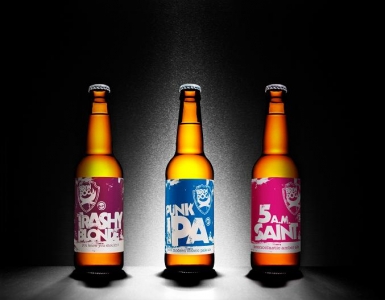
As noted on their own blog, BrewDog have now got three of their beers listed in Morrisons, who of the “big four” supermarkets arguably take the most conservative approach to their beer range. They are Punk IPA, 5am Saint and Trashy Blonde, and they are priced at a somewhat eye-watering £1.59 for a 330ml bottle. Tesco, in comparison, sell Punk IPA and 77 Lager for £1.39 a bottle. Morrisons sell a wide range of 500ml premium bottled ales for £1.69 each, or £5.50 for 4, which works out at 27.5p per 100ml. The BrewDog beers, in contrast, are 48.2p per 100ml, 75% dearer. Are they better beers than Pedigree or Abbot Ale? Very possibly. Are they that much better? The jury is still out on that one. I did pick up a bottle of 5am Saint, as I’ve never tried that particular beer, but in general I think I’ll be waiting for the offers to kick in.

Sunday, 24 October 2010

Losing your Spoons

The other day, I received an e-mail from Fleurets, the licensed trade estate agents, about the Red Lyon in Whitchurch, Shropshire, a former Wetherspoon’s pub that is now closed and up for sale. It could be yours for £300,000, freehold and contents.

I’ve recently praised Wetherspoons’ skills in site identification and property management. But it’s clear they don’t always get it right. This web page listing all of Wetherspoon’s outlets, also lists 99 former ones that have closed. In some cases, they may have moved to bigger and better premises nearby, but in others they must have misjudged the local market, as they spectacularly did with the Edwin Chadwick in Longsight, Manchester.

There are Spoons in some fairly small market towns, of similar size to Whitchurch, such as Ross-on-Wye and Haverfordwest. I don’t know the Red Lyon, so can’t really comment on why it closed, but it would be interesting to look into the reasons that lead to Spoons succeeding in some small towns, and failing in others. This news report links it to a general decline of pubs in the town. There is a Cheshire example in the Lodestar in Neston on the Wirral. Maybe a key factor is the extent to which a town is a magnet for people from the surrounding area.

Saturday, 23 October 2010

Turning a blind eye

I’ve never thought much of Robert Crampton as a newspaper columnist: he always comes across as one of those who writes whimsical, knowing drivel that doesn’t actually say very much, in other words much like every writer in the unlamented Punch magazine. Indeed, I remember a column he wrote a few years ago in which he effectively said “I don’t see the point of pubs. I once went in one and didn’t like it.”

However, he’s spot on in a recent column in the Times, which I can’t link to because it’s behind a paywall, but which has been reported in the Morning Advertiser. In this he argues that tolerating under-18s drinking in pubs is a way of socialising them and teaching them the rules of the adult world, a point that has been made before by Tim Martin of Wetherspoons, amongst others.

“Part of the tacit arrangement with the landlord was that we had to keep a low profile, behave ourselves, act in at least a civilised manner, learn the etiquette of communal socialising.

“If you got too gobby, you would be chucked out. Literally chucked out.

“Being in a pub meant that you absorbed a code of behaviour and that code did not include being an annoying little prat, or what is nowadays called antisocial behaviour.

“A pub is actually a very good place — much better than a street — for older men and women to pass on words of wisdom or warning to those who need to hear them.”
Unfortunately, the current draconian insistence on age-checking paradoxically makes the problems of underage drinking worse, not better.

What is needed is not a change in the law, but a tacit acceptance that, unless trouble is caused, a blind eye will in many circumstances be turned. If you know you are underage, you haven’t a leg to stand on if you step out of line. A similar blind eye is often turned, for example, with underage sex and many minor motoring offences, so it can’t be said that it never happens.

The deception that isn’t

Last night, the local CAMRA branch did a crawl of some of the pubs on the east side of Stockport town centre. One of the pubs visited was the Queens on Great Portwood Street. Go in, and you’re greeted by the sight of two handpumps dispensing Robinson’s Unicorn and Hatters. However, ask for either, and the barmaid will not pull the pump but flick a little switch to dispense your beer. Shock! Horror! Fake handpumps! But, in fact, the beer you get is cask-conditioned, served via electric meters, so while it may on the face of it look like a deception, it isn’t. The Unicorn was fine, and a beer I could happily have drunk all night, although those who went for the Hatters weren’t so happy. It’s a smartly-decorated, comfortable pub that, while never likely to be a CAMRA favourite, perhaps gets dismissed too easily.

I’ve expressed in the past a certain amount of nostalgia for the disappearance of metered real ale dispense. I know handpumps are an unequivocal symbol of cask beer, but in my view electric meters provide the ideal halfway house between sparklering a beer to death, and serving it flat, they remove the ability of incompetent bar staff to cock up dispensing a pint, and they give you a full measure too! Once very common in the North-West (especially in Robinson’s, Hydes and Greenalls pubs), the Queens and the Flying Dutchman on Hillgate are the only pubs I know of that still have it.

Incidentally, the best beer of the night was (handpumped) Robinson’s Battering Ram in the Tiviot – a wonderful pub that is like stepping back into the 1950s.

Thursday, 21 October 2010

Proxy parenting

A South Shields woman has been fined £80 for buying cider and sparkling wine for her 14-year-old daughter to drink. Fair enough, you may think, and the report doesn’t go into the circumstances in detail. Possibly the fact that the alcohol was being drunk by the girl’s friends as well was a significant factor in the case.

But it does raise questions as to where it is right to draw the line. The law is quite clear that if an adult buys alcohol on licensed premises on behalf of a minor, they are committing an offence. But the offence is specifically in the proxy purchasing. It is not illegal for someone between the ages of 5 and 18 to drink alcohol, and nor is it illegal for parents to give their children alcohol. If a parent gave their 14-year-old daughter a glass of wine and she took it out into the park, would that be an offence?

Although it might not be an example of first-class parenting, I do not believe I would be committing an offence if I went into Tesco Express to buy a ready-chilled four-pack of Stella, went back to my car, and gave one of the cans to my hypothetical fifteen-year-old son who was sitting in the back seat. It’s far from unknown for parents to buy alcohol for parties given by their under-18 children, or to give their children alcohol to take to such parties.

Is this a case of the authorities seeking to push the boundaries and uninformed people who feel a bit guilty about their behaviour meekly acquiescing?

Bottled beer poll

The current poll is intended to find out to what extent people are influenced by in-store offers when buying bottled or canned beer. After I’d done it, it occurred to me that there is really a fifth category – people who don’t mainly stick to familiar brands, but are always on the lookout for something new or unusual. But if you take that approach, and don’t pay much attention to the price tag, then the first answer, “I buy the brands I like regardless of price” is the best one to go for. So far, that’s well in the lead, which will no doubt disappoint Cooking Lager and his campaign for cheap lout.

Wednesday, 20 October 2010

Snippery slope

A US charity called Project Prevention is offering drug addicts £200 if they agree to have a vasectomy so they can’t pass on their degenerate lifestyles to the next generation. Apparently alcoholics (however defined) will get £100. Whether or not this will actually produce the desired results is doubtful, and you can’t help wondering where all this is going to end. What about people who weigh 20 stone? What about long-term benefit claimants? It’s not hard to find people prepared to express Sun-reader type opinions that “they shouldn’t be allowed to breed”. What about smokers? What about heavy drinkers, or indeed anyone who drinks more than the officially sanctioned annual thimbleful? Or those who don’t eat their “five a day”?

The discredited eugenics movement of the early 20th century is generally thought of now as being about racial purity, but in reality it was just as much, if not more, about improving the quality of the population by preventing the feckless underclass from breeding. The well-known novelist H. G. Wells, generally regarded as a man of the political Left, advocated ridding the world of the “unfit” through forced sterilisation, and he was far from alone. It seems that this mentality of making value judgments as to who is fit to reproduce and who isn’t, based on “lifestyle” criteria, is starting to creep back in again by the back door. It’s certainly widely spoken of already in relation to healthcare entitlement.