Tuesday, 29 January 2013

Minimum support, maximum damage

I know others have got there first, but I thought these two stories about minimum alcohol pricing that came out in the past few days were worth a mention.

First was an opinion poll conducted by YouGov on behalf of SABMiller, which found that a mere 0.36% of people said that it would lead them to drink more in the pub and less at home, while no less than 39% said it would mean they actually drank less in the pub. That completely undermines the argument advanced by some in CAMRA and industry twerps like Rooney Anand of Greene King that it would actually help pubs. In fact it would do just the opposite.

The pernicious effects of the policy are underlined by the fact that 16% of respondents said it would lead to them cutting back on other areas of spending, and 13% of those already in financial difficulties said they would cut back on food. A better way of making the poor poorer is hard to imagine.

Second, another poll conducted by ComRes on behalf of the WSTA found that fewer than one in five people support the plan. No less than 87% thought it would do nothing to reduce binge-drinking. You do have to wonder why the government are pressing on with such a blatantly unpopular and ineffective policy, although the word is that they are looking for a way to quietly shelve it before the European courts do it for them.

Yes, of course both SABMiller and the WSTA have an axe to grind, but YouGov and ComRes are reputable polling organisations and they certainly would not conduct such polls using dubious methodology.

Saturday, 26 January 2013

Take me home country roads

Councillors in County Kerry in the west of Ireland have voted in favour of asking the Irish government to introduce a relaxation of the drink-drive limit for rural areas. Ireland reduced its limit from 80mg to 50mg in 2011 and, not surprisingly, the move has led to a sharp fall in trade for rural pubs, already reeling from the impact of the smoking ban. The petition has minimal chance of success, but it underlines how cutting the limit has cast a grey blanket of Puritanism over social life outside major towns and cities, just as it would on this side of the Irish Sea. For the most part, Ireland is a far-flung, rural country, and the available trade for such rural pubs as remain must now be very thin pickings.

The cut is defended as a road safety measure, but in reality the vast majority of drink-related casualties have always been caused by people well over the previous limit, and the additional risk for drivers in the 50-80 mg band varies between zero and very little. The people who cheerfully ignored the previous law will continue to do so, while the law-abiding will sit miserably at home over a few cans of Guinness or a bottle of whiskey, missing the companionship of the pub. Many will have been happy to enjoy a couple of legal pints with their friends, but if restricted to just the one will conclude the trip is no longer worthwhile.

The proposal isn’t entirely far-fetched, as there is a precedent for having different limits in different areas within the same country – until fairly recently, this applied between different states of the USA, and of course it will be the case if and when Alex Salmond cuts the limit in Scotland.

Friday, 25 January 2013

Decline accelerates

Three months ago I wrote a post called Steady Decline Continues, saying that the most recent BBPA Beer Barometer figures weren’t actually all that bad, considering. However, following a sharp downturn in the final quarter of 2012, the latest ones, released today, are markedly worse.

On an annualised basis, the overall beer market is down by 4.7% on 2011, with the pain shared equally between on- and off-trades. The on-trade is now 25% down on five years ago, and an annual 4.7% fall will halve the total in 14 years. Indeed, the past 14 years have seen a 45% drop. It’s no longer a switch from one to the other, it’s a decline right across the board, so the argument that “supermarkets are killing pubs” looks very threadbare.

The beer duty escalator must bear a substantial share of the blame for this. I certainly get the impression there has been a significant fattening of margins on undiscounted products in the off-trade, with a humble four-pack of Carling now often costing well north of £4, and the £3+ pint of cooking bitter has become commonplace in pubs. On the other hand, the anti-drink lobby will look at the figures and say “good result – keep with it”.

Sunday, 20 January 2013

Bière ordinaire

Robinson’s Unicorn (formerly Best Bitter), the best-selling cask ale in and around Stockport, is brewed to a relatively generous 4.2% ABV. It’s fairly rare for a beer of that strength to be sold as the staple bitter in pubs, and I’ve heard people complaining that “it gives them a bad head”, probably because it’s that little bit stronger than most of its competitors.

It’s sometimes claimed by anti-drink campaigners that drinkers will simply “go for strength”, but in fact that is very wide of the mark. Beer has a much wider range of strengths than wines or spirits, but in reality beers of a particular type tend to cluster within a fairly narrow strength range, and people rarely choose one over another just because it is that bit stronger.

“Ordinary bitter” took over from mild as the best-selling beer in Britain in the early 60s and, although it has now relinquished that position to cooking lager, it remains by far the best-selling type of ale. Despite the rise of golden ales and premium beers, I would guess it still accounts for well over half of all real ale sold, and a much higher proportion of keg beers.

Typically it falls in a strength range between 3.4% and 4.0%, and within that I don’t really think drinkers are too concerned about the actual strength. Indeed, one of the best-regarded examples, Brakspear Bitter, is down at 3.4%. Intoxication is not the main object of drinking ordinary bitter. It’s a beer suited to long evening sessions in the pub, where the effect builds up gradually and it acts as a social lubricant. It doesn’t instantly render you incapable; a couple at lunchtime won’t stop you working in the afternoon, or cause you to fall foul of the breathalyser. It’s a subtle, social kind of beer. Up to a point, as with the example of Unicorn, moderation in strength is even seen as a virtue. Arguably, it is the quintessential English beer.

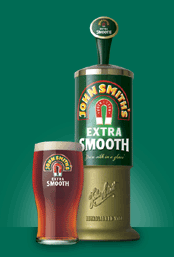
This helps explain why the reduction in strength of John Smith’s Extra Smooth won’t be met with outrage and boycotts, just as the reduction of Stella wasn’t. As long as a beer continues to fit within its category, drinkers, especially pub drinkers, won’t be too bothered.

Out of interest, here are the strengths of the some of the popular ordinary bitters in the North-West, compared with their original gravities from the 1977 Good Beer Guide:

  • Holt’s Bitter: 4.0% (1038.5)

  • Hyde’s Bitter 3.8% (1036)

  • Lees Bitter: 4.0% (1038)

  • Robinson’s Unicorn/Best Bitter: 4.2% (1042)

  • Sam Smith’s Old Brewery Bitter: 4.0% (1039.9)

  • Tetley Cask Bitter: 3.7% (1035.5)

  • Thwaites Bitter: 3.6% (1036)
So we weren’t drinking particularly strong beers back in 1977 either, and nobody would have been outraged at being offered a 3.6% bitter.

Boddingtons Bitter – now no longer available in cask – was declared at 1035 in 1977. The brand owners made a big mistake when they increased its strength to 4.1% a few years before its demise – indeed Brunning & Price replaced it with Thwaites because their regular customers (no doubt including many drivers) felt it had become too strong.

Wednesday, 16 January 2013

Water, water everywhere

The latest round in the inexorable process of watering the workers’ beer came with the announcement from Heineken that the strength of John Smith’s Extra Smooth was to be cut from 3.8% to 3.6% ABV. This was greeted with hoots of derision from many quarters, but it should be remembered that this beer, however little you may think of it, is the best-selling draught ale in the UK. To be honest, I can’t recall ever having drunk it, although I have had Tetley’s Smooth a few times.

Heineken have managed to save themselves £6.6 million a year in beer duty while at the same time gaining brownie points by going with the flow of the government-approved programme of taking alcohol units out of the market. It still isn’t out of line with its competitors – Greene King IPA is 3.6%, and I believe smoothflow Boddingtons is only 3.5% – but this is a clear indication of the overall direction of travel. And don’t forget that some popular Scottish smooth beers such as Belhaven Best and Caledonia Best are a mere 3.2%, so there may well be further to go. In the long term, beer strength reductions are an inevitable result of the duty escalator.

Cask John Smith’s Bitter will remain at 3.8%, so there may be a temptation to say “I’m all right Jack.” However, we have already seen strength reductions for many popular cask brands such as Bombardier and Old Speckled Hen and, while there remains a wide mix of strengths in the market, I certainly get the impression that the average strength of guest beers offered in pubs has significantly fallen in recent years. And it’s not inconceivable that, for example, Robinson’s might decide that they gain no benefit from brewing Unicorn at 4.2%, which is a couple of points stronger than any of its direct competitors.

Of course, given that in some quarters it is portrayed as a virtue that beer is a “low-strength drink”, this could be regarded as good news in advancing the responsible drinking agenda.

Saturday, 12 January 2013

Obscure beer syndrome

Something I’ve noticed a few times recently is pubs aiming to establish their credentials for selling and promoting real ale trying a bit too hard by offering an ever-changing roster of often distinctly obscure and seasonal guest beers. These are not the specialist multi-beer alehouses, but pubs of a more general appeal, with food trade and footy-watching regulars, that want to make a mark for themselves.

There’s nothing wrong with rotating guest beers, but you can have too much of a good thing. In the widely-mentioned Peter Jackson article about CAMRA’s image with the young, he says that the reported factors putting people off drinking it include “too much variety” and “confronted with unfamiliar brands, which makes the decision difficult”.

I’m probably vastly more knowledgeable about the beer market than most punters, but even so I recently went in a pub where I was confronted with four totally unfamiliar beers and struggled to establish which I’d actually want to drink. I’m not suggesting an unremitting diet of familiar brands, but surely it would make sense, especially in a pub with a lot of casual customers, to have at least one beer on the bar such as, say, Brains SA, Black Sheep Bitter or Draught Bass that they might at least recognise. In a pub with a stronger regular trade, perhaps you should have one or two regular beers from a well-respected local micro on the bar alongside the more unusual brews. A well-chosen permanent beer can be a pivot around which the guest beers revolve.

It shouldn’t be forgotten that, even now, most real ale is probably consumed by drinkers as their “regular brew” in just the same way as Carling, Guinness and Strongbow. It certainly is round here in the average Robinson’s, Holts and Sam Smith’s pub.

Another problem is that this approach can easily lead to a lack of balance in their beer range, and four rather samey beers occupying the pumps. Ideally, if you have four pumps, it would make sense to offer a choice of a dark mild or stout, an ordinary bitter, a stronger special bitter and a golden ale. Christmas brings a slew of seasonal specials which are typically not too dark, not too strong and not too hoppy, and four of those can be distinctly underwhelming.

Down in the trenches

Some telling words here from William Lees-Jones of Middleton family brewer J W Lees:

Lees-Jones said that the company had been “in the trenches” since the smoking ban. He said the firm had initially adopted a “very defensive” approach, protecting its core wet-led trade by building smoking shelters.

“It has been a waste of time, if I’m honest. That part of our trade changed forever.”

“Where we have seen success, it has been with food and families”.

Food sales throughout its 30-strong managed-pub estate have increased from about 15% to 43% since the smoking ban was brought in”.

Surely, looking at it the other way, that means wet sales have declined from 85% to 57%, not good news if you run a brewery. This is yet more evidence of how the smoking ban has killed the traditional drink and chat community pub.

Lees may succeed in opening a few trendy café-bars, but how does a café-bar benefit from being owned by a family brewer dating back 185 years? As I reported here, the future of the pub is seen as “food, families, females and fortysomethings”. No fags, though, at least those sold in packs of twenty. Which, for all too many long-standing pub customers, spells “f-off home”.

And a smoking shelter, however commodious and well-intentioned, can never be more than a grudging, third-rate substitute for actually allowing the smokers inside the pub itself.

Saturday, 5 January 2013

Out of their boxes

Tom Paine recently made a blogpost in which he suggested that resistance to State nannying is only likely to become serious once the pleasures of the working class are directly targeted:

The state can beat up as many anti-statist intellectuals as it likes and no-one will protest. Let it beat up the smokers, drinkers and pie-fans however and popular resistance can be expected - even from those usually too idle to move further than to the nearest Greggs. Doctors with God complexes may therefore be our best hope. Perhaps as we enter the final phase of end-of-year excess, we should be campaigning for votes to be proportionate to BMI, units of alcohol per week or fags per day?
I’m not too sure about that, as we seem to have meekly accepted all kinds of intrusion into private behaviour in recent years. But the BMA seem determined to prove him right, with their latest call for official government alcohol guidelines to be revised downwards. Apparently we should cut our consumption to no more than a quarter of a pint of beer a day. That’s really going to keep loads of pubs in business.

Mind you, if this becomes official, the convenient figleaf used by CAMRA and others that “moderate drinking is compatible with a healthy lifestyle” will be torn away. If you accept the BMA’s definition of a healthy lifestyle, it won’t be. To my mind, the day CAMRA abandon any pretence of standing up for “responsible drinking”, as officially defined, will be the day they are set free.

Of course, all this stems from a ludicrous misinterpretation of the concept of risk. Pretty much everything you do involves some risk, and drinking a bit more (or even quite a lot more) than some made-up official “guidelines” actually doesn’t involve significantly more risk. And it’s funny how they keep quiet about participation in sports and promiscuous sex.

Saturday, 29 December 2012

Halcyon days in Poynton?

I wrote here about how Wetherspoon’s had bought the former Kings Bar and Lounge in Poynton and were busy working on it with a view to opening on Tuesday 18 December, reverting to the pub’s original name of the Kingfisher. Well, that deadline was achieved, so I popped in to have a look.

It originally opened as a Greenall’s pub in 1959, and has the typical sprawling, low-built style of estate pubs of that era. There’s a plaque inside the door with some information about the pub’s history. Untypically for the Wetherspoon’s estate, it has a small car park, maybe with about 20 spaces, which was completely full shortly after noon.

I never visited it in its previous incarnation, so I don’t know if the layout has changed at all, but it’s largely open-plan, with a long bar counter down the right-hand side, a raised seating area to the left, and an odd windowless area with a skylight full of chairs and tables right in the middle. The toilets, in typical Wetherspoon fashion, are upstairs, which I doubt was an original feature.

The food and drink are the standard Wetherspoon offer, with ten handpumps on the bar and guest beers of up to 6.0% priced at £2.09. Interestingly, in view of my previous posting, amongst the beers on the bar was Harviestoun Schiehallion craft lager on keg. Some, but not all, of the food prices were a little higher than Stockport and Didsbury.

The interior design is unashamedly modernistic, and to my eye more resembles a modern upmarket McDonalds than a traditional pub. The colour scheme is predominantly pastel, the floors are bare wood or lino with geometric patterns, and many of the chairs are tubular steel rather than wood. The only bench seating is one stretch right at the far end, and there’s no shortage of high-level posing tables. It was also, on this particular visit, heated to an uncomfortable level, with a fierce downdraught of hot air right in front of the bar counter.

There’s an extensive discussion on the Poynton web forum here, and some photos here which give a reasonable impression of the interior. Like all Spoons, it does what it says on the can, and no doubt they have researched the potential marketplace thoroughly and it will prove a success. However, as a place to have a drink or a meal, I didn’t personally find it remotely congenial. Other Spoons, such as the Gateway, have a much more “pubby” feel to them.

Friday, 28 December 2012

Complements of the season

Over the years I have been consistently critical of the dogmatic “real ale good, keg beer bad” attitude but, on the other hand, I have seen precious little evidence of “craft keg” breaking out of the beer bubble and getting into mainstream outlets.

The dinosaur view that nothing that isn’t real ale is worth drinking remains surprisingly common even now. You can see it, for example, in the postings of Richard “chemical fizz” English on the CAMRA forum, and only this month there was a letter in our local CAMRA magazine Opening Times from a prominent local member saying “I would hope that Opening Times will in future drop the ‘craft keg’ and call keg beer ‘keg’ in whatever form it is marketed (treating it with disapproval rather than tacit acquiescence)”.

In contrast, many of the proponents of craft keg, most notably BrewDog, seem to see it as a stick to beat CAMRA with for being fuddy-duddy and out-of-touch. There’s a blogpost here from Hardknott Dave in which he – I think deliberately provocatively – portrays keg as the dispense method of the future for craft beers.

There’s an interesting article by Peter Jackson in the January issue of the CAMRA newspaper What’s Brewing discussing ways of attracting younger drinkers, in which he points out the negative stereotype of real ale as a drink for middle-aged men with beards, and concludes:

CAMRA should take new craft keg on board and regard it as a friend rather than the spawn of Satan: it’s often innovative, good stuff with its heart in the right place; we drink it in Belgium, Bavaria and Prague and think it can be great. So why not embrace it here, see it for what it is, a bridge to the real thing?
There are various reasons why pubs and bars might want to stock craft keg beers
  • They are venues such as small hotels, social clubs and music venues where turnover is low and/or erratic
  • They want to offer a wider choice of unusual beers which may not sell in the volumes necessary for cask
  • They want to cater for drinkers who want a beer served colder than is traditional for cask
  • They want to put a toe in the water of offering a more “interesting” beer without committing themselves to selling twenty or more pints a day of it
But, on the other hand, thirty or forty years ago, the discerning beer drinkers of Britain decisively plumped for cask over keg ale on the grounds that, when properly looked after, it was quite simply better. They wouldn’t have continued buying real ale if it actually had been warm vinegary muck. The argument that now, across the board, keg is “better” doesn’t really wash.

All of this suggests that craft keg is something that, in the overall marketplace, should complement cask beer rather than being its direct rival. It can bring good beer to places where cask cannot reach. To my mind, it will always remain a niche product, and the large majority of decent ale served on draught in British pubs will continue to be cask. And, as I’ve said before, the big opportunity for British micros to expand keg sales may well lie in lager rather than in ale.

Thursday, 27 December 2012

A cheesy gift

As someone known to have an interest in beer, over the years I’ve received my fair share of rather naff beer-related Christmas gifts. Possibly the worst was a set of four “Great British Ales”, in 275 ml bottles, three brewed by Ridgeway Brewery, the other being Elgood’s Black Dog, with strengths of 3.0%, 3.2%, 3.6% and 4.0%. Whoever got away with charging a fiver for that made a mint. And, while I’ve never received one myself, I’m sure in the past I’ve seen one of “Lagers of the World” including both Fosters and Stella. This isn’t much better – and I think all four are British-brewed.

However, I thought this gift pack of Lancashire cheese and ale which I received this year was actually very decent. Traditional farmhouse Lancashire cheese together with a couple of decent beers from a Lancashire family brewery, and oatcakes and chutney, is a good combination. In many ways the ideal gift is something that will be appreciated by the recipient, but which they wouldn’t have bought themselves, and this fitted the bill perfectly.

Gill Hall, third generation cheese maker at Butlers said of the new product, “Lancashire has a rich foodie heritage and we wanted to create a gift that showcased this. All our cheeses are made from milk from local farms so we chose to match it with two local ales that complement the soft, open texture of our traditional creamy Lancashire with their complex flavours. Cheese and beer make an excellent pairing so we hope people will enjoy this special Christmas gift!”

Sunday, 23 December 2012

Enemy within the gates

A comment by Phil alerted me to the dubious delights of CAMRA’s Nottingham Drinker magazine:

I've just got back from Nottingham, where I had a pretty foul pint of flabby, metallic-tasting beer while reading the local CAMRA magazine - which featured a column applauding the decision to bar a local offie from selling anything over 6.5%. The enemy is already within the gates, I fear. (Other odd features of the mag included what appeared to be a regular column contributed by the local police. I was glad to get back to Opening Times-land.).
Further investigation reveals that, not only does the magazine include a column from the police, it also includes one from an anti-drink pressure group. See here to download the latest issue.
News from Suffolk: The local Police, fed up with ‘offies’ selling super-strength cider and lager to known nuisance characters, are encouraging the offies to stock nothing above 6.5% ABV. It is a voluntary scheme, with a slow take up, but it is a positive step towards dealing with the products that are associated with most of the problems. Responsible drinkers will be heartened by this news and we look forward to seeing the scheme adopted locally.
Oh, sorry, I had a bottle of Duvel (8.5% ABV) the other day which I bought from Tesco on a 3 for 2 offer. Apparently I am not a responsible drinker and don’t feel in the slightest degree “heartened”.

In what weird and perverted world do those who claim to stand up for pubs, beer drinkers and breweries see it as in any way sensible to give a mouthpiece to those who abhor all those things? Has Nottingham CAMRA somehow been infiltrated and taken over by the anti-drink lobby?

And, of course, the police are no friends of pubs either.

To his credit, the editor of our local CAMRA magazine Opening Times will have no truck with such appeasing nonsense.

Saturday, 22 December 2012

Smoked out

In the days of the old licensing laws, the “lock-in” where a pub continued serving after hours to a group of favoured customers was commonplace, and was often carried out with the full knowledge of the local police, if they were confident no trouble would result.

With the liberalisation of licensing hours, that probably happens much less often now but, following the 2007 smoking ban, it has been replaced by the “smoke-in”, where the doors are shut and the ashtrays come out. Various comments over the past five years have suggested this is very widespread.

But, apparently, Bolton Council see it as a priority to clamp down on such outrages.

Lesley O’Reilly, who is landlady of the Gilnow Arms in Deane, has been fined £500 and ordered to pay a further £510 in costs and surcharge after pleading guilty to failing to prevent smoking inside the pub.

Speaking after she was sentenced at Bolton Magistrates’ Court yesterday, Ms Reilly said: “I really think they have killed the trade with this law.

“Why can’t we give smokers a room inside where they can go instead of them having to stand outside.” The court was told the pub was visited at 1.25am on May 13 by council enforcement officers and police as part of a routine inspection.

The front door was closed and curtains shut, but the officers were allowed inside after knocking on the door and they smelled smoke.

Rebecca Kirk, prosecuting on behalf of Bolton Council, said one man was stood at the bar smoking a cigarette with an ashtray at his side and Ms O’Reilly was sitting with a woman who was smoking a hand -rolled cigarette.

Altogether there were four ashtrays out in the pub, containing a total of 18 cigarette butts.

Whatever happened to the old policy of turning a blind eye? £27.78 per butt – that is beyond harsh.

One of the comments on the article is very telling:

The smoking ban HAS killed the pub trade..fact! All the people who said they hated smoke filled pubs never went in in the first place, and they certainly don't go in now.

And what are the council doing organising a posse of officers and police at that time in the morning just to find 18 cigarette stubs and somebody smoking a cig and somebody smoking a roll up. Pathetic!

There are far worse things going on in 'the suburbs' going on...ah but council officers won't go there.

In an era of cutbacks and austerity, it is beyond belief that Bolton Council thought it worthwhile to spend council tax payers’ money on such a vindictive crusade. And I hope the scumbag who grassed the pub up feels thoroughly pleased with his efforts.

Not so black Friday

Yesterday was widely described as “black Friday” – the day of the year on which most pressure is placed on emergency services from drunken revelry. Fortunately none of this resulted from the latest occurrence of Stockport & South Manchester CAMRA’s annual Hillgate Stagger. Sadly, the number of pubs serving cask beer is now depleted to eight, but on the other hand this gives more chance to linger in each one.

There was a good turnout, all the pubs (apart, perhaps, from the Sun & Castle) seemed to be doing a healthy trade and there wasn’t a bad pint to be had. The Fairway, reborn from Robinson’s closed Flying Dutchman, seemed to be doing very well. There were some heroic drunks to be seen, especially in the first couple of pubs where presumably they had been at it all day. We were even favoured with an appearance by @CarpeZytha. And the world was duly set to rights over some stunning Old Tom in the final pub, the Blossoms.

This pub crawl may not offer the world’s widest or most exotic choice of beers, but as a way of experiencing authentic English pub life it is hard to beat. And nobody suggested that I looked like Ronnie Barker! For me, almost certainly the best pub night of a generally crappy year.

Wednesday, 19 December 2012

Then they came for the pub drinkers

It often seems to be assumed by people involved in the pub trade that either alcohol minimum pricing won’t affect them at all, or it may even help them by making cheap off-trade drinks less attractive.

However, it should be remembered that the University of Sheffield study which has been used as justification for the proposals actually said that the most beneficial results would come from setting differential minimum prices for the on- and off-trades, with the former more than twice as high.

And now it seems that Newcastle City Council are taking them at their word by imposing a minimum price of no less than 125p/unit as a licensing condition for two city-centre bars.

Decantus (30-32 Grey St) and the Grey St Café Bar and Grill (77 Grey St/21-27 Market St) have been awarded a premises licence subject to a condition that alcohol is sold at set prices which equate to minimum price of £1.25 per unit of alcohol.

This is nearly three times the 45p per unit price currently subject to government consultation.

These prices have been agreed as a condition in order to maintain standards and to keep the street as the city’s premier street.

The minimum prices will apply at all times during which alcohol may be supplied under the premises license and there will be no specific trading hours/evenings when alcohol is discounted below the minimum agreed price and used as a vehicle to attract customers.

This initiative by the city council, with the full cooperation of the applicants, is designed to maintain the quality of the city centre, control crime and disorder and improve health. It also seeks to end the availability of the most irresponsibly priced alcohol by controlling multi-buy promotions which lead to irresponsible drinking.

Bear in mind that this is well above the price of most draught beer sold in the North-West. It would make a pint of Robinson’s Unicorn three quid, and it’s over twice the unit price of some of the stronger guest ales sold in Spoons. It’s a fat lot of good campaigning for an end to the duty escalator if pubs are prevented from taking advantage of it anyway.

No doubt some will say that it’s only a couple of posers’ bars in the centre of Newcastle which is notorious for alcohol-fuelled disorder. But I’d like to bet there’s a Spoons within a few hundred yards that is now anxiously looking over its shoulder. And how many times have we been told that some principle will never be extended only to find ourselves rapidly sliding down a slippery slope?

This seems to be an example of a growing trend for councils to make up the law as they go along by imposing licensing conditions that go well beyond legal requirements. For example, we have just seen Perth and Kinross council prevent a new Sainsbury’s supermarket selling any beers or ciders above 5.5%, which excludes many craft favourites such as Duvel, Old Tom and even Punk IPA. Let us hope that in future the likes of Wetherspoon’s and Tesco manage to mount a robust legal challenge and leave the councils with egg on their faces.

Edit: and it seems as though the Newcastle plan may well be legally questionable.