Saturday, 8 February 2014

Driving blind

In the February issue of the CAMRA newspaper What’s Brewing, there’s a very interesting letter from Tim Webb that will certainly put the cat amongst the pigeons. I won’t repeat the whole thing, but he concludes:

Uniquely among beer consumer groups, CAMRA has championed a bureaucratic device to inform its members what sort of beer is good – as in the term Good Beer Guide. Thirty years ago this mattered little, as decent beer and cask ale, in Britain at least, were synonymous. But then things changed and will not return to where they once were.

The challenge for the Campaign is how to adapt to the much-improved world of beer it helped create. Luke warm acceptance of, or being not against the greatest improvements to beer tastes in a century, is not a good enough stance. To younger eyes it makes CAMRA look like a much-loved grandparent who wants to keep driving even though they can’t make out the road ahead.

Friday, 7 February 2014

Another country

The Daily Mash may have made a joke of it, but the view is often heard that London is becoming increasingly detached in economic and social terms from the rest of the UK. Its economy seems to be more a part of an international world of finance than the realities of workaday provincial life, it experiences a house price boom while the rest of the country is stagnant, and its sheer size and density make its transport problems and solutions unique in Britain. Also, unlike pretty much any other major city apart perhaps from Edinburgh, it has a large population of prosperous middle-class people living in inner-urban areas which gives them a distinctly different feel. A significant issue resulting from this is that, since so many politicians and journalists are based in London, it is all too easy to form the opinion that the capital is typical of the rest of the country and what works there is likely to work anywhere else.

It’s also home to the social phenomenon of the hipster which only appears to have spread outwards in a rather half-hearted fashion. This seems to be bound up with the direction that the London beer scene has taken. I get the impression that craft keg ales and lagers have become much more widely available there than anywhere else. The craft beer bar, or the minimalist makeover of an old pub, has become an essential centrepiece for the up-and-coming trendy neighbourhood. Many of the London microbreweries seem to intent on developing a cutting-edge image rather than brewing a a range of conventional, accessible beers. This has given rise to the phenomenon of “London murky” which really is very specific to the capital. And the sky-high property prices make it attractive to convert even thriving pubs for residential use, which is something you just don’t see here. All the pubs local to me that have been turned into something else have either been obviously struggling or already closed.

It’s sometimes said that, where London leads, the rest of the country eventually follows but, in wider terms spreading well beyond the world of beer, I get the feeling that the two are increasingly heading in different directions.

Wednesday, 5 February 2014

Do the hokey-cokey

It wasn’t exactly a good advertisement for joined-up government when the Home Office announced that they wouldn’t be giving pubs a blanket extension for England’s late-night opening World Cup match, only to be in effect overruled by the Prime Minister the following day.

The argument that it wasn’t an event of national significance was ridiculous given how many pubs were likely to be interested in it, and was yet more evidence of how out-of-touch Civil Service mandarins are with ordinary people. And the alternative wasn’t pubs not opening, but having to apply for Temporary Event Notices on an individual basis, which would have cost each pub £21 and also resulted in a burden on councils who are always moaning about the cost of licensing administration.

So, a victory for common sense, but you have to wonder at the thought process that led the Home Office to make such a joyless “computer says no” announcement in the first place. Having said that, given that the matches will be on free-to-air TV, they may not be quite the moneyspinner that some licensees imagine. I can see many people preferring to opt for a few pints in the pub and then returning to watch it in the comfort of their own home.

Me? I’ll probably be tucked up safely in bed by then.

Sunday, 2 February 2014

Beer, wine and cheese party

The most recent poll was inspired by Boak and Bailey’s blogpost about the uncertainty over whether Camden Hells was brewed in London or in Germany. I widened the issue to look at how important knowing the country of origin was for beer in comparison with other consumer products. The results show that this is much more important for beer, wine and cheese than anything else, with frozen meals (maybe surprising in the wake of the horsemeat scandal) and clothing bringing up the rear.

I suspect in a poll directed at a general rather than a beery audience wine would have topped the poll, as in the vast majority of cases the country of origin is a key part of its identity. On the other hand, a substantial proportion of the beer sold in the UK is actually foreign brands brewed here under licence and, as I reported here, the average drinker of Carlsberg, Stella or San Miguel is well aware that his beer isn’t actually brewed in the country associated with the name, and isn’t really that bothered. The higher you go up the premium scale, though, the more consumers would be unhappy that an ostensibly Belgian or US brand wasn’t actually produced in that country.

This works on several different levels, for example

  • Expecting a basic standard of honesty about where products come from so consumers are not being deliberately misled
  • A badge of authenticity and integrity in the supply chain
  • Choosing products from a particular country because of specific national characteristics
  • Wanting to favour particular countries and avoid the produce of others for “political” reasons, whether preferring goods from your own country or boycotting those from countries that for whatever reason you don’t like
In the field of beer, while knowing the country of origin is clearly very important for enthusiasts, as I mentioned above the average consumer isn’t really too concerned. Many popular beers simply say “brewed in the EU” on the bottle or can. However, even this audience is much more relaxed about other products. In the wake of the “Peckham Spring” controversy, the low figure for bottled water is perhaps surprising. And how many people actually check the country of origin on clothing labels before making a purchase? It has also been said that, of major car-producing nations, Britain actually has the first genuinely post-nationalistic car market.

The regulations covering food labelling are extremely complex and, looking through my cupboards, while most packaged foodstuffs do seem to show the country of origin, some, such as chocolate bars and a jar of pickle, don’t. That a company has a UK address does not guarantee UK production. The bottle of HP sauce admits to being “made in the Netherlands”, but has that damaged sales? In fact, supermarket own brands seem to do better on this front than branded goods. While I’m not a regular buyer, I recall that supermarket own-brand beers, even bog-standard Tesco Lager, state in which country they are brewed.

Friday, 31 January 2014

Losing the last of England

Here’s another trenchant article by David Atherton about the decline of the pub, and its causes: Pub closures mean we’re losing the last of England. This comment is especially telling:
But the smoking ban was Labour’s idea, and they prosecuted it with a vigour that would make a Mormon knocking at your door asking about Jesus look apathetic. It was quite clear that the average Fabian, middle class Labour apparatchik never goes to the pub, or has the slightest level of empathy for working class people whose pleasure they killed. The contempt for their core vote is limitless.
It will be interesting to see whether that contempt is thrown back in their faces at the forthcoming Wythenshawe by-election.

Wednesday, 29 January 2014

Barfly or corner bug?

Rather gratifying results from this poll following on from my post here. 90% of respondents don’t see sitting or standing at the bar as their favoured position in a pub, and 65% either never see it as their preferred option, or will only occasionally do so.

For me, the ideal location is sitting down on a bench seat with a window behind me and with a clear view of both the door and the bar counter so I can see what’s happening. The only times I’ve stood or sat at the bar are when there’s either been no alternative or when I’ve been buttonholed by someone who was already there.

Never enough

Martyn Cornell has done an excellent blogpost entitled Moral panics, Tim Martin and motorways about the hysterical overreaction to the news that Wetherspoon’s had opened a pub that was actually quite near a motorway. He also makes a wider point about whether the drinks industry should be so willing to pander to the agenda of the anti-drink lobby.

What is even more frustrating than the illogicality of these arguments, and the willingness of newspapers, TV and radio programmes to give people space to promote these ridiculous claims, instead of slapping them about the head and telling them not to react as if drivers are like toddlers at a supermarket check-out, who can’t resist grabbing for the bad-for-you goods on display, is the framing of the debate about the availability of drink once again as an argument solely about intoxication and its evils. It’s something the whole drinks industry, from producers to retailers, colludes in, and it’s why personally I believe setting up the Portman Group was an extremely bad idea, because its existence plays to the anti-alcohol lobby’s agenda-setting. By banging on about “responsible” drinking, the drinks industry’s own warrior in the “alcohol awareness” wars destroys the main argument for drinking: that it’s fun. No one is ever allowed to say that drinking is fun, because fun and responsibility don’t mix.
It has to be said that the very term “responsible drinking” conjures up a joyless vision of sipping carefully at a half-pint of 2.8% pisswater while nibbling at an organic tofu salad. As he says, drinking should be about enjoying yourself, and there’s precious little enjoyment if you’re too responsible about it. This is also a case where the industry seems happy to go along with the definition put forward by the anti-drink lobby which basically means losing the argument before you’ve even started.

Basically, the drinks industry can never win, because however much ground they concede, the anti-drink lobby will always demand more. There is no defined end-point – it’s all about “direction of travel”. It sometimes seems disappointing that they are so reluctant to speak out in their own defence, but it has to be recognised that business is about making a profit, not conducting a moral crusade, and it may make sense to keep your head down, playing along with the official agenda while dragging your feet a bit, and hoping that in time the storm will pass.

Indeed, there is a good historical precedent for this, as the Temperance campaigns of the late Victorian and Edwardian period had largely blown themselves out by about 1930, and from 1960 to about 1995 the drinks industry enjoyed a remarkable period of steady growth with little public censure. Meanwhile, of course, the task of defending them is left to private individuals such as myself who then get unjustly accused of being paid industry shills. I did once get given some free beer by Wells & Youngs – does that count?

It is depressing, though, how willing the industry seems to be to allow itself to have its arm twisted by the government to in effect emasculate itself. It has signed up to the “Responsibility Deal” which has led to many of the best-selling beers and ciders having their strength reduced, with yet more certain to come. And recently the Drinkaware charity, which is funded by the drinks industry, was criticised for being too closely linked with them and not putting across a sufficiently independent anti-drink message.

It is impossible to engage in any kind of constructive dialogue when your opponents, at heart, believe that you represent an illegitimate and toxic trade. So maybe it would make sense for the industry to adopt a more robust line and take the stance that, while they will obviously comply with all legal requirements, they do not believe they have anything to be ashamed of and will not have a hand in undermining their own business. Tim Martin of Wetherspoon’s, while he certainly isn’t right about everything, deserves much credit for being one of the few industry leaders actually prepared to speak out directly against the wave of miserablist anti-alcohol sentiment and to promote the positive benefits of pubs and drinking.

Monday, 27 January 2014

Turn of the tide?

Some surprisingly positive figures from the latest BBPA Quarterly Beer Barometer, which shows a growth in overall beer sales for two consecutive quarters, the first time this has happened since 2004. However, within these figures there is strong growth for the off-trade set against a continued, albeit slower, decline for the on-trade. The off-trade has historically been more price-sensitive and more susceptible to changes in general economic sentiment, and it would seem that it has reaped most of the benefits of the cut in beer duty, combined with a rise in consumer confidence. While the price of beer has not in general fallen, a whole swathe of price increases has been skipped, which would probably have increased the price of a single PBA by 10p and a four-pack of Stella by 30p.

Looking at the figures on an annual basis, the total beer market is down by only 0.4%, the best figure since 2006, with the off-trade up by 3.2% and the on-trade down by 3.6%. For the past two quarters, off-trade sales have exceeded the on-trade, so it looks as though the tipping point when the balance of the market decisively swings is nearly upon us, after a period of a few years when the momentum had almost ground to a halt. In 1998, the off-trade accounted for 71% of the total market, compared with 51% over the whole of 2013 and 49% in the second half of the year.

Sunday, 26 January 2014

Oak to be felled?

Rather depressing, but not entirely surprising, news that Holt’s brewery have put the Royal Oak in Eccles up for sale at a mere £170,000. It’s an impressive Grade II listed Edwardian pub that features on CAMRA’s National Inventory of Historic Pub Interiors. The webpage gives a good impression of its magnificent, unspoilt interior.

However, the comment that it “may close early if no customers” tells its own story. It has been left high and dry by the dramatic shifts and contraction in the pub market in recent years. It has always been somewhat overshadowed by Holt’s two other impressive Edwardian pubs in Eccles – the Grapes and the Lamb.

If you listen to some people, the pubcos are constantly closing thriving pubs down to redevelop them as flats or convenience stores. But somehow I doubt whether potential free-trade buyers will be queueing up for this one, as they weren’t for this Cheshire pub I highlighted a while back.

Another chapter in the long, slow, sad decline of the British pub. If someone buys it and makes a go of it I’ll be gobsmacked. I don’t really expect Holt’s to apply a restrictive covenant.

Obscured by clouds

The increased promotion of intentionally cloudy/hazy* beer (*from here on I use the term “cloudy”) in the craft ale sector has been much discussed recently and has been the subject of blogposts by Tandleman, Paul Bailey and Phil on Oh Good Ale. There are various issues involved here, but I thought I would create a poll on one specific point. The results are shown on the right. While this is a clear vote in favour of declaring intentional cloudiness at the point of sale, it isn’t by any means an overwhelming one. The poll results and associated comments are here.

Let me make it quite clear that I don’t believe that cloudy beer is intrinsically bad. There are various styles of beer around the world such as Belgian Witbier and Bavarian Hefeweizen that are cloudy by definition, and if British or American brewers want to try to develop new beers in these styles, or to produce brand-new cloudy beers, then good luck to them.

However, it has to be recognised that, for several generations, it has been taken as given that British draught beer, whether cask or keg, should be crystal clear. Any deviation from that, except in extremely rare and unlikely circumstances, indicates a fault either in brewing or cellaring. It means that nasty stuff you don’t want to drink is suspended in the beer. The guff you occasionally hear about “layering” and thunderstorms turning casks cloudy is, in the vast majority of situations, complete bullshit.

It seems that some brewers now want to tear up this received wisdom and brew beers in the British style that they expect to be cloudy. Fair enough, but the customer has a right to be informed what he or she is getting. Let us say we follow the views of those who say “it’s not a concern to me”. I go into a pub and order a beer that I’ve never heard of before. It comes out looking like a pint of soup. I take it back to the bar and complain, but am told “oh, it’s meant to look like that”. So I respond “why didn’t you tell me before I ordered it, then?” If they won’t change it for a clear one, then I’ll think twice about going back to that pub again and warn others against it.

In the bad old days I have taken several pints back to the bar only to be told “it’s real ale, it’s meant to look like that.” It wasn’t then, and neither is it now. In general I stood my ground and got an exchange or a refund. I thought those days were behind us, but some people seem to want to bring them back. And how am I to know it’s an intentionally cloudy beer, or one that is supposed to be clear but just happens to have turned out looking like Amazon river water?

If you serve up cloudy beer to your customers without telling them, you are harming the reputation both of your particular venue and of cask beer in general. If brewers want to promote the idea that British-style beers can be produced in an unfined form and be cloudy at the point of sale, then surely it is in their interest to make it clear to customers that is what they’re going to get. Some will try it, some might even like it, others will choose to avoid it. Maybe specialist alehouses need to start showing on their blackboards, as well as the % ABV and the colour, whether a beer is cloudy or crystal.

As Cooking Lager says here, it is all too easy for a defect to masquerade as a feature. And it’s hard to avoid the thought that promoting the virtues of cloudy beer is another way to create a divide between the crafterati and the general public. It’s said that Picasso mastered the art of producing conventional paintings before venturing on to distorted avant-garde ones. Perhaps that is a lesson that needs to be learned by the modern crop of railway arch brewers. Brew a classic clear amber bitter first, and then go on to the weird stuff.

Friday, 24 January 2014

Geezers at the bar

On Oh Good Ale, Phil wrote of his experience in calling in to the Cocked Hat (ex Pack Horse) on Stockport Market Place:
It struck me as one of those pubs which would be written up as warm, friendly and welcoming, but only by its regulars. Put it this way, there were five or six punters stood in front of the bar, and every one of them looked round as I came in. The last time that happened to me the punters were speaking Welsh. As for the beer, there were five or six hand pumps, but it was actually quite hard to see all the pump clips, what with the discussion group parked in front of the bar...
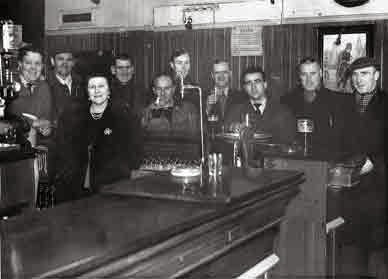
This prompted me to do a blogpost on a subject I had been mulling over for a while. Very often a group of geezers chatting at the bar is a positive sign that you’ve walked in to somewhere that still functions as a pub as opposed to a dining venue. But, on the other hand, if they are the only customers, it’s a bad sign. And I can’t help thinking that the buggers would be better off sitting down to continue their conversation once they’ve got their drinks, or at the very least moving away from the counter.

In many cases a group of voluble barflies encountered immediately you walk in through the door can be seriously offputting. Ideally, they should be in the vault, but in general they aren’t, even if the pub still has one. If they’re standing at the bar in a line it can make it difficult to get served or to see what beers are available, even more so if they’re sitting on barstools. And as for barstools with backs, what an abomination!

There’s one pub where I deliver the local CAMRA magazine where in my view a cluster of regulars chatting around the apex of the bar just inside the entrance gives a very poor initial impression, and a Wetherspoon’s where a group gather and block the view of the handpumps. They also very often seem to be the kind of guys (and you’ll know what I mean) who have a bunch of keys attached to the waistband of their trousers.

If I ran a pub there would be no barstools, let alone barstools with backs. What’s that I hear? “If you ran a pub there would be no customers!”?

Thursday, 23 January 2014

Outbreak of reality

There was a rare eruption of home truth in the Daily Telegraph earlier this week in a piece by Peter Oborne entitled The smoking ban killed the British pub. This vandalism is Labour's defining legacy He wrote:

Some people believe Labour’s defining legacy is Iraq. Others think it is the hunting ban. But the issue which has affected most people and which has damaged the fabric and appearance of British community more than anything else is the loss of the local pub.

The British pub is internationally famous. It is entirely bound with the nation's history. Yet 26 are closing per week – more than 1,000 a year – changing the look of the nation. Town and countryside are littered with pub corpses, boarded up and often awaiting permission for conversion to flats or houses.

And it is not as if something else has come along to bring communities together. Instead, people sit in front of their televisions. This terrible process started with the ban on smoking. Labour was warned that it would result in pub closures, but went ahead regardless. The people it was supposed to protect – the bar staff – have suffered catastrophic job losses as a result (though this is rarely noticed, as so many bar staff are non-unionised, cash-in-hand foreigners). Labour knew this would happen, as the state of British Columbia in Canada had introduced a similar ban a couple of years earlier and the immediate result had been bar closures and (I have been told) one third of bar jobs lost.

For the Labour Party to have initiated a Parliamentary debate on the future of pubs when they have done so much to destroy them really is an act of contemptible hypocrisy. It is bizarre that a party that claims to stand up for the working class will leave as one of its most lasting achievements the destruction of the pubs and clubs that helped bind working-class communities together. In a hundred years’ time it is what they will be remembered for when so much else has been forgotten, just as the implementation and repeal of Prohibition are about the only legislative acts most people remember about the USA in the twenties and thirties.

Mind you, nowadays they seem to represent the interests of benefit claimants and public sector professionals rather than anyone who actually works with their hands for a living. About the only worthwhile thing that Stockport native Owen Jones has ever said is that, in a couple of generations, the English working class have “gone from being the salt of the earth to the scum of the earth”. From the noble Stakhanovite coal miner to White Van Man with fag in mouth and copy of the Sun on the dashboard.

This chimes with the comments made in this blogpost by Russell Taylor about how modern-day metropolitan liberals hate the poor:

When the deprived masses favour things that liberals can’t comprehend…well, forget it. Their fondness for smoking cigarettes, eating junk food, and frequenting pubs that aren’t disinfected gastro eateries, is inexplicable to the liberal elite. It’s not that they want the poor to adopt their interests, or to join them at the top table – God, no – they just don’t want them acting in ways that offend their delicate sensibilities, or getting so cocksure that they think they can get by without liberal help. Ultimately, it’s about power. They want to exert their moral and social authority over the poor, while keeping them in their place. Liberals don’t mind addressing them from a soapbox or pledging their support in a Guardian article, but the last thing they want to do is actually mingle with them or befriend them.

Out of control?

A phrase you often near nowadays in relation to pubs is that they represent a “controlled drinking environment”. The implication is that the restraint imposed by the presence of the licensee and other customers leads people to drink in a more responsible manner than they would if they had bought a load of booze from Tesco and were drinking it at home.

This is a concept that has only really appeared in the past fifteen or so years. Back in the 1970s, when pubs accommodated the vast majority of drinking, whether responsible or irresponsible, such an idea would have been unheard of, except perhaps to distinguish well-run pubs from poorly-run ones. It’s only in recent years when on-trade consumption has been clearly losing ground to the off-trade that it’s become popularised as an attempt to distinguish the two.

The idea has some validity in the context of socialising young people into drinking in a restrained and moderate way. They’re much more likely to do that in pubs under the watchful eye of the licensee and older customers than experimenting on their own on a park bench. But, as a concept applied to general adult drinking, it’s basically special pleading that bears little relation to reality.

People drinking in pubs are likely to consume considerably more per session than those doing it at home, and are also more likely to be involved in drink-related disorder, whether as victims or perpetrators, and also to be the innocent victims of traffic accidents. For many people, a weekly pub night is an opportunity to cut loose a bit, whereas at home even if they drank anything it would just be a glass of wine or a single bottle or can of beer.

Even in the best-run community pub (and how many of those are left?) you will find customers towards the end of Friday or Saturday night very much the worse for wear, if not actually drunk, and certainly guilty of binge-drinking as defined by the anti-drink lobby. You won’t be told that you’ve had enough until you’re staggering and slurring your words. If you’re in there every night you’ll be a loyal customer, not someone with a drink problem.

The alcohol-fuelled disorder that we see in some of our larger towns and cities is often laid at the door of “pre-loading” on cheap off-trade spirits before going out on the town. However, it seems somewhat perverse to blame the state people end up in on the first drink they had rather than the last, and people wouldn’t be pre-loading in the first place if the intention wasn’t to go out afterwards. If you’ve just been drinking at home or at a private party all evening you’re more likely to end up passed out on the sofa than throwing up in the middle of the High Street at 3 am. And someone in the on-trade has sold them that last drink that has put them in that state.

The point is also made that most of the people referred to hospitals with chronic alcoholism have been mainly drinking alcohol bought in the off-trade. No doubt that’s true, not least because it’s much cheaper, but it doesn’t mean cracking open a bottle of wine with Sunday lunch or a beer in front of the telly when watching Midsomer Murders is automatically going to set you on the road to rack and ruin. Going back a generation, many alcoholics were predominantly pub drinkers and, even now, there are a surprising number of people who are mainly drinking in pubs and clubs, but where the regularity and scale of their consumption must put them in the problem category. In fact a common pattern of alcoholism is people who give the appearance of engaging in enthusiastic but not abnormal social drinking in pubs but then secretly top it up at other times.

You sometimes hear anti-drink campaigners like Don Shenker and Sir Ian Gilmore praising the role of pubs and expressing regret that they have been allowed to decline. But this really comes across as breathtaking hypocrisy when over the years they have consistently opposed the liberalisation of licensing hours and supported every anti-pub measure and proposal such as the smoking ban, the duty escalator and cutting the drink-drive limit, not to mention encouraging a general anti-drink climate in society that has deterred responsible people from using pubs. They’re no more friends of pubs than the Faroe Islanders are friends of whales. They’re only expressing sympathy for pubs as a kind of divide-and-rule tactic because they can see they are on the slide. It wouldn’t surprise me if their equivalents of fifty years ago had been advocating a move to more at-home drinking with the family and with meals, as opposed to men boozing together in the pub, as a way of encouraging a more responsible approach.

Nobody who reads this blog could be left in any doubt that I see pubs as a valuable British tradition that has an important role to play in bringing people together and encouraging a sense of community, and at their best are havens of conviviality that bring pleasure to millions. It is very regrettable that, over the years, legislators and opinion-formers have done so much to undermine them. But to claim that, in comparison with at-home drinking, they have some kind of privileged moral status is frankly just silly and, in a wider context, distinctly unhelpful.

Over the years, for a variety of reasons, most of which fall under the category of “the tide of history”, there has been a marked shift away from on-trade drinking, and for most people their drinking is now a balance between the two depending on the context. Plenty of people probably never drink in a pub from one month to the next. The attitude of “we never have drink in the house” now comes across as distinctly old-fashioned. And it has to be pointed out that there’s a slight inconsistency in self-proclaimed beer lovers bewailing the plight of pubs while at the same time stocking up on obscure American and Belgian imported bottles from specialist off-licences.

To parrot the mantras of the anti-drink lobby about preloading on cheap vodka, the evils of white cider and drink being available at pocket-money prices does the wider cause of defending pubs, the brewing industry and responsible drinking no good. It is the mirror-image of the press hysteria about “binge-drink Britain” and weekend town-centre disorder. Each form of drinking can be done either responsibly or irresponsibly, and the vast majority of drinkers fall into the first category. Neither on- nor off-trade has a unique claim to the moral high ground.

If the anti-drink lobby is to be countered effectively it is essential to stop the pointless squabbling, accept that all forms of drinking have their positives and negatives, and present a united front. That is the lesson that needs to be learned from the successful campaign to scrap the beer duty escalator.

Wednesday, 22 January 2014

A house for the public

The pub has a unique legal and psychological status. In one sense it’s a private house, but in another it is open to the public. It’s something quite distinct from a shop or a café.

Across the country, although pubs vary dramatically, their “body language” is always clear. Wherever you are, you can enter a pub, order a drink and – if available – food and not have your purpose or presence questioned. It is a public house, you are a member of the public, thus you are welcome. Yes, there are the occasional inner-city or estate pubs where regulars will remark on the presence of strangers, but that is extremely rare and even less common now than it once was. I find it very impressive that, over many years of legal drinking, I have so rarely encountered any signs of hostility or adverse comment in pubs.

But what of establishments that, while they may have a full on-licence, do not identify themselves as pubs? Are they as welcoming and inclusive? Would you be as keen to nip in to Frotters Bar for a swift half as the Red Lion? Or, for that matter, an Indian with a full on-licence that describes itself as “restaurant and bar”? Some “bars” come across as quite inclusive and generally welcoming, but others certainly don’t. I would imagine, for example, that many casual pubgoers would feel seriously out of place if they happened to wander into a BrewDog bar. Is the spread of bars as opposed to pubs perhaps undermining the traditional universal welcome of licensed premises?

Of course that isn’t a problem with Wetherspoon’s where nobody is made to feel that they don’t belong.

Sunday, 19 January 2014

How much?!

My latest poll collaboration with Mark Wadsworth has attracted an impressive response of over 300 people. For once, the results show a fairly normal distribution, with a substantial number who don’t drink at all (presumably mostly Mark’s readers) and then, amongst those who do drink, a peak in the 21-30 units range which tails off in each direction. Nine people, though, are willing to admit that they routinely drink over 100 units a week. The original poll and associated comments can be seen here.

Given that the official guidelines lay down a maximum of 21 units a week as consistent with a healthy lifestyle, this will no doubt be disappointing to the anti-drink lobby.

I deliberately included the “none of your business” option as people are fully entitled to take the view that questions of this kind are unnecessarily intrusive. Recently, I was asked to complete a health questionnaire by my dentist which included a question on alcohol consumption. While recognising that heavy drinking can be a risk factor for mouth cancer, I took the view that was nothing to do with him, so handed it back with that part left blank.