Friday, 31 May 2024

Vive la différence

A report by consultancy Dea Latis has revealed that the proportion of women in the UK drinking beer is well below that of men, and indeed has fallen over the past six years.
According to The Gender Pint Gap: Revisited, while 50% of UK men drink beer on a weekly basis, just 14% of women do so now, which is a three percentage points fall from research carried out by Dea Latis in 2018.
However, the question has to be asked whether this is something that really matters. Rather than being the result of discrimination, could it simply stem from differing tastes and preferences? It’s now generally accepted that women are entitled to equal treatment and esteem in society as compared with men, but that does not mean that one should simply be a mirror image of the other.

In my professional capacity, I used to audit the annual accounts of a local flower arranging society. As far as I could see, 100% of the active members were women. Likewise, the audience at a Girls Aloud concert would be predominantly female. On the other hand, the people interested in trainspotting and World of Warcraft are overwhelmingly male.

A society in which it was viewed as a desirable objective that every single activity should see equal participation from men and women would be a very uncomfortable and stifling one. Especially when it comes to leisure activities, differences in involvement simply reflect different proclivities, not any lack of opportunity.

And, as the report acknowledges, two of the reasons women are deterred from drinking beer are that it is perceived as fattening, and that it makes you pee. Maybe they are right on that, but they are factors that men do not see as being so important.

The report also found that beer advertising was a key factor deterring women from drinking it. However, as any advertising professional will tell you, the main role of advertising, especially of regularly-bought products, is to validate the decisions of existing purchasers, not to win conquest sales. Decisions on what to drink mainly come from social cues and peer group influences. The targeting of beer marketing at women also has a rather dismal track record of being cringe-inducingly patronising.

The beer sector supposedly “fails to communicate its huge range of aromas, colours and flavours in consumer friendly language”, thus making lager the default option. But, when pale lager accounts for around three-quarters of the market, that is simply a fact of life, as it is in every other major beer-drinking country.

And much of that huge range exists only in obscure niche products. The selection on the bar of the typical pub consists of various forms of lager, bitter, stout and probably now IPA, and you have to make your choice from one of those. Using terms such “grapefruit, caramel, mango, nutty, marmalade and chocolate” is more likely to come across as pretentious and offputting than informative.

A comparison is drawn with the wine market, which is said to have “navigated this education piece really successfully”. But the pretentiousness and obscurantism in wine is off the scale compared with beer, and most people who regularly buy it still find it baffling to some degree. They tend to stick with categories they are familiar with, and only venture slightly off the beaten track on to similar products. Choice is determined by trial and error, other people’s recommendations, or what is being promoted at the end of the supermarket aisle. There is also, compared with beer, far less brand identity and loyalty in wine, making it a very different market.

It’s worth noting that this report was produced by the same Annabel Smith who asserted that “Fresh Ale”, a form of keg beer, could be the saviour of cask. So maybe we need to treat her conclusions with a healthy degree of scepticism.

Friday, 24 May 2024

Here we go again

So Rishi Sunak has unexpectedly called a General Election for July 4th. As with previous elections, I have created a poll on people’s voting intentions. I’ve put it in the sidebar, but for those reading this on a phone, which is probably the majority now, I’ve repeated it below.

POLL: How will you vote in the General Election on July 4th?
 
pollcode.com free polls

There is a direct link to the poll here. Feel free to comment on the election, although please try to retain a modicum of politeness!

The results of my poll on the 2019 General Election can be seen here.

And there is a crumb of good news in that the appalling legislation for a generational smoking ban has fallen victim to the wrap-up process of dealing with outstanding bills. Obviously Labour, who have never seen a ban they didn’t like, are highly likely to revive it, but we have to take every win when we can.

Thursday, 23 May 2024

The antisocial discount

The Coronation pub in Bristol has announced that it is introducing an unusual scheme under which customers will receive a discount for ordering their drinks from the table using a QR code rather than at the bar.

Customers who insist on ordering at the bar of the Bristol boozer will now pay up to 30p a pint more than those who order via the online menu. It means a pint of Southville Session house lager costs customers £3.50 at the bar – but only £3.20 if they order through the QR code.

A pint of Korev lager is £4.20 at the bar or £4 at the table, while Guinness is £5 at the bar or £4.80 at the table. A pint of Proper Job, the Cornish ale, will be £3.50 when ordered online, instead of £3.80 at the bar.

I would have thought carrying drinks to tables creates more work for the staff than dispensing them at the bar, so it seems counter-intuitive that table service should be cheaper. It’s illegal to impose a surcharge for paying by card rather than cash, so by the same token surely the reverse should be true as well. The report goes on to say:
‘The app gives the pub a nice atmosphere, there's no queuing at the bar, no hassle at the bar, and you don't have to interrupt your drink to go up and order’, Mr Cheshire said. He said engaging with customers could be ‘mentally draining’ over the course of an eight-hour shift, and the digital system made things easier for himself and his staff.
Oh, the poor things! If he thinks interacting with staff in a pub is “mentally draining” it sounds like he’s in the wrong business. The interaction between staff and customers, and between customers at the bar, is a crucial part of the atmosphere of pubs. Much of that is lost if people are just sitting at tables and tappingat a phone to get their drinks brought to them.

Hearteningly, the report states that 90% of the pub’s clientele are continuing to order at the bar, so obviously they’re not impressed with the scheme. If I lived locally I’d certainly think long and hard before going there. It is worth noting, though, that the beer prices do seem pretty good value for anywhere, let alone Bristol.

Monday, 20 May 2024

Raising the stakes

For as long as I can remember, the “one-armed bandit” has been an integral part of the pub scene. Starting as mechanical devices with a handle, they steadily morphed into ever more complex electronic machines. In the 1980s I did have a spell of routinely playing them, but for whatever reason lost the habit, possibly because they became increasingly hard to fathom out.

The government have now announced that, for the first time, debit card payments will be permitted for slot machines in addition to cash. This is a recognition of the declining role of cash in society, and brings them into line with other forms of gambling. Use of credit cards, which may result in players borrowing unsustainably to gamble, will still be prohibited.

It’s hard to argue against this in principle, as it simply creates a level playing field, although anti-gambling pressure groups inevitably will. Another reason is that restricting stakes to cash was adversely affecting the business of physical venues, including pubs. However, the change does have other implications for pubs.

The traditional cash slot machine was tied in with the general economy of the pub. Spare change might go in the machine, while winnings could be recirculated across the bar. Allowing card payments turns it into an entirely separate activity that just happens to take place in the pub. Pub staff will also be tasked with the responsibility of monitoring the amount of money being spent, which creates another administrative burden and could potentially lead to confrontations with punters.

It also isn’t made clear how winnings will be paid out if customers do not have some kind of registered account. If vouchers are issued that can be redeemed across the bar, it will inevitably attract the ire of anti-drink campaigners. Some people may not be happy with the fact that all card transactions are traceable, whereas just bunging a few pound coins in a slot machine is anonymous.

Restricting stakes to debit cards means that you can’t gamble with money you don’t have, but it does remove a certain level of inhibition. With cash, you can only use the money you physically have in your pocket, but it’s not hard to imagine someone getting a bit carried away and splurging next week’s grocery and petrol money, especially if they’ve got a few drinks inside them. It’s not something that’s ever really tempted me, but it’s well-established that gambling can be highly addictive.

So, while this may be a recognition of changes in society, it’s not going to come without potential problems.

Thursday, 9 May 2024

Flight to the suburbs

Back in 2020, just after the end of the first Covid lockdown, I wrote about how the shift from city-centre offices to home working was likely to lead to a permanent change in the dynamics of the pub trade. And indeed so it has proved. While there has been a significant move back to offices, the level of working from home remains well above what it was before, especially in the public sector. This obviously has had a major impact on the business of city-centre pubs and bars.

In response to this trend, the Daily Telegraph reports that Star Pubs and Bars, the retailing division of Heineken UK, have announced a substantial investment in its suburban estate.

Heineken is to spend £39m on reviving hundreds of “tired” suburban pubs in a bid to attract punters working from home. The brewing giant’s retail arm, Star Pubs & Bars, is planning to improve more than 600 pubs across the UK, as bosses respond to the surge in remote working since Covid. The investment drive will include reopening 62 pubs in 2024, with 94 other sites set for full refurbishments. The remaining pubs will receive varying upgrades.
The report goes on to say:
Heineken said it wanted to “broaden each pub’s use and appeal” in response to an increase in people working from home, giving customers more reason to visit throughout the day.

Lawson Mountstevens, chief executive at Star Pubs & Bars, said: “Fundamentally, the changes in people’s working habits means that in a lot of these suburban locations, you’ve got more people who are around those areas a lot more.

“It’s not rocket science. Those people are looking for pubs of a certain standard.”

It comes as hybrid working forces the hospitality industry to divert their attention away from city centres and focus increasingly on towns and villages.

Heineken said its refurbished pubs, which will each receive an average of £200,000 in investment, will have dividing screens to help separate areas for different types of customers.

Mr Mountstevens said that many pub visits were now taking place earlier in the day, with customers arriving and leaving earlier than they used to. He also dismissed suggestions that younger customers were visiting their local less due to high living costs.

By the end of the year, Heineken is expected to have re-opened 156 pubs since the start of 2023, including in places such as Barnsley, Carlisle and Derbyshire. Its entire UK estate includes 2,400 pubs.

One fairly local pub to me that is reported to be affected is the Hesketh in Cheadle Hulme, pictured above, which has been closed since the autumn of last year, and where plans to convert it to a Pesto Italian restaurant have presumably fallen through.

The switch to visiting the pub earlier in the day as been widely observed, with pubs often busy in the late afternoon and early evening, but trade tailing off much earlier than it once used to. However, I have to say that some of my local suburban pubs still seem deathly quiet during the daytime, so maybe the trend should not be exaggerated.

It’s also good that the desirability of compartmentalising pubs is at last being recognised, after many years of asserting that knocking everything through was more modern and democratic. People want to engage in a variety of activities in pubs, and there are few more dispiriting things than walking in to an echoing one-room barn entirely dominated by TV sport, often with only a small knot of customers half-heartedly watching.

You might have thought that any investment in pubs would be welcome, especially if it involves bringing closed pubs back to life. However, there were the inevitable sour grapes in some of the responses. The Drinks Business site bizarrely asked whether it would help or hinder beer. I would have thought it was obvious that enhancing the appeal of pubs would increase beer sales, but it seems that some people have an axe to grind. You get the impression that some would prefer that pubs didn’t receive any investment at all than that it was done by an international brewer.

Wednesday, 1 May 2024

Starting them young

A report by the World Health Organisation has claimed that Britain has the worst rate of child alcohol consumption in the world.
Great Britain has the worst rate of child alcohol abuse worldwide, and more than half of children in England, Scotland and Wales have drunk alcohol by the age of 13, according to a report.

The study, one of the largest of its kind by the World Health Organization (WHO), looked at 2021-22 data on 280,000 children aged 11, 13 and 15 from 44 countries and regions who were asked about alcohol, cigarettes and vape usage.

The analysis found that Great Britain had a significant issue with underage alcohol abuse. More than a third of boys (35%) and girls (34%) had drunk alcohol by the age of 11, and by 13, 57% of girls and 50% of boys in England had consumed alcohol – the highest rate included in the analysis.

More than half of girls (55%) and boys (56%) in England from higher-income families said they had drunk alcohol in their lifetime, compared with 50% of girls and 39% of boys from lower-income backgrounds.

However, they are conflating two very different things here. If a child has consumed alcohol in the home on a handful of occasions, it does not necessarily mean that they are drinking in an abusive or problematic manner. There is no law against adults giving alcohol to children over the age of five, and many parents may feel that, once they enter their teens, that allowing them the occasional small drink in a controlled environment is better than imposing a strict prohibition that they may well kick against. If parents are regularly drinking alcohol themselves, it comes across as hypocritical to deny their fifteen-year-olds, who may well be physically bigger than them, a small glass from time to time.

It used to be a commonplace observation that children in countries like France and Italy would be routinely given wine at family meals from an early age to accustom them to the culture. This was once regarded with slightly raised eyebrows in this country, but as cultures have grown together and drinking at home has become normal, the situation here has become much the same.

When I was a young child, the attitude was very much one of “we never have drink in the house except for Christmas”, with the exception of my dad having the occasional bottle of brown ale. But, in the 1970s, there was a cultural shift, and home drinking was seen as more normal and indeed aspirational. I remember been allowed the odd glass of bottled cider from my mid-teens, which was probably perceived as something virtually non-alcoholic at a time when strengths were never declared, and by the age of 16 I was regularly having half-pint cans of lager.

I did a couple of polls on Twitter which generally bore this out, that most people had first sampled alcoholic between the ages of 13 and 15, and most had been introduced to it in the family home.

Of course, there is another side to the picture, in that many under-18s are drinking alcohol in an uncontrolled and potentially hazardous manner, in parks, at parties and at informal gatherings. But merely having been given a glass of beer or wine by your parents does not automatically lead on to this, as bodies like the hard-line prohibitionist Institute of Alcohol Studies, quoted in the article, allege.

We now have the tightest ever controls on underage purchasing of alcohol and, while there may be the odd dodgy backstreet shopkeeper, under-18s find it very difficult to obtain drink on their own account. So they are either getting it from older peers, unrelated adults, a black market, or parents and relatives. Some parents are not particularly bothered about their children drinking a lot once they’re 16 or 17 and see no problem with it.

This will inevitably be used as ammunition for further restrictions on the availability of alcohol and increases in the price for adult drinkers. But it is essentially caused by a decline in social cohesion and a sense of moral values, and tightening the screw even more is unlikely to do much to curb it. No doubt someone will pipe up with the bright idea, thought, that since we are increasing the legal age for buying tobacco products by one year every year, why shouldn’t we do the same with alcohol for the protection of the young?

Much tighter restrictions on underage drinking on licensed premises have perversely had a negative social effect. When I was growing up in the 1970s, it was considered entirely normal for young people to be drinking in pubs from the age of 15 or 16 onwards, and it provided a convenient social outlet for them. This helped to socialise young people into drinking in a restrained and moderate way under the watchful eye of the licensee and older customers. They knew they were only there on sufferance and had to behave themselves.

However, pubs today are required to take a very strict line on checking the age of young drinkers, and aggressive ID’ing often continues well after 18 under the aegis of schemes such as “Challenge 25”. Many evening venues will refuse to admit any under-18s due to concerns about drinks being shared within groups. This is something that has only really happened in the present century. But the result is not that young people abstain from alcohol, but that they drink it in less controlled environments such as park benches or each other’s homes. And this has had a detrimental effect both on the licensed trade and on wider society.

Thursday, 25 April 2024

Suffer the little children

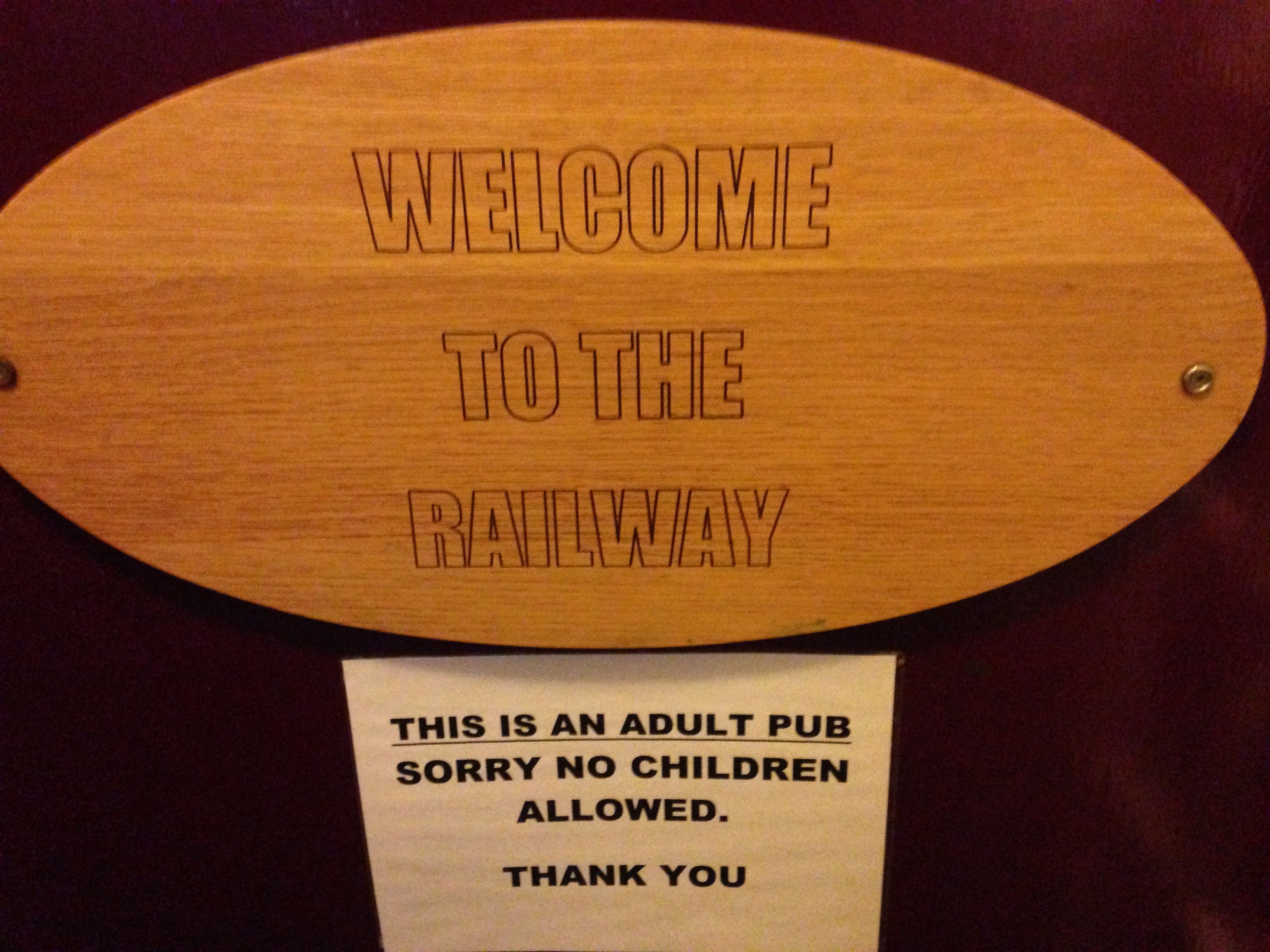
The subject of children in pubs never fails to spark controversy, and there was an outbreak last week when the image shown above was widely shared on social media. Perhaps surprisingly, some of the strongest objections to this came from what might be called the “Christian Right”, with one commentator on Twitter stating: “Good luck with funding your pensions and finding someone to look after you when you're old and ill. Not sure that Fido is going to be much use then.” However, it should be pointed out that the birth rate was a lot higher in the days when children were not allowed in pubs.

Historically, under-14s were not allowed in the bars of pubs, although they could be admitted to restaurants and to physically separate “family rooms”. This was frequently ignored, but it did generally apply, and gave rise to the familiar memories of children being expected to sit outside in the car with a bottle of pop and a bag of crisps. It was undermined by the rise of dining pubs, which blurred the boundary between bar and restaurant, and in the early 1990s was abolished, leaving the admission of children up to licensees’ discretion. It should be noted that a different system applies in Scotland, where pubs and bars have to get specific permission to admit children in their licensing conditions, which is often refused for wet-led establishments.

Now, children are admitted to pretty much every food-serving pub, although a minority do require that they should actually be eating a meal. However, with wet-led pubs, the picture is more mixed, with some admitting children, but others not. Yet some people seem to raise an objection if they ever come across a pub that does not welcome their offspring. This comment on Twitter sums up the sense of entitlement of a certain category of customer, often to be found in craft bars.

If you take your children for a meal in a pub, they are going there for a specific reason in which they can participate. However, to take them into a wet-led pub while you enjoy a drink is essentially putting yourself first and expecting them to put up with it for a while. Children spend much of their time tagging along with adult activities, but surely it is best to spend leisure time with them doing something in which they can be involved.

The advocates for children in pubs with give examples of caring, involved parents taking their children for a quick drink at the end of a shopping trip or country walk. But that is a rose-tinted view that fails to reflect the spectrum of human nature. All too often, adults are immersed in their own conversation and leave their children to their own devices. Bored, fractious children will inevitably start to behave in a manner that other customers find irritating. This is not their fault; it is that of their parents. Children are also often given electronic tablets to entertain themselves, but I really don’t want to have to sit in a pub listening to Peppa Pig videos or the bleeping of computer games.

The point is sometimes made that adults often engage in far worse behaviour than children in pubs. That is true, but it is generally recognised as being out of order and dealt with, whereas it can be very hard to draw the line with the natural exuberant behaviour of children. If licensees to raise an objection, they are likely to find themselves branded as a monster on Mumsnet. So it is hardly surprising that many, who are running pubs targeted at adult drinkers, take the view that it is much simpler to exclude children entirely rather than having to deal with them on a case-by-case basis.

I carried out a Twitter poll on the admission of children to pubs, which received an impressive 619 votes. Nearly 70% of respondents preferred the “mixed economy” solution of some pubs being child-friendly and others adults only, thereby obviously stating that they felt it was entirely legitimate for some pubs to exclude children.

The sign draws a comparison with dogs. Obviously the issues surrounding dogs in pubs are different from those relating to children, although it’s worth pointing out that dogs will often happily sit quietly under tables, which cannot be said of children. I ran a similar poll on the admission of dogs. Again the “mixed economy” solution was the most popular, but it should be noted that 26% of people thought dogs should be admitted to all pubs, compared with only 12% for children. I would say it’s considerably easier to find a dog-free pub than a child-free one, at least in urban areas. In particular, Wetherspoon’s never admit dogs. On the other hand, most rural pubs would struggle if they excluded dogs, as Alex Polizzi pointed out in an episode of The Hotel Inspector. All Sam Smith’s pubs exclude dogs (apart, of course, from assistance dogs) and they only admit children if dining, which means that any wet-led ones are adults-only.

On a related topic, I always wonder why there isn’t the same clamour to admit children to betting shops, a comparable situation of an adults-only activity where they remain strictly excluded by law. And I can’t help thinking there’s another area of human behaviour where a similar “mixed economy” approach might be beneficial to the pub trade ;-)

Thursday, 18 April 2024

Filling a gap

Much of the discussion around the concept of Fresh Ale has revolved around Carlsberg-Marston’s intention to dispense it via handpumps, which is unquestionably misleading given that it is a keg beer. However, what has been largely ignored is that it represents a perhaps rather clumsy attempt to provide a better choice to ale drinkers in venues where no cask beer is offered.

A substantial number of pubs, for various reasons, now do not stock any cask ale whatsoever. In Stockport, this includes pretty much all the remaining working-class wet-led locals apart from those belonging to family brewers. If you go in them and want an ale of some kind, you will be confronted with a choice of one of the widely-distributed “smooth ales”, whether John Smith’s, Worthington, Tetley’s or Boddingtons, and possibly a rarely-seen keg mild bearing a historic brewery name. In one or two there might be some form of modern keg IPA. But there will be nothing remotely resembling a premium bitter, and nothing from any independent brewer, whether family or new-generation.

When CAMRA was formed in the early 70s, it was fair to say that the vast majority of pubs had sufficient turnover to be able to keep cask ale properly. Not doing so was a choice, not a necessity. However, since then, broadly speaking, the total on-trade beer market has fallen by two-thirds, and the share of ale (excluding Guinness) within that has fallen from over 80% to below 20%. This leaves a far smaller pool of sales for ale of any kind. Added to this, pubs are pushing the boundaries of what is feasible for cask to offer an ever-wider range.

I have written before of how a simple comparison of the number of cask outlets, the average lines per pub, and the size of the overall cask market, means that much of this beer must be being kept on sale for well over the recommended three days. Given this, it is only natural that brewers will look at ways of presenting their ales in ways that aren’t so critically dependent on rapid turnover.

Arguably, as long as it doesn’t seek to mislead drinkers as to its true nature, the existence of keg ale in pubs is beyond CAMRA’s scope. And most thoughtful members would accept that, for reasons of turnover, customer profile and simple lack of commitment, there are many pubs that really shouldn’t bother with cask. However, in practice there is a tendency to badger pubs to put cask on even when it’s unlikely to find many takers, and then complain when they don’t. Plus there is the view that the existence of traditional British beer styles is inextricably bound up with that of cask, which doesn’t necessarily need to be the case.

I have mentioned before how, amongst people who see themselves as ale drinkers, there is a strong loyalty to cask as a category as opposed to individual brands. They will choose an alternative cask beer in preference to a keg version of their favourite. This helps maintain cask sales, but arguably it is detrimental to traditional ales as a whole as it inhibits people from even trying non-cask versions. There is also the strange inconsistency than many will happily drink a “craft keg” raspberry sour or marshmallow stout, but turn their noses up at a mild or best bitter.

The loyalty to cask results in a kneejerk rejection of keg ales of whatever type. In the case of the well-known smooth bitters, this may be justified, as they are all pretty lacklustre products, made even worse by being reduced to 3.4% ABV. There is a distinct lack of keg options directly comparable to the popular cask brands. On the other hand, last year Samuel Smith’s increased the strength of their keg Dark Mild and XXXX Best light mild to 3.4% and, while not on a par with a well-kept pint of Old Brewery Bitter, I’d say these are both pleasant and palatable beers that avoid the soapiness of the smooth bitters. They also produce the 5.0% India Ale, about the only premium keg bitter I can think of, although this isn’t found in any of my local Sam’s pubs. To reject keg ales out of hand on principle comes across as prejudice rather than an objective consideration of the beer’s actual characteristics.

Some keg ales seem to do well as they are perceived as something that is “modern” and thus not to be competing head-on with cask. The obvious example is IPAs, which are seen as a category in their own right, even though they are basically just a heavily-hopped type of ale. Beavertown Neck Oil appears to be very popular at present, helped by being of a more sessionable strength than Punk IPA which was the initial pioneer of the type. Boak and Bailey recently reported that keg Sharp’s Atlantic Pale Ale was widely sold in the Bristol area. This is a much “softer” beer than Neck Oil, and indeed has a direct cask equivalent.

I was recently having an interesting discussion about the development of Mild in Ireland. Cask is virtually unknown in Ireland, so pretty much all “interesting” or micro-brewed beer is keg. Obviously mild is very much a niche style, but this gives brewers a much freer hand to make beers of traditional types without having to consider whether they will be viable in cask.

There is also a comparison to be drawn with the lager market. “Most of it’s mass-market crap, and Madri isn’t even a genuine Spanish beer” say the enthusiasts. But it’s lager that enjoys a market share of over 70%, while cask languishes below 10%. Virtually all lager sold in Britain is stabilised and filtered and sold in keg form, so there is no question of dividing the market up into sheep and goats, and everything competes on a level playing field. And, while the enthusiasts may say “actually, some of those German and Czech lagers are not that bad”, they are exactly the same as Corona and Madri in type, if not in quality.

Some may argue that the introduction of better keg beers will undermine cask. But, if they go into places that currently serve no cask at all, how can that be? And I would suggest that the pub offering a single handpump of stale Doom Bar hiding at the end of the bar does cask no favours either, and a keg alternative would be better all round. The core of pubs where cask is popular and sells well wouldn’t be remotely threatened. Taking a wider perspective, the greater availability of quality keg ales would surely boost the general category of traditional British ale styles. I’m certainly not suggesting that keg is on par with well-kept cask. But, rather than saying “I’m not going there, they have no cask”, wouldn’t it be better to say “well, they have no cask, but they do have keg Landlord”?

Thursday, 11 April 2024

Boom or bust?

Earlier this week, the Guardian published a rather self-contradictory article about the craft beer market. On the one hand, they say:
For the time being at least, the demand is still there. A report from the independent brewers’ trade body Siba, due for release in May but shared with the Guardian, will show double-digit growth in production volumes. Increased output correlates tightly with sales, reflecting Britain’s enduring thirst for the complex and diverse flavours that the craft sector offers, particularly compared with mass-market rivals.
But, on the other hand, they report:
But competition is fierce, customers’ budgets are squeezed and costs associated with Covid-19 – and Britain’s sluggish economic recovery from it – are piling up. “It’s like death by a thousand cuts at the moment,” said Alex Troncoso, co-founder of the award-winning Bristol-based brewer Lost & Grounded. He reels off a long but by no means exhaustive list of factors paring back the industry’s meteoric growth. Amid the inflation crisis, the cost of energy, ingredients and wages has soared. Debt repayments, including on government Covid loans, have become more punishing, as the Bank of England raises rates to keep a lid on prices.
These two statements just do not stack up. And my feeling is that, while a handful of craft brewers may be trading strongly, the second is much more generally true than the first. If the market really was buoyant, there would be scope to rebuild margins through increasing prices. Craft beer is not a homogenous commodity and there should be scope to charge more for well-regarded products. But intense and cut-throat competition in a market that is at best flat is more the reality they have to face.

A distinction also needs to be drawn between brewers mainly supplying cask ale to the one-trade, and those who concentrate more on craft keg and the off-trade. I’d guess the second category are struggling less, and there certainly still seem to be plenty of takers for garish cans priced at £3+.

Brewing differs from most other businesses, at least at the lower end, because most participants enter it to some degree as a labour of love rather than as a purely commercial proposition. The boom in brewery numbers during the 2010s was driven by a combination of low interests and the rise in interest in craft meaning that more wanted to seize the opportunity to give it a go. It wasn’t the case that consumers were saying there was a severe lack of choice when there were only 750 breweries. And, while competition is broadly a desirable thing, there is a law of diminishing returns as to what benefit to consumers an ever-increasing number of producers actually provides.

But the shock of lockdown combined with the increase in interest rates triggered by the rise in government spending to fund it brought these favourable conditions to a grinding halt. While one has to have sympathy for individual brewers left with no alternative but to cease trading, there is still considerable oversupply in the market, and there is likely to be a lot further to fall until some kind of equilibrium is restored.

It also has to be accepted that there are no broad sunlit uplands awaiting just over the horizon. The current conditions of higher interest rates (although still only normal by historic standards) and suppressed demand are likely to persist for some time. This is the “new normal” we were told we had to adjust to. There is also the likelihood that an incoming Labour government, faced with pressure to fund various areas of spending, will return to annual inflationary increases in beer duty, which has been fairly flat for the past eight years.

There are some parallels with the situation at Stonegate, Britain’s biggest pub company, which is currently struggling to refinance its enormous debts. While trading in many cases is reasonably healthy, the company is being overwhelmed by the huge burden of debt it took on to acquire Enterprise Inns just before Covid struck. This situation can be traced back as far as the 1989 Beer Orders, which resulted in the “Big Six” brewers selling off their tied estates, much of which were freehold, to debt-financed pubcos. Debt has been a millstone around the neck of the pub industry ever since, and company failures are in most cases caused far more by excessive debt than by poor trading.

I suspect at the end of the day a way will be found to kick Stonegate’s debt can further down the road. However, even if it were to become insolvent, many of its properties are sound businesses and would find willing buyers, so would not be permanently lost as pubs. But such an event would cast a shadow over the whole industry.

Wednesday, 3 April 2024

Falling short of success

At CAMRA’s annual National Conference being held in Dundee later this month, the following motion has been put forward by Swale branch:
This Conference agrees that oversized lined glasses should be mandatory for pubs and clubs to be entered into the Good Beer Guide. It therefore instructs the National Executive to ensure that licensees are aware of this change and shall be given until the 2026 edition to comply.
My immediate reaction is “Good luck with that!” A better way of reducing the number of entries to double figures is hard to imagine, although obviously it would make life a lot easier for the intrepid people trying to tick off every pub in the guide. It also greatly overestimates CAMRA’s influence on the licensed trade.

I wrote about this back in 2014, and nothing has changed since then. It’s something that just isn’t seen as a significant issue any more. If it was, pubs might seek to gain a competitive advantage by using lined glasses, but in practice vanishingly few do. If there was already a critical mass of pubs using them, then such a motion might stand some chance of success, but there isn’t. A full measures law was included in the Labour manifesto in 2001, and indeed Wetherspoon’s jumped the gun on it, but in the end it never happened, and its time has now surely passed. I ran a quick poll on Twitter that shows it isn’t at all commonplace.

It also seems to be the case that British drinkers have an attachment to the concept of a brimming pint glass. Back in the days when oversize glasses were commonplace, a lot of drinkers didn't actually like them because of the air space left at the top of the glass, and described them as “glass buckets”. Somehow it just doesn’t look right.

You also have to be very careful what you wish for. Serving a pint to the line, and excluding the head above the line, is by definition giving a certain amount of over-measure due to the amount of liquid contained in the head. Plus it is difficult to achieve with any degree of accuracy in a busy pub. So, if such a law was brought in, it is inevitable that the major pub operators would lobby to be allowed to use metered dispense, to ensure they don’t give over-measure.

Now I used to like metered dispense when it was commonplace, because it ensured you got a full pint and prevented your beer being spoilt by barstaff with an incompetent pulling technique. But I imagine losing out on thirds and tasters would not go down too well, and nor would the loss of the “theatre of the serve” associated both with dispensing Draught Guinness and pulling cask pints.

And it’s impossible to discuss this subject without recalling that, in the 1980s and 90s, there was a large-scale replacement of oversize glasses with brim measures that CAMRA didn’t raise a peep about, because it also happened to involve the replacement of metered dispense with handpumps.

There is another motion on the order paper from Edinburgh and South-East Scotland Branch instructing CAMRA to abandon any campaigning for full pints on the grounds that it has been “by any metric, a failure”. I can’t see that one being passed either, but maybe it is time for CAMRA to recognise that it is pissing in the wind on this issue and put it on the back burner.

CAMRA beer festivals are often now the only places drinkers ever encounter lined glasses, and the lack of demand can make festival glasses difficult to source. It’s a gesture that comes across as “everyone’s out of step but our Johnny”, and perhaps that instruction should be quietly dropped too.

Monday, 1 April 2024

Be careful out there!

Last week, we were treated to the advice from NHS doctor Andrew Kelso that over the holiday period we really shouldn’t eat an Easter egg all at once, which was greeted with predictable and justified ridicule. Yes, maybe it isn’t really a good idea, but does this really need saying?

This was then followed by a gratuitous warning from the Foreign Office to England fans travelling to Germany for Euro 2024 to be careful with German beer as it is often considerably stronger than that in the home country.

Fifty years ago, when most British beer was below 4% ABV, and many fewer people travelled abroad, this might have made sense. But, in the intervening period, British drinkers have gained much more exposure to beers of the typical German strength, with the likes of San Miguel, Heineken and Peroni, all at 5%, being big sellers. In recent years, there has been a little retrenchment but, even so, Stella and Madri still come in at 4.6%, which is in the same ballpark as the leading German beers, which tend to be in the 4.8-5.0% range.

Plus British people have gained much more opportunity to sample stronger Continental beers both on Mediterranean holidays and overseas football trips. So the strength of German beer should not really come as a surprise to anyone. The whole thing comes across as another unnecessary and patronising attempt to lecture people about the evils of drink.

England's first game in the tournament is aganst Serbia on Sunday June 16 in the Veltins-Arena at Gelsenkirchen in the Ruhr. And Veltins Pilsener is a very good 4.8% ABV German beer. They used to sell it on draught in Robinson’s pubs.

Friday, 29 March 2024

Killing cask to save it?

The continued debate around the subject of Fresh Ale has thrown up a rather muddled article from Annabel Smith entitled Could ‘Fresh Ale’ be cask’s saviour?. I would have expected more clarity of thought from someone who is an accredited beer sommelier. The basic proposition is fallacious, as Fresh Ale by definition is not cask ale, and so there is no way it could save it.

The question might be better posed as “Could Fresh Ale be traditional ale’s saviour?”, but loyalty to cask is likely to prove a major stumbling block. Fifty years ago, drinkers tended to give their allegiance to a particular brand of beer, and whether it was real or keg was a secondary consideration. But, over the years, they have increasingly come to identify with cask as a category. If cask Landlord wasn’t available, they would switch to cask London Pride in preference to keg Landlord, even if that existed. Most of the biggest-selling brands of cask ale are either unavailable in keg form, or only found in tiny volumes, so it isn’t a case of having the choice anyway. The only keg premium bitter I can think of is Sam Smith’s India Ale, and that isn’t in most of their pubs.

That, of course, is why the makers of Fresh Ale want to dispense it through handpumps, as drinkers, even if they appreciate that it isn’t actually genuine cask, will subconsciously view it as something “cask-like”, which they would not do if the identical beer was dispensed through a keg-style tap.

In recent years, there has been a growth in “craft keg”, and many beer enthusiasts who once would have pretty rigidly stuck to cask are prepared to dabble in the category. However, it generally confines itself to niche styles and very strong beers, and rarely treads on the toes of traditional ale. You don’t see many craft keg Best Bitters. I’d also guess that there isn’t much overlap between the craft keg-curious and volume consumers of Doom Bar and Abbot. Keg IPAs such as Punk IPA and Neck Oil have gained fairly wide distribution, but again they tend to be regarded as a category in themselves rather than a subset of “ale.”

Ms Smith repeats the oft-heard cliché that keeping cask ale is difficult, and describes it as “a bloody nightmare”. But that is a gross exaggeration. Yes, it does take some more work than keg beers, but there’s no rocket science about it , just the conscientious application of straightforward procedures. If there’s a demand for it, looking after cask is part and parcel of the business of running a pub.

She also makes a strange assertion that cask is often a mandatory “must-stock” that is enforced on the operator and ends up being a “millstone” round a business’s neck. If pub owners are genuinely forcing pubs to stock cask when there’s no demand for it, that sounds like a poor business practice. If you are a pub manager, then it’s part of your job to sell what the pubco tells you to sell, so there’s no room for complaint, although a good owner will take account of what sells and what doesn’t.

If you’re a tenant or lessee, then you have much more discretion. Maybe it is part of the agreement that you are expected to stock certain brands, but again the owner should recognise that some beers aren’t suited to the pub. And if you work for an independent family brewer, stocking cask comes with the territory. I wonder if she can provide any concrete examples of unwilling licensees who feel they have been forced to stock cask.

The argument about low volumes is also often exaggerated. More and more brewers are now supplying cask ale in 4½ gallon pins, with Greene King just having invested in a large batch of them. Selling twelve pints a day of a given beer really isn’t all that much. But there will be pubs where the nature of the trade is such that there just isn’t much demand for cask, and in cases like that it will surely be better to drop it entirely rather than having a single pump of stale Doom Bar. If the volumes are that low, then any loss will be minimal.

There are plenty of pubs that manage perfectly well without stocking cask, but they tend to be either working-class locals or trendy high street bars. Others, though, even if they don’t actually shift much of it, see it as a key part of their overall offer. A high-end rural dining pub would look rather strange if it didn’t offer any cask. Plus, once you drop cask, you lose any exposure from CAMRA’s Good Beer Guide and WhatPub online pub guide. CAMRA’s influence on pub choice may not be all that great, but a little bad word of mouth can go a long way, and a few complaints about the lack of cask on a site like TripAdvisor will get a lot of views from potential customers. And if you swapped cask for Fresh Ale on a fake handpump, that would not be overlooked.

There is a case to be made for “better keg”, and I’ve argued in the past that CAMRA tends to be too dogmatic in dividing the beer world into black and white, with no shades of grey. All keg beers are not the same, and I would expect Fresh Ale to be a big improvement on the likes of John Smith’s Extra Smooth. I’ll certainly give it a try if I ever come across it. There are examples of pubs with limited or erratic trade where it would be a better alternative to either stale cask or classic keg.

But, for the reasons I set out earlier, the strong consumer loyalty to cask as a category means that Fresh Ale will struggle to gain acceptance, and using fake handpumps to sell it is blatantly misleading and will get it off to a bad start. And, if it does gain popularity, the risk is that it will be extended beyond marginal cases to pubs where the licensee just can’t be bothered with cask, or to extend the range on offer even though the overall turnover is entirely adequate for a smaller number of cask beers.

Sunday, 10 March 2024

Not so fresh

Last year, Otter Brewery launched a concept called Fresh Ale, which was described as “beers that are said to straddle the lager, cask ale and craft beer categories”. The stated intention was to produce beers suitable for outlets without sufficient turnover for cask, but there was inevitably going to be some risk of scope creep. Otter claim to have enjoyed some success with this, although as I live well outside their trading area I haven’t personally seen any evidence of it.

However, Carlsberg-Marston’s Brewing Company (CMBC) have now announced a launch of Fresh Ale on a much larger scale covering their Wainwright Gold, Wainwright Amber and Hobgoblin brands. Vice-President of Marketing John Clements was at pains to point out that it isn’t a cask ale, and isn’t being marketed such, but it is hard to avoid the conclusion that it is going to significantly blur the distinction.

Draught beer is often simplistically regarded as being split between “cask” and “keg”, but in fact the distinction is better expressed as “cask” vs “brewery-conditioned” – beers that undergo a secondary fermentation after leaving the brewery, versus those that are stabilised before being despatched.

In the 1970s, there were many different ways of serving it as well as real ale, such as bright beer, tank beer and top-pressure beer as well as the archetypal keg, all of which had their own characteristics. This is much less so now, but all non-cask beers certainly aren’t uniform, and many keykeg craft beers are unpasteurised and have a much softer level of carbonation than classic kegs. Fresh Ale undoubtedly falls into the brewery-conditioned category, as Clements admits.

We looked at how we could take the issue of shelf life away and how we could do the secondary fermentation in the brewery so it becomes brewery-conditioned ale. A pub can get this beer after we have filtered the yeast out yet it remains unpasteurised so consumers get the same kind of experience as cask but, for the retailer, it lasts 14 days rather than three. By no means are we claiming this to be cask beer or that it is to replace cask because we are one of Britain’s biggest cask brewers.
There’s nothing wrong that as such, and brewery-conditioned beers of various kinds happily coexist alongside cask in pretty much every pub that stocks it. But the big problem is that the intention is to dispense it through handpumps.
He added the term “cask” is not being used when it comes to the marketing of Fresh Ale, but did say the idea is to create the same look and mouthfeel. Meanwhile, along with a longer shelf life than cask ale, it also preserves the hand-pull ritual that delivers a theatre of serve so a bartender would draw a pint on a hand-pull.
The handpump has become a very clear and unmistakable indicator of real ale. If you see a handpump, that what you’d expect to get. Back in the 70s and 80s, there were a scattering of pubs that dispensed keg beers through handpumps in an attempt to mislead customers that they were real ale. CAMRA always strongly deprecated this policy and, while not illegal as such, has a long-standing policy that any pub serving non cask-conditioned beers through handpumps would not be eligible for Good Beer Guide entry or receiving any kind of award. The practice seems to have pretty much disappeared now, and I can’t say I’ve seen any examples for many years.

However, as Fresh Ale is, by CMBC’s own admission, brewery-conditioned, exactly the same is going to apply here. They could of course dispense it through a tap as with keg beers, which would eliminate the problem, but that would presumably deter most potential customers from drinking it. That in itself is a recognition that presenting it on a handpump is misleading.

In recent years, the rise of craft keg has made many enthusiasts more willing to consider beers that do not come from a handpump. However, craft keg tends to be reserved for the more experimental end of the market, and it is virtually unknown to see it applied to traditional British styles. The overlap between regular drinkers of craft keg, and regular drinkers of cask Wainwright and Hobgoblin, is probably very small.

The argument that it is only going to be supplied to low-turnover outlets comes across as distinctly disingenuous. Cask ale is now widely supplied in 36-pint pins, and CMBC’s competitors Greene King have recently invested in a large stock of these. Maybe CMBC should consider following suit. But if you can’t shift twelve pints a day of a particular beer, then it seems pretty pointless having it on draught in the first place. And CAMRA now officially turns a blind eye to the use of cask breathers, which have the potential to extent the shelf-life of cask beer. However, this comment reveals the true agenda:

CMBC added this innovation not only reduces waste and enhances profitability but also simplifies storage and upkeep, bypassing the need for specialised cleaning and conditioning. On pricing to pubs, Clements said it is slightly above current cask ales costs but it works out to be very similar after allowance for sediment and usual wastage in casks.
So it makes life easier for licensees even in situations where the turnover would make cask entirely viable. It’s just “more convenient”. It could be the thin end of the wedge for the wholesale removal of cask from pubs.

CMBC have every right to launch such a product, and it may well be considerably more palatable than the like of John Smith’s Extra Smooth. However, it is not a cask beer and they should not be leading drinkers to think it is, or something very like cask, through the style of presentation. If they chose to use free-flow taps and presented it as “nicer keg”, then it may have merited no more than a shrug of the shoulders. But by serving it on handpump they risk significant kickback. This isn’t just CAMRA being pedantic – the link between handpumps and cask is universally accepted in the industry, and indeed acknowledgment of this is implicit in CMBC’s approach. Everyone who drinks cask beer recognises the connection.

It’s worth pointing out that CMBC is a separate organisation from the Marston’s Pub Company, and is only minority owned by Marston’s. So it doesn’t automatically follow that Marston’s pubs will adopt this, although there must be a strong chance that they will.

Friday, 8 March 2024

Better than a poke in the eye

This week’s Budget provided a crumb of comfort to drinkers in that the freeze on alcohol duties was extended from August this year to January 2025. This was given a cautious welcome by industry figures, as stated in the linked report.
Chief executive St Austell Brewery, Kevin Georgel, welcomed the decision to extend the freeze in beer duty but added it “will not see costs cut for our sector”.
In the same report, CAMRA chairman Nik Antona “welcomed the freeze in alcohol duty, as it would help to ‘mitigate an additional hike in costs’ to be passed on to pubs and pub-goers.”

However, this led to a strange wave of denialism in some quarters that alcohol duty had anything to do with the pub trade, such as this example from Ed Bedington, the editor of the Morning Advertiser, which I quickly slapped down.

Obviously, a freeze does not leave anyone better off, but neither does it make anyone worse off, which was a very real possibility if duty rates were increased in line with inflation. Clearly pubs are subject to many other cost pressures, but to dismiss the level of alcohol duties as irrelevant is ridiculous.

This was topped by the bizarre assertion that beer duty was paid by brewers and thus had nothing to do with pubs. In a very narrow sense this is true, but plainly it increases the cost of their product, which is then passed on to pubs and ultimately to drinkers. If the price increases, it may reduce the demand, and pubs may meet resistance if they try to pass on the full impact to their customers. It must be said that some people seem to have a very warped perception of the economics of the pub industry.

Compare this to twelve years ago, when CAMRA mounted a vociferous and ultimately successful campaign to scrap the hated Alcohol Duty Escalator, which raised duties every year by 2% above the rate of inflation - see the image at the top of this post. They even organised a mass lobby of Parliament to protest against it. Clearly then they saw it as a vital issue. And they are currently campaigning to widen the duty differential between draught and packaged beer from 10% to 20%. From the report I linked to above,

In response to the chancellor’s announcement, the Campaign for Real Ale chairman Nik Antona described the Budget as a “missed opportunity” to support the Great British pub by cutting tax on draught beer and cider... He said: “Making duty on draught beer and cider significantly lower would promote drinking in the regulated setting of a community local and help small and independent producers who sell mainly into pubs and taprooms to compete against the global brewing giants and the likes of supermarket alcohol. CAMRA will continue to campaign for the Treasury and all political parties to back our sensible ask of making tax on pints in pubs 20% lower than the general duty rate.”
Perhaps they shouldn’t bother.

Irrespective of any impact on pubs, there is a strong philosophical case in general for cutting alcohol duties. We have some of the highest levels in Europe, and the only places that are anywhere close are Ireland and some of the Scandinavian countries. All the other major European countries such as France, Germany, Spain and Italy have much lower duty levels. This places an unfair burden on consumers and makes life more difficult for producers of all kinds of alcoholic drinks. Kevin Georgel of St Austell Brewery pointed out on in the linked article that British beer duty was twelve times higher than that in Germany, and called for the government to set out a roadmap to bring current duty down to the European average.

Don’t hold your breath, though. But, in the current climate, even freezing duty is a whole lot better than the alternative.

Saturday, 2 March 2024

Branded

In the early 2000s, I visited Brussels several times on business trips. I was struck by how all of the well-known Belgian beers had their own specific design of glass – Duvel, Chimay, Orval and even Kwak which needed a little wooden support to stop the glass falling over. It was a very distinctive and characterful part of the drinking experience.

At the time, this was virtually unknown in this country, but over the succeeding twenty-odd years branded glasses have become increasingly common here. At first it was simply standard designs with a brand logo, such as the well-known John Smith’s Extra Smooth tulip, but it then evolved into each brand having its own characteristic and unique form. The Stella chalice, as shown, was one of the first to become commonplace.

Now, Guinness and pretty much every leading lager brand have their own individual glass design. This obviously helps to promote the brand, and leads to drinkers having a sense of ownership and feeling they are making a statement about what they are drinking. On the other hand, it could be argued that it helps people distinguish what are essentially pretty samey beers.

One obvious problem is that branded glasses are much more likely to be stolen than plain ones, particularly ones of a highly distinctive form such as the Leffe chalices now seen in Wetherspoon’s. However, my understanding is that they tend to be provided either free or at a substantial discount by brewers, so they may not be too concerned about their promotional material ending up in people’s houses.

Personally, I have to say I’m not a fan of stemmed pint glasses, which to me come across as unwieldy. That includes many leading brands such as Stella, San Miguel and Cruzcampo. I also find gold-rimmed glasses a touch “icky”. And getting a beer in the wrong branded glass is surely much worse than getting one in a plain glass.

This tweet illustrates the pitfalls of serving beer in the wrong glassware. Surely in this case, even a plain stemmed glass (which Wetherspoon’s have large stocks of) would have been better than an unmarked conical.

As I mentioned in my post about guest ales, the lack of branded glasses arguably puts cask at something of a disadvantage. Plenty of beers do have their own glasses but, like the Bass one, they tend to be just standard designs with the appropriate logo on it. Some brewers such as Robinson’s have generic branded glasses for their own pubs, and Lees have introduced the distinctive “grip” glass for their cask ales, although personally I’m not a fan. And, by definition, ever-changing guest ales are not going to come with a branded glass. Some pubs do make up for this by having a stock of glasses with their own logo.

I recently ran a Twitter poll on this which produced some remarkably symmetrical results. Half of respondents thought that a branded glass did enhance their experience of drinking at least to some extent, while another half felt it made no difference or was actively offputting. I suspect, given the nature of my followers, the sample was heavily biased towards people who mainly drink cask.

Branded glasses are certainly here to stay, and it’s hard to avoid the conclusion that to some degree they do give pub drinking more of a sense of occasion. Plus a good-looking pint in its own glass might tempt others to try it. So, even when it is on as a permanent beer, this is something where cask possibly does lose out when it is competing for attention with other beers.