Wednesday, 3 November 2021

Turkish delight

During the lockdown, Holt’s brewery bought and refurbished the Lower Turk’s Head on Shudehill in Manchester city centre, and reopened it in July. So I thought I would take a trip to have a look at it, and also take advantage of the opportunity to pay a visit to one or two of the other classic pubs in the city. Manchester is only ten minutes on the train from Stockport, but you have to be aware when buying a ticket that there is an evening peak period that lasts until 6.30. However, it wouldn’t be too much hardship to spin out my visit until after that, and at £3.20 after the Senior Railcard discount the off-peak return is very good value.

Outside the main entrance to Piccadilly station I was struck by a sculpture of a line of wounded soldiers that had been installed in November 2018 to mark the hundredth anniversary of the end of the First World War. I had actually been through Piccadilly a couple of times in 2019, but on both occasions I took the tram from the undercroft and so had never noticed it before. On the walk up Piccadilly towards the city centre the heavy pedestrian traffic was very noticeable, much more so than in any of the other towns and cities I have visited since reopening, and a clear sign that Covid paranoia is receding in people’s minds.

Shudehill is a street on the northern fringe of the city centre climbing up towards Rochdale Road, where the dwindling number of Victorian buildings seem to be fighting a losing battle against the encroachment of modern steel and glass edificies. One of them is the Lower Turk’s Head, with its striking tiled frontage. After a long period of closure, it was brought back to life in 2013 and then bought and refurbished by Holt’s during the lockdown. It has now been extended into the building on the right. In the 2000s, StreetView shows this as an adult bookshop, but it later became Scuttlers Wine Bar – I’m not sure whether this was an offshoot of the pub at the time. In any case, it has now been incorporated as a part of the pub proper.

The entrance door on the left takes you into the main part of the pub which has been refurbished by Holt’s in their characteristic style with an abundance of dark wood and polished brass. There’s an alcove of bench seating at the front by the window, the long main bar on the right, and then a comfortable but rather dark seating area at the rear which widens out to the left. The extension is at a lower level, and contains another bar and some rather odd choir stall-type seating with a ridge just where you want to put your neck when leaning back.

On the bar were the full range of Holt’s cask ales – Mild, Bitter, IPA and Two Hoots – plus a guest from their Bootleg microbrewery. It’s noticeable that, nowadays, all the keg beers are their own products too, Sam Smith’s style. Unfortunately my Bitter was a little warm and lacklustre, and £3.60 is hardly the value for money we have traditionally expected from Holt’s. It was fairly quiet, although Tandleman found it heaving on a late Saturday afternoon. The soundtrack seemed to feature some of the more quirky songs from the early 80s such as The Safety Dance by Men Without Hats and Waiting For a Train by Flash and the Pan. The pub in general has been tastefully refurbished, but hopefully at busier times the beer is better.

A few doors further up is the Hare & Hounds, another Victorian pub with a tiled facade, albeit rather more subdued. The steps up to the front door take you into a superb unspoilt interior dating from a 1920s refit, which qualify it for a full entry on CAMRA’s National Inventory. The central bar is surrounded by a front vault, a drinking lobby and a rear smoke room with a narrow bay of seating extending into the window.

There are usually three beers on, often including Robinson’s Dizzy Blonde, but two were obscured by drinkers at the bar, and the only pump I spotted was Holt’s Bitter, which was what I was after anyway. At £2.70, this was much cheaper than the Lower Turk’s Head and also of much better quality. This must be some of the cheapest cask beer in the city centre outside Wetherspoon’s.

The good value may have been a factor in it being much busier too, with a good number of customers throughout, particularly clustering in the lobby. They mostly reflected the archetypal older male clientele, and this pub could be regarded as being a local in the city centre. The music choice included Back Stabbers by the O’Jays.

I then made my way through the grid of streets in the Northern Quarter to reach another National Inventory pub, the Unicorn on Church Street. This is an altogether grander affair, a substantial street-corner pub in a kind of modern classical style built in 1924. The largely untouched interior boasts a wealth of light oak panelling and has an island bar with a seating area facing it on the left, a snug at the rear, and two cosy rooms to the right on the other side of the central corridor.

A couple of years ago, there was a threat to gut it and turn it into a sports bar, which led to its qualities being reassessed by CAMRA and promotion to the first tier of the National Inventory, together with gaining official listed building status. Sadly, it’s one of those places where the quality of the fittings does not seem to be matched by that of the actual pub operation. On this occasion, much of the bar was draped with cobwebs and other Halloween tat. There was a good scattering of drinkers occupying the seating on the bar side, and I overhead one of them suggesting to a companion that he should “get one of those fucking electric frogs.” No, I have no idea...

It was originally built by one of the companies that became part of the Bass empire, and for many years has featured Draught Bass on the bar. Indeed the Honourable Order of Bass Drinkers used to meet in the upstairs function room – I’m not sure if they still do. I was pleased to see that it was on today, as there had been reports of intermittent availability. It was reasonably priced at £3.40, but was distinctly disappointing, not off as such, but very much on the warm and flat side. Other beers on the bar were Doom Bar, Wainwright and Hobgoblin Gold, which wasn’t the world’s most enticing range. The one next to the Bass is just a notice hung on the pump handle. I’m not sure whether the sound system was a jukebox or not, but it suddenly switched to an Irish Republican anthem going on about Kilmainham Gaol, which to my ears struck a discordant note.

I headed back to Market Street and crossed what remains of Piccadilly Gardens to reach the Circus Tavern, which always seems to be further down Portland Street than I had thought. This is another National Inventory entry, a tiny, narrow-fronted pub in a row of variegated Victorian buildings that have managed to survive amongst the more modern development surrounding them. It isn’t the smallest pub in Europe, but it claims with justification to have the smallest bar, a tiny quadrant on the left half-way along the corridor.

It has two small cosy rooms with bench seating. The one at the front always seems to have a vault character and is frequented by the regulars, while the one to the rear is more of a snug. I managed to take a snap of the seating opposite in the brief interlude between it being occupied by groups of customers. Understandably, the Circus didn’t reopen until social distancing restrictions were lifted in July, and anyone concerned about getting too close to others would do well to avoid it. At teatime, it seemed to attract a wide range of customers who were just popping in for a quick one in between doing other things.

Historically a Tetley pub, it has always sold Tetley Bitter alongside another beer. Last time I visited this had been Robinson’s Dizzy Blonde, but on this occasion I think it was Wainwright. I plumped for the Tetley’s, which was in very good nick, and seems to have become less sweet and regained a hint of its old character since the brewing was moved from Wolverhampton to Cameron’s at Hartlepool. This was £4, the dearest beer of the day.

If I had been showing a stranger around the pubs of Manchester, I would then have taken them in the almost equally small Grey Horse a couple of doors down, which indeed is what I did when following a similar itinerary five years ago. However, on this occasion I wanted to take a look at the Waldorf on the way back to the station, which is a pub I hadn’t visited during this century. It used to be a Whitbread pub, and one thing that sticks in my mind was it selling the short-lived GB Lager, which was dispensed from a pump resembling an actual bath tap. What a brilliant marketing idea to get customers to associate your beer with dishwater.

It is situated on Gore Street just off the main thoroughfare of Piccadilly. I don’t really recall how the interior was before, but my memory was of a knocked-through but reasonably comfortable pub with plenty of dark wood. However, I was taken aback to be confronted by posing table hell. The only normal-height seating was one alcove of benches and a raised seating area with a few tables. It very much gave the impression of somewhere designed for customers who would have a quick one before moving somewhere else rather than settling in for the evening.

The beer choice was Doom Bar, Landlord and Banks’s Amber, which was being promoted as a guest beer. I went for this at £3.95 which was actually better than I had expected from the general vibe of the pub, and I managed to find a decent spot in the raised seating area. I also asked for a glass of tap-water to wash down my anti-lycanthropy pills, for which purpose you really don’t need a whole pint. It was interesting to visit the Waldorf to see what it was like, but it’s not a pub that I’d return to in a hurry.

It was now after the witching hour of 6.30, and from here it was only a short walk back to the station and the brief train ride back to Stockport. I have to say I never really feel at home in Manchester city centre, finding it much too metropolitan and impersonal for my tastes, but it does retain some welcoming oases of traditional pub life if you know where to look.

It’s impossible to judge from one visit at what is normally a slack time anyway how trade compares with pre-lockdown, but the Hare & Hounds and Circus Tavern in particular seemed to be doing good business and there was no evidence of Covid rules in any of the pubs. The general level of activity on the streets suggested that people had now put lockdowns well out of their minds. So it would be disappointing if the government were to heed the siren calls of the usual zealots and bring the shutter of restrictions clanging back down again.

Friday, 29 October 2021

Pin money

In his budget earlier this week, Chancellor Rishi Sunak announced the most comprehensive review of alcohol duties for many years, and indeed probably the first root-and-branch overhaul of the system since duties were first imposed. One feature that immediately caught the headlines was the introduction of a new lower rate of duty for draught beer, something that CAMRA and the pub industry had been lobbying for. It’s a very straightforward and targeted means of directing financial support to the on-trade.

However, as I wrote earlier this year, it’s important not to get carried away over this. It’s only a cut of 5%, equating to about 3p per pint, and so the likelihood is that it will be used to support the margins of hard-pressed pubs rather than being passed on to the drinker. But something is better than nothing , and we shouldn’t look a gift horse in the mouth. I’ve also always been somewhat sceptical of attempts to favour one sector over another via the tax system.

There was a major fly in the ointment, though, when it became evident that the benefit would only apply to containers of 40 litres or more. This excludes a huge swathe of draught products, overwhelmingly produced by smaller brewers. More and more cask ales are now being made available in 4½-gallon pins (just over 20 litres) to maintain quality in the face of declining sales. Ed Wray reports here in his tour of Palmer’s brewery (pictured above) how they are using more and more pins for both their own pubs and the free trade. Added to this, the normal size for craft kegs is 30 litres, as opposed to 50 or 100 for mainstream products.

Given this, it seemed distinctly hypocritical for Sunak and Johnson to be pictured promoting this policy pouring beers that wouldn’t benefit from it.

The charitable assumption is that this is an oversight rather than a deliberate policy, and it seems counter-productive to exclude most smaller brewers from the benefit. Plus the tax loss from reducing the threshold to 20 litres would be minimal. CAMRA and SIBA have urged their members to lobby the government to make this change, and it would be hoped they are pushing at an open door. There’s a template you can use to write to your MP here. This morning, there have been reports that the government may be heeding this pressure.

This, of course, is only a small part of a radical reform of the entire alcohol duty system. The current structure has grown up piecemeal over the years and is riddled with anomalies and inconsistencies, in particular the fact that some categories are taxed by alcohol content, whereas others are simply taxed by volume. It is, however, very rare nowadays to see the government take a clean-sheet approach to anything as opposed to just tinkering at the edges. As it states on Page 88 of the official Budget document:

The government will radically simplify the duty system, reducing the number of main rates from 15 to 6, and taxing all products in proportion to their alcohol content, enabling businesses to bring new products to market with fewer tax complications. All tax categories (e.g. beer, wine) will move to a standardised set of bands, with rates for products between 1.2-3.4% alcohol by volume (ABV), 3.5-8.4% ABV, 8.5-22% ABV, and above 22% ABV. Above 8.5% ABV, all products across all categories will pay the same rate of duty if they have the same proportion of alcohol content.
There will also be a small producers’ relief scheme for makers of products under 8.5% ABV, covering all categories, not just beer. The whole package would not have been possible had we still been members of the European Union.

It’s sometimes argued that it would be fairer if there was a single rate of duty per unit of alcohol that applied to all categories of drinks. However, the problem with this is that stronger drinks, especially spirits, are cheaper to make and distribute per unit than weaker ones such as beer, and thus the system would effectively discriminate in favour of them. As I wrote a few years ago:

A fair system would be one that, broadly speaking, ensured a relatively level unit price to the drinker at the point of sale for mainstream products. And, while there are perils in the excessive consumption of all kinds of alcoholic drinks, you can do yourself serious harm more swiftly and easily drinking spirits than beer or wine. A tax regime loaded in favour of spirits would not be a good idea. It could also be argued that brewing and winemaking provide much more employment and general economic stimulation than distilling.

Yes, there is a strong case for making alcohol duties simpler and more consistent. But there are good public policy reasons for stronger drinks bearing a heavier rate of duty per unit. Remember Hogarth’s comparison of Gin Lane and Beer Street?

It is interesting that the threshold for the lowest rate of beer duty is being increased from 2.8% ABV to 3.4%. The lower rate was introduced a few years ago, but has never gained much traction. It is difficult to make beers with much flavour and character at such a low strength and, as most beer in pubs is drunk in rounds, the attractions of saving a few pence per pint by choosing one product over another are limited. The only draught beers I regularly see in this category are Sam Smith’s light and dark milds and Alpine lager.

However, there is much more scope for making tasty beers at 3.4%, and indeed many existing milds and light bitters fall into this bracket. But there might be a temptation to lower the strength of existing products to take them below the cut-off. It would surely be a no-brainer for Hydes to reduce 1863 and Dark Ruby from 3.5% to 3.4% and, if the drinkers of John Smith’s Smooth accepted a cut from 3.8% to 3.6%, then they might not be too bothered about losing another couple of points. It will be interesting to see how this plays out, although I wouldn’t really expect a stampede of new products to take advantage of it.

The various inconsistencies of the current duty system give plenty of opportunity to sow division between the different sections of the alcohol industry. Someone else always seems to be getting a better deal than the producers of your favourite product. So we had the wine trade complaining that beer was taxed more lightly per unit, while in turn the brewers felt that cider got off very lightly. Sometimes that has been exploited by the government to favour one sector at the expense of others, which in recent years has actually tended to benefit beer. This week, Labour politicians have been quick to accuse the government of cutting the duty on champagne while screwing the poor, conveniently overlooking that prosecco, which comes under the same sparkling wine category, is now a staple of Wetherspoon’s. Placing all products under the same duty regime would eliminate all this pointless infighting and hopefully allow the alcohol industry to speak with one voice on taxation.

Inevitably any attempt to rationalise taxation will produce losers as well as winners, and the losers will tend to be more vocal. This is why governments have shied away from any wholesale reform of council tax. Once the dust had settled, it became clear that these plans would lead to duty increases for most cider and table wine. In 2010, the then Labour government attempt to raise cider duty by 10%, which provoked vocal opposition in the West Country, and ended up being abandoned by the incoming Coalition.

And the chattering classes have now started to realise what the effect on wine is likely to be. Overall, in value terms, wine now overshadows beer in the alcohol market and is very much the drink of choice at North London dinner parties. So it’s likely that these changes will not go through as smoothly as the Treasury might have hoped, and there must be a distinct possibility that opposition from various quarters will result in them running into the sand.

Edit: Here are the full details of the government proposals. In fact, they do include a lower rate of duty for cider as compared to beer below 8.5% ABV, as it was felt that equalising the duty would deal a severe blow to a historic industry that is already in decline. This was not made clear in their initial top-level statement. However, taxing cider by alcohol content rather than volume will result in an increase in duty for ciders above 4.8% ABV, which includes the vast majority of premium ciders sold in the off-trade.

Wednesday, 20 October 2021

A touch of grey

On our recent day out in Stockport, someone commented that they weren’t too enamoured of the recent grey makeover applied to the Swan With Two Necks, and I couldn’t disagree. To my eye it looked much better in the previous more clearly defined black and white.

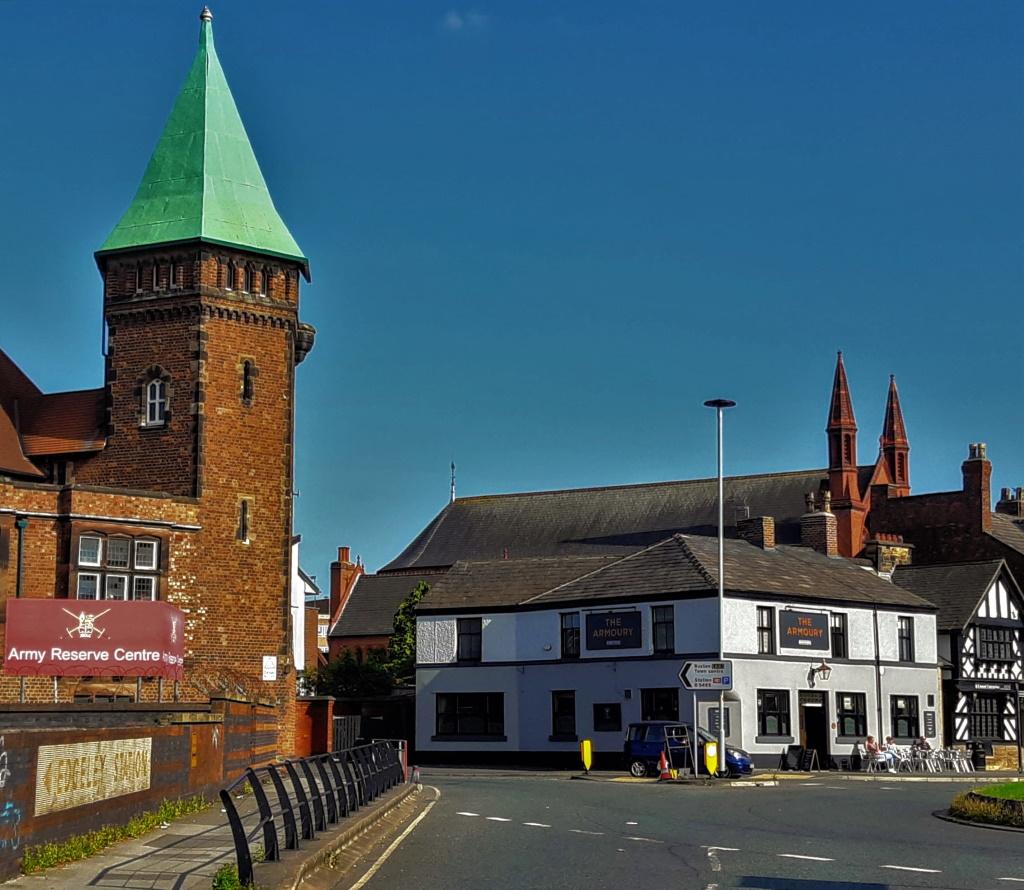
Something similar has happened to the Armoury which we visited later on in the day, where two shades of cream have been replaced by two shades of grey.

And these aren’t just two isolated examples – up and down the country, the past few years have seen an ever-growing number of pubs cast off their old guise to adopt a new grey uniform. It’s a very definite trend. Boak and Bailey wrote about Why are all the pubs going grey? earlier this year. As they say:

Our assumption is that this is about trying to attract a newer, more aspirational crowd – or, at least, not to put them off. This preference for would-be classy neutralness mirrors recent trends in home décor sometimes referred to disparagingly as ‘the grey plague’.
But if this is the case why has it been applied to the unapologetically downmarket Jolly Crofter just a couple of hundred yards away from the Armoury, where nobody of a vaguely aspirational bent would ever cross the threshold?

I would be genuinely interested to hear someone explain the thinking behind this, because to my mind deliberately painting pubs in a cold, drab shade only serves to make them less appealing. A few years ago, there was a fashion to remove whitewash and return pubs to their natural brickwork, which can be seen, for example, at the Old Blue Bell in Preston. But if pubs are to be plastered, then surely they are much more welcoming if it is done in white or cream, or in the pinks and pale blues that are often seen in the West Country and East Anglia.

There are numerous fads that seem to spread across pubs over the years where it is hard to understand the rationale. Examples include posing tables, scatter cushions, getting rid of beermats, dispensing with zeros in menu prices, and replacing carpet with bare wood flooring. A while back, although it seems to have passed now, there was a vogue for installing shelves of dusty old books that nobody would ever read. And nobody can ever satisfactorily explain why. People can sometimes come up with post-facto rationalisations, such as claiming that doing away with beermats makes tables easier to clean, but that isn’t the real reason.

As pubs are owned by a whole host of businesses of varying sizes, these trends cannot be blamed on a single controlling mind, and instead seem to spread organically in the same way that fashions in clothing do. We now look back aghast that people ever wore such things as platform soles. But are there certain influencers of taste in the pub world from which the wider population refreshing the decor of their pubs take their cue?

Of course, it’s only a coat of paint on the exterior, and it can easily be removed in the next refurbishment. On its own, it makes no difference to the customer inside the pub. But this trend has extended to interiors too, and in fact predated its application to external walls. To my mind at least, if a pub is decorated and furnished in cold pastels rather than warm browns, creams and reds it does detract from the experience. But it seems that the current fashion is for pubs to be edgy rather than cosy.

Friday, 15 October 2021

Bringing them all back home – Part 2

We pick up our day out in Stockport having just left the Railway and heading back past the Arden Arms to the second Sam Smith’s pub of the day, the Boar’s Head. This is a handsome redbrick building with stone quoins which dominates one corner of the Market Place and faces the Baker’s Vaults and the open area known from its origins as the Castle Yard. I mentioned to the others that it used to have a large, fluffy black-and-white pub cat called Felix who I did see last year in the interregnum between lockdowns, but unfortunately has since died at the age of 16.

It has the unusual distinction of having had some of its internal walls restored in the 1990s to separate out two areas from the bar counter to provide more seating. There’s also a large room at the back that was used for live music before this was banned by Humphrey Smith. Although it can get busy at lunchtimes, with a lively, bustling atmosphere, by mid-afternoon today it was fairly quiet. Although it won’t kill them off, it does seem that the Sam’s price increase has damaged the trade of their two pubs in Stockport town centre and deprived them of some of their characters.

The Old Brewery Bitter also seemed a little tired, and the one person who tried the keg Light Mild reported similar, although there were no complaints about the Taddy Lager. The fact that the long-serving licensee has recently retired may also have been a factor here.

Although Friday isn’t an official market day, there were some stalls selling jewellery and craft items. We then crossed the bridge over Little Underbank which we had seen earlier from underneath and passed Stockport’s Wetherspoon’s, the Calvert’s Court, to reach the Petersgate Tap on St Petersgate. As a modern craft bar, it formed a distinct contrast to some of the earlier pubs. It opened in 2016 in the premises of a former betting shop and since then has won a number of CAMRA awards.

It’s considerably larger than the typical micropub. Downstairs the bar is in the rear left-hand corner, with a a couple of seating booths on the left and more seating facing it on the opposite wall. There’s also an upstairs room that it sometimes used for live music. The beer range normally consists of six cask lines and four craft kegs, together with a selection of real ciders.

Among the beers tried were Ossett White Rat, Durham Dark Angel and the powerful Torrside Reign of Grain, while one person had the Ross-on-Wye Gilly and Friends Cider. Some eyebrows were raised by me going for a third of the Brew York Jackie Flan Pastry Sour. While I certainly won’t be making a habit of it, I’m interested to try these novelty beers when I come across them to see what they’re like. Yes, it was a bit sour, and yes, it had a thick, pastry-like consistency.

The itinerary then took us out of the town centre proper into the higher part of the town. The route took us along Stockport’s High Street, which isn’t the typical shopping hub, but takes its name from running at a higher level above Little Underbank. From here there was an impressive view of Robinson’s Brewery in the bright afternoon sunlight. Next came a short but stiff climb up Middle Hillgate which required a brief rest stop half-way up. This stretch is notable for the large number of closed pubs – we passed the Spread Eagle, Royal Oak, Bishop Blaize, Waterloo and Black Lion, all of which have closed in the present centre. One that closed a long time earlier, well before I moved to Stockport in 1985, was the Land O’Cakes, which is now used as offices, but preserves its name in the tiling in the entrance lobby.

Just past here was our next pub, the Sun & Castle, which is actually a substantial 1920s building, although that isn’t immediately obvious on a Victorian street unless you take a step back. It originally had a fine unspoilt inter-wars interior, although this was swept away in the 1990s in favour of cod-Victoriana. However, it still presents a traditional aspect, with plenty of dark wood, a separate public bar on the left, a spacious area facing the main bar, and a comfortable lounge section at the front right by the door featuring a couple of caged budgies.

Once a Tetley pub, it now belongs to Holt’s, and only cask beer available was their Bitter at a very reasonable £2.60 a pint. This was on particularly good form, and those from other parts of the country who never come across it were very impressed. By this time the party had started to straggle out somewhat and some latecomers turned up a quarter of an hour after the advance party. The pub was fairly quiet, but this was only to be expected in the late afternoon outside the town centre. The Sun & Castle is essentially a classic down-to-earth boozer, and none the worse for that.

We then headed westwards into the blinding rays of the low sun. The route passed the side entrance of Stockport’s impressive Town Hall, which is where the Stockport Beer Festival was held for a number of years before moving to the Edgeley Park football ground. Next to the Town Hall is a well-known fingerpost sign that includes “London 182½” amongst its destinations. Wellington Road South here is still the A6, once the London to Carlisle trunk road, and in fact was one of the first town bypasses in the country when originally built in the 1820s.

The Armoury pub stands opposite the impressive building from which it takes its name, with its distinctive pointed tower. Built in the 1920s, its latest repaint saw it fall victim to the currently fashionable grey paint scheme. The interior has been opened up a little, but still retains three separate rooms – the main lounge area on the right, a vault on the left and a rear snug that is used as a darts room – and the pub qualifies for a regional entry on CAMRA’s National Inventory.

Most of the seats in the lounge were taken, although I’m not sure whether the Indian Premier League on the television was the main attraction so, the weather still being fairly balmy, we found some space in the beer garden at the rear. This is really an extended covered smoking shelter, and is a very good example of facilities for smokers being enhanced after the 2007 ban. The beer range in this Robinson’s pub was again Unicorn and Dizzy Blonde, both of which were very good. We were joined here by a couple of escapees from the Crewe Beer Festival who had decided to meet up for the last two pubs before staying overnight in Stockport.

On the way to the next pub, we were distracted by a beautiful silver Bengal cat that was behind a set of railings but was happy to submit to a bit of fussing. The question was asked whether it was wise to allow such a potentially valuable animal to wander the mean streets of Edgeley alone.

Our final call of the day was the Olde Vic, of which I hold the distinction of owning a small share. It differs from many community-owned pubs in that in this case the community group bought the freehold from the previous owner back in 2015, but allowed the existing tenant to continue in place. It’s a small street-corner free house that, back in the late 1980s under a previous licensee, was the first in Stockport to offer a varying selection of guest beers.

The interior is basically a single room with seating areas on three sides of the bar which is in the apex of the street corner. Since being taken over, the community group have smartened it up and carried out some much-needed repair work, but it retains its individualistic character with a selection of memorabilia and bric-a-brac. The wall behind us was covered with an array of pumpclips for beers served over the years. It’s also notable for an impressive range of snacks on cards behind the bar, including the famed Ploughman’s Lunch.

I had not actually been in since before the first lockdown last year, and was slightly surprised that the number of handpumps had been reduced from six to three, although in the current climate this makes sense and will help maintain quality. On this occasion, the beers available were Mallinsons Jester and Stockport Challenger and Stout. I think we all had the Mallinsons, which went down well, although entering into a discussion about climate change at this stage in the proceedings was possibly not a good idea. It was now about 7.30, and the pub was rapidly filling up.

A few had already dropped by the wayside, but those of us remaining then went their separate ways. This day was certainly by far my best pub-based social event of the year so far, although in most of the previous nine months they have been few and far between. As Paul Bailey says in his write-up of the day:

After an absence of over a year and a half, it was great to be able to travel un-hindered, drink freely in pubs and enjoy one another’s company once again. Fingers crossed, there will be many more such trips!
Some will no doubt be disappointed that we missed out their favourite pub, but there are only so many that can be fitted into a day, and it wouldn’t be difficult to find an alternative nine pubs in and around the centre that would also do the town proud. I had initially pencilled in a visit to the Robinson’s Brewery Visitor Centre, but unfortunately the bar has not yet reopened. I deliberately put the emphasis on some of Stockport’s classic heritage pubs, and indeed there are two more full National Inventory entries that are just a bit too far out for a town centre crawl, the Alexandra in Edgeley and the Nursery in Heaton Norris.

It’s difficult to judge the trade of pubs from one visit, especially at what are normally slack times anyway, but some at least were clearly doing good business, and there was plenty of evidence of the return of normal pub life. With the exception of table service in the Arden Arms, which may be more related to food service, none of the pubs visited were applying any Covid-related restrictions. Indeed, in my experience over the past three months, by and large pubs are the sphere of life where the shadow of Covid seems to have retreated most. Let us keep our fingers crossed that this isn’t derailed by the government reintroducing restrictions over the winter.

Thanks to Peter Allen for the photos of the Petersgate Tap, Sun & Castle and Olde Vic.

Sunday, 10 October 2021

Bringing them all back home - Part 1

On Friday 6 March 2020 we had a very enjoyable day out in Burton-on-Trent. On the platform of Sheffield station I spotted a Chinese student wearing a face mask, which turned out to be the proverbial cloud on the horizon no bigger than a man’s hand. We didn’t realise that, just two weeks later, all the pubs would be shut down, and for the following sixteen months would either be closed completely or only allowed to trade under restrictions of varying severity.

However, just short of twelve weeks after the lifting of restrictions on pubs, and on travel, on 19 July, we felt sufficiently confident to organise another day out, a mere nineteen months and two days after the last one. Having visited various towns and cities around the North and Midlands, this time I suggested my home town of Stockport, which has a wealth of interest in pub terms. Unfortunately, Paul Mudge, a stalwart of these trips, was unable to make it due to a broken foot, but we still had a healthy attendance, and Friday 8 October was blessed with glorious Indian summer sunshine.

Our starting point was Sam Smith’s Queen’s Head on Little Underbank, alternatively known as Turner’s Vaults. Not the easiest of pubs to find, this may seem an odd place to meet up, but along with Wetherspoon’s and the other Sam’s pub, it is one of the few 11 am openers in the town centre, and fitted in well with the rest of the itinerary. Although it isn’t a direct route from the station, people were surprised by how close it was. It’s a small, single-fronted pub standing in the shadow of the bridge carrying St Petersgate over Little Underbank.

Inside, it has a long, thin historic interior of great character which merits a place on CAMRA’s National Inventory. The bar, adorned with vintage spirit taps, is at the front, face by bench seating opposite it and in the window. Behind this is a distinctive “horse box” snug, and then a cosy toplit smoke room at the rear where the presence of a real fire seemed slightly incongruous. While much of it seems original, in fact some of the work only dates back to a sensitive refurbishment carried out by Sam’s in the 1980s. The pub also features the “Compacto”, a urinal that was once billed as the “World’s Smallest Gents”, although it has been locked for many years as few modern men are skinny enough to be able to use it.

It has the usual Sam’s range of Old Brewery Bitter Blus a wide selection of kegs. Most of us plumped for the OBB, which I thought was fine, but some detected a slight taint, while our Carling aficionado went for the Taddy Lager. The price rise last year from £2 to £3 a pint for bitter came as something as a shock at the time, but it still leaves Sam’s noticeably cheaper than most other pubs in the town centre apart from Wetherspoon’s, with Robinson’s 40 to 60 pence a pint dearer. Apart from our group, the pub was fairly quiet, although it was still before noon.

Just on the other side of the bridge is the premises of former jeweller’s Winters, which for a while became an increasingly downmarket Holt’s pub, but is currently in the process of being converted to an upmarket French restaurant. This features an elaborate mechanical clock with animated figures, and I had got the impression it had now been restored to working order and would be striking at noon, so we trooped out to watch. However, nothing happened, and it seemed that we weren’t the only onlookers to have our expectations dashed.

Swallowing our disappointment, we crossed the Merseyway shopping precinct to reach the Swan With Two Necks on Princes Street, facing the rear entrances of the now-closed Woolworths and Marks & Spencer stores. Behind a mock-Tudor frontage, this is another long, thin pub stretching well back from the street. It was remoddled in the 1920s with extensive use of light oak panelling and is another National Inventory entry. There’s a central bar, with a small former vault at the front, a wonderful toplit snug in the middle and a further cosy room with bench seating yet further back which features an original Brains mirror. In recent years the beer garden at the rear has been spruced up and opened up to the rear where it faces The Light cinema in the new RedRock leisure development, which has boosted the pub’s trade.

A Robinson’s tied house, the beer range was Unicorn and Dizzy Blonde, both of which were judged to be very good. I have to say I have been impressed by the quality of Robinson’s beer post reopening, and pubs seem to have sensibly curtailed the number of pumps. Just after noon, there were a fair number of other customers, some of whom may have been attracted by the pie offering being served from a hatch in the beer garden.

Skirting round the north-eastern side of the town centre, the number of closed shop premises was sadly all too obvious, including the large Sainsbury’s supermarket which closed earlier this year. I remember the excitement when it opened in 1986 as the first large modern supermarket in the town. At one point, there is a small opening where you can view the River Mersey flowing underneath the shopping centre. Round the back of the giant and somewhat intimidating ASDA we came to the Arden Arms, which is the jewel in the crown of Stockport’s heritage pubs.

Another Robinson’s pub, it’s a three-storey brick building dating from the early part of the 19th century. The centrepiece of the pub is the bar with its very rare sash windows. Behind this is a little snug that can only be accessed by walking through the servery, making it virtually unique. To one side is a comfortable lounge with bench seating, and on the other what is now a dining room but which was extended from a smaller public bar some years ago.

Stockport town centre isn’t really brimming with pub food options, but what the Arden Arms offers stands comparison with anywhere in the country, and not surprisingly is very popular for dining. There’s a full menu which changes monthly, plus a lunchtime selection of hot and cold sandwiches and snacks. We maybe weren’t too adventurous, choosing fish and chips in large and small sizes, and a bacon, brie and cranberry ciabatta, while one of us contented himself with soup and a pudding, which was pretty substantial. The quality of the food could not be faulted, although the pudding was a little long in coming. As it was lunchtime, table service was being operated, although I’m not sure whether this applies throughout their trading hours.

The handpumps are unusually mounted against the back wall of the bar. At times in the past it has offered five or six different beers, but today it was limited to three – Unicorn, Dizzy Blonde and Trooper. Three of us plumped for the Unicorn which was very good indeed, while one decided to go for the keg Hopnik Citra IPA, which the waitress described as a lager, although in reality it isn’t. He pronounced himself very pleased with this, although at £4.95 a pint compared with £3.65 for the Unicorn there was a substantial “keg premium”. And guess whose round it was!

We then retraced our steps somewhat to the Railway facing the shops of the Stockport Retail Park on Great Portwood Street. As I wrote here, it has been operating under a stay of execution for sixteen years, and planning permission to demolish it for a retail development has recently been confirmed, but as the developers are believed to be unwilling to proceed without a confirmed tenant, this may take some time in the current retail climate. It could be closed in six months, or still going in six years. The carpet warehouse next door, which is to be part of the same development, is already closed and boarded.

It’s a small pub in the acute angle of two streets, with no obvious external signage to identify it. Inside, it’s basically one room, with an L-shaped bar flanked by extensive bench seating on both sides, extending to a snug-type area to the rear, where we managed to find enough seating for a group that had now swelled to eight. There’s also a small beer garden. For early Friday afternoon in a wet-led pub outside the main part of the town centre there were a decent number of customers in. It has a loyal band of regulars and has more of a “local” atmosphere than the typical “beer shrine” venue.

It offers an extensive range of beers, tending to major on paler brews from local breweries, but always having one or two dark ones as well, and sold at very reasonable prices. Those sampled today included Thornbridge Jaipur, Salopian Oracle, Pictish Brewer’s Gold, Dunham Massey Porter and Strange Times Neo Cosmo Blonde. While everyone was happy with their beer, I always feel that it has rather too many on, and the beer can often be somewhat lacking in crispness.

To be continued...

Thanks to Peter Allen for the photos of the Arden Arms and Railway.

Tuesday, 5 October 2021

A long road back

Last week, it was widely reported that 2021 had seen a 40% decline in sales of cask beer compared with the last pre-lockdown year of 2019, which naturally set many alarm bells ringing. However, this figure needs to be taken with a considerable pinch of salt. It covers the period from April to July, during most of which pubs either couldn’t open at all, could only serve outdoors, or were operating under severe restrictions that affected both their capacity and their appeal to customers. It was only in the last two weeks of July that relatively normality was allowed to return.

The 40% figure is therefore likely to be a considerable exaggeration, but there are many signs that the cask market is struggling. Licensees are reporting a noticeable shift from ale to lager, and my local Robinson’s brewery are now only supplying cask in 9-gallon firkins. There have been a number of reports of pubs, especially in London, dropping cask entirely.

Since the unlocking in mid-July I have visited around 50 different pubs. Obviously I can’t claim that my experiences are representative of the whole but, while there has been the expected variation in quality, I can’t say I’ve had any pints that were obviously well past their best and had to be returned to be bar. Nor have I come across any pubs where I expected to see cask on the bar but there wasn’t any, and I haven’t heard of any local examples where it has been dropped entirely. I wonder whether the pubs in question are ones where there was previously just a lone handpump of vinegary Doom Bar at the end of the bar, as opposed to those with a significant cask offer.

One thing that has happened is a reduction in cask ranges but, given some reduction in demand, this is a sensible case of cutting your coat according to your cloth, and in some pubs is probably long overdue. The overall conclusion seems to be that, while there are grounds for concern about the prospects for cask, it certainly isn’t time to be reading its last rites, and in some pubs it has made a strong comeback.

Of course the fortunes of cask are closely tied in with the general health of the pub trade. Again, judging from my experience, while trade seems somewhat subdued, it’s not dramatically out of line with what it was before. Some licensees have said that things are now pretty much back to normal, and I have come across one or two extremely busy pubs, particularly those with a strong Sunday lunch trade. One thing that has been widely reported is that trade is much less predictable than pre-lockdown, with unexpected rushes being offset by dead sessions.

The fact that many workers have still to return to the office has an impact on pubs in city centres although, as Tandleman reports in relation to the Lower Turk’s Head in Manchester, the city-centre weekend leisure trade in some places seems to be thriving, with several reports of peaks coming earlier in the day.

Heavy-handed Covid safety protocols largely seem to have gone by the board, although a few Perspex screens at bars and pointless one-way systems remain. I have walked out of one pub where it was clear that the full works of safety theatre were being applied, and declined to go in another because of a sign outside saying the same, but those were isolated examples. In general, rural and semi-rural pubs seem keener to retain restrictions than urban ones, maybe because they feel they have a captive market who can’t take their trade elsewhere so easily. Pubs may feel they are doing this to reassure their customers, but they should recognise that it doesn’t help the trade overall as it perpetuates the feeling of not knowing what you’re walking into on a casual visit. If you want normality to return, you have to embrace it.

I haven’t been anywhere that refused cash or insisted on app ordering, although I did go to one restaurant when on holiday that was card-only. Something that has persisted in a number of pubs is asking customers to move away from the bar after being served. While I accept that some people like standing at the bar, if not managed properly it can lead to others being blocked and so from my perspective in many pubs it is a welcome development.

It is clear that there is a long road back for both pubs and cask beer to return to what might be regarded as pre-lockdown normality, but there are some grounds for optimism in both the level of trade and customers feeling at ease in pubs. However, the last thing the trade needs is for restrictions to be reimposed over the winter, which would deal many pubs a grievous blow.

This coming Friday, I will be meeting up with a few fellow pub connoisseurs for a visit to central Stockport, and it will be interesting to see how things have come on just short of three months after unlocking.

Tuesday, 28 September 2021

First, they came for the nightclubbers

Earlier this year, I wrote about the threat of the introduction of vaccine passports, especially as it might potentially affect the pub trade. Things seemed to go quiet on this front over the summer, but it has now resurfaced. Although the government has, for now, ruled out their introduction in England, they are to be implemented next month in Scotland and Wales for nightclubs and similar venues. And yesterday a consultation document was issued on their possible application in England, which must be the first time I have seen the word “discotheque” used in a contemporary context for years.

It seems to me that the whole idea of forcing responsible adults to be medicated, or seeking to deprive them of their liberties if they were not, is fundamentally repugnant and immoral, as is expecting people to accept medication primarily for the benefit of others. Bodily autonomy is a fundamental human right. It is the kind of thing that is done in totalitarian states. While not exactly the same, it is analogous to the various forms of discrimination, including that against people with disabilities, that are prohibited under equalities legislation.

It has also been argued that, as these vaccines are still in an experimental stage, any attempt to coerce people into taking them would contravene the Nuremberg Code, which was introduced in the 1940s to outlaw various kinds of non-consensual medical experimentation carried out by the Nazis.

Of course there is an argument that, in a time of emergency, normal civil liberties may need to be suspended, although we must always bear in mind the words of the economist and philosopher Friedrich Hayek that “If we wish to preserve a free society, it is essential that we recognize that the desirability of a particular object is not sufficient justification for the use of coercion.” There is also always a tendency for emergency measures to be kept in place long after the emergency they were intended for has passed. However, even at a strictly utilitarian level, the idea falls flat on its face.

It has become clear over the course of this year that some of the early expectations for the vaccines were overstated. Yes, they are effective in greatly reducing the severity of infection for people who do contract Covid, and I’m certainly not seeking to dissuade anyone from taking them. However, they do not prevent people from contracting Covid at all, and nor do they stop them transmitting it. With over 80% of the adult population now double-jabbed, far more of those being hospitalised or dying of Covid are now vaccinated than unvaccinated. So it’s hard to see how passports could be of much value in preventing or restricting the spread of the disease.

The proposals also make no recognition of the role of natural immunity amongst those who have already had Covid, which is said to be considerably stronger than that of vaccination. This strongly suggests that the primary motivation for the scheme is not so much health as control, and a desire to maximise the proportion of the population who are vaccinated. No end point is given, or even any indication of what the criteria would be to discontinue the scheme, which is something that always raises suspicion.

The implementation of the scheme would also bring about severe practical difficulties. This may be relatively simple for nightclubs, which already control entry, but many other types of venue have multiple entry points and would need to recruit additional staff to carry out the checks. The Labour Party Conference that is currently in session has already abandoned mandatory certification in favour of random spot checks because it was proving impractical.

It could also in practice lead to racial discrimination, as a much lower proportion of ethnic minorities have been vaccinated than whites. This primarily results from greater reluctance, not from a failure to make vaccines available. In New York City, the implementation of vaccine passports has been strongly opposed by Black Lives Matter, which no doubt will pose a moral dilemma for some.

The argument will be made that, if you’ve been vaccinated, why should you have anything to worry about? However, many vaccinated people are likely to feel uncomfortable about enjoying events and facilities from which a substantial minority are being excluded. The same is true of business owners, who will be faced with a Devil’s bargain of having to accept something that they feel is morally objectionable in order to stay afloat.

Nightclubs have been the primary focus of discussion on the subject, but in fact the scheme will extend considerably further to cover various kinds of large indoor and outdoor gatherings including, for example, music venues and sports events. So nobody should just say “I never go to nightclubs, I don’t care.” And, while these proposals do not extend to smaller hospitality venues such as pubs, the government have not ruled this out, and indeed Sajid Javid has specifically said it is something that may need to be considered over the winter.

So, in conclusion, vaccine passports would be totalitarian, immoral and ineffective, which raises the question of why the government seem so keen on them. I would say that it falls into the category of “something must be done”. Covid, while no longer an existential crisis (if it ever was), remains a serious ongoing problem and this at least is being seen to be doing something about it, even if in practice it makes little or no difference. This is why they have been enthusiastically taken up by many governments across the world in a kind of wave of mass hysteria rather akin to that which led to a domino effect of competitive lockdowns in the Spring of last year.

There has been a considerable amount of political opposition, at least in England, although it remains to be seen whether the Labour Party will be prepared to stand against the plan if it ever comes to being implemented, or whether they will continue to act as Johnson’s human shield. It’s not going to happen without a fight.

Many organisations, business groups, campaigners and professionals, including a strong contingent from the hospitality industry, have joined forces to sign the Together Declaration against mandatory vaccine passports. If you are concerned by the plans, I’d urge you to add your name to the list. And the pressure group Big Brother Watch have gained a lot of media coverage for their high-profile campaigning on the issue.

Monday, 13 September 2021

Come outside!

Over the recent Bank Holiday weekend, I was able to enjoy sitting outside pubs in the pleasant late Summer sunshine for two days in a row. Then, last week in Wolverhampton, the licensee of the Combermere Arms expressed surprise that I preferred to sit inside on a hot sunny day. It occurred to me that the past few decades have seen a marked movement of the business of pubs from indoors to outdoors. Of course the smoking ban was a major catalyst for this, but it had started long before that.

There was a time when outdoor drinking was largely associated with rural pubs. A trip out there on a sunny time would give the opportunity to enjoy sitting outside in a leafy beer garden. But it was a rarity in an urban environment. Those seas of underused car park surrounding estate pubs were noticeably devoid of benches for drinkers. It just wasn’t seen as important. I remember the news that one street-corner local was converting its cobbled yard into a “beer garden” being met with derision.

However, in the 1990s that began to change, motivated by a desire to present pubs as welcoming to fit, sports-oriented younger people rather than just being the preserve of grey-faced codgers in gloomy vaults. People also wanted to recreate memories of al fresco drinking on Mediterranean holidays.Benches started to appear on yards and in the margins of car parks, and gardens were brought into public use.

But then the whole situation was turned upside down by the smoking ban, which placed a huge premium on pubs being able to provide some kind of outside area to accommodate smokers. If they couldn’t cater for them at all, they would be severely disadvantaged. Smokers were looking for somewhere they could sit with their pint rather than just nipping out for a quick fag, and their non-smoking friends often wanted to be there with them.

So we saw a concerted programme of improving existing outdoor areas, making back yards open to the public and building new decking and shelters. Very often, given reasonably clement weather, pretty much the entire business of the pub moved outside, with customers just popping into the deserted interior to buy drinks. This is something that particularly struck me at the Barrels in Hereford in 2011. It seems now that virtually every pub that has the space now has a few tables outside at the front, protected by a little barrier of advertising banners.

With all this enhancement of outdoor areas, it’s hardly surprising that antismoker felt that they weren’t getting a fair crack of the whip, so pressure began to designate part of them specifically as non-smoking. Many pubs with sufficient space have taken this up, and the result is often that the best parts of the outdoor area have become non-smoking, with smokers confined to a dingy yard at the back, even though for three-quarters of the year they will be the only ones outside anyway.

Then, this year, there has been a further boost to outdoor drinking from the Covid regulations. In England, for five weeks in the Spring, pubs were only allowed to serve either food or drink outside, which obviously conferred a huge advantage on those with enough space to make it viable. In Scotland, for a short period, eating was allowed indoors, but not drinking. Even after customers were allowed back inside, capacity restrictions still led to many having to stay outside, and some felt they were safer there anyway.

Planning restrictions were eased to allow pubs to put out tables on pavements and in roads, and some of these may end up being permanent. Although in general we have a cool, damp climate that isn’t ideally suited to outdoor drinking, there does seem to be a psychological attachment to the idea of Mediterranean café culture. Despite the weather, we are the biggest purchasers of convertible cars in Europe.

Sometimes there seems to be an element of bravado about it, as with the people who go to football matches in the middle of winter wearing just a team shirt. I get the impression that it is often the louder and more boisterous customers who choose to colonise the seating just outside the door, meaning that anyone wanting to venture inside has to run a bit of gauntlet.

Some may argue that it reflects the influence of climate change, but personally I don’t really feel that our summers have become appreciably drier or warmer. Many will remember the very hot summers of 1976 and 1990, whereas this summer has been, subjectively, generally cool and wet.

An increase in outdoor drinking can cause problems for pubs’ neighbours, leading to pressure to put a curfew on allowing drinkers outside. It’s all very well saying that you shouldn’t buy a house next to a pub and then complain about the noise, but if what used to be private yard has now been turned into a beer patio that is packed with noisy drinkers into the late evening, it’s quite understandable.

Despite this, outdoor drinking is certainly here to stay, and there are regular reports such as this one I spotted recenlty of pubs seeking permission to expand their outdoor areas. The move outdoors is a major change that has happened to pub culture during my drinking career.

Friday, 10 September 2021

Thirsty like the wolf

Following on from my trip to Chester, earlier this week I decided to broaden my horizons and have an afternoon trip to Wolverhampton. As I said then, while it is about half as far away again, and the train fare is proportionately even more expensive, it can actually be reached considerably more quickly, with an hourly service from Stockport taking around an hour for the 63-mile journey. One reason for choosing Wolverhampton was to revisit the Great Western, one of my favourite pubs, but there are plenty of others in the city worth visiting.

The train from Stockport was delayed by about ten minutes due to signalling problems at Heaton Chapel, but managed to make up most of this during the journey. It was a nine-car Voyager, with a four- and five-car set coupled together so, unlike the trip to Chester, there was plenty of room. I was surprised to find on my arrival that the main entrance to the station, previously a functional 1960s design, had been completely remodelled in the two years since my last visit, with an impressive frontage in black and gold reflecting the colours of Wolverhampton Wanderers. Work was in progress to extend the West Midlands Metro, which previously terminated on the south-east side of the city centre, to reach the station.

My first port of call was Wetherspoon’s Moon Under Water, which is only a short walk from the station on Lichfield Street. This was really only a pit stop for lunch – I’m sure there are better pub food options, but I didn’t really have the time to research them. I had a rather underdone burger and an alcohol-free beer. As in Chester, no mustard was available – surely this is something nobody can blame on Brexit! It’s very much an old-school Wetherspoon’s with plenty of dark wood, and benefits from having a fair amount of bench seating around the walls. A pair of old boys across the way from me were chewing the fat on various topics, principally it seemed bemoaning the standard of customer service. But they will still go back!

I headed west along the spine of the city centre which changes from Lichfield Street to Darlington Street. On my left I passed the Posada, a well-known heritage pub that I had pencilled in for a visit later but, looking in through the window, the only cask ale on the pumps seemed to be Robinson’s Unicorn, so I decided to give it a miss. Sadly the city centre seemed very quiet, even more so than Stockport, with numerous closed shops including the magnificent Art Deco Beatties department store which was in the midst of a closing down sale. On Darlington Street one disused shop had been done up as the imitation bar shown above.

Crossing the Inner Ring Road brought me to Chapel Ash, a tree-lined street containing a number of Georgian buildings, but again looking a touch down-at-heel. I was last here in the Spring of 2018, when we did a tour of Banks’s Brewery, which stands just to the north. My destination was the Combermere Arms, a small cottage-style pub set back from the road behind a couple of trees. It also famously has a tree growing inside the gents’, which I didn’t actually need to visit on this occasion.

The pub is more spacious inside than it appears, with a room by the bar on the left, two cosy rooms on the right and a fair-sized garden at the rear. The licensee expressed surprise that I didn’t want to sit outside, but frankly I was glad to get out of the blazing sun. It’s Greene King lease, but apart from London Glory most of the beers on the bar were guests, including Black Sheep Bitter, Tribute and Landlord. I perhaps approached my pint of Black Sheep with trepidation, in a quiet pub on a hot day, but in fact it turned out to the best beer of the day, cool, tasty and with plenty of condition. I had a brief chat with the licensee, who was a relief manager with plenty of experience of pubs around Wolverhampton, about beery things before he closed up at 2.30.

A few doors along from the Combermere Arms is the Clarendon, which I suppose still qualifies as Banks’s brewery tap. It states “The home of Banks’s” on the wall alongside the names of the other major brands owned by the parent company. I remember going in here many years ago when it had a multi-roomed layout, but has been progressively altered over the years, and now consists of a central bar area with posing tables surrounded by several congenial alcoves with bench seating. The only cask beers were Banks’s Amber Bitter and Sunbeam. I went for the Bitter at a very reasonable £2.90, and it was pretty good. It’s not a bad pub, but I couldn’t help thinking the brewery could make more of what should be a showcase.

Heading up the hill back into the city centre, I passed on the right the impressive Darlington Street Methodist Church, with its green copper dome, which is more visible now the buildings that used to be at the side of it have been demolished. The Lych Gate Tavern is situated at the top of the hill just off the central Queen Square and predictably facing the parish church. It’s an early Georgian building converted from offices to a pub a few years ago by Black Country Ales.

You go downstairs from the entrance to reach the main bar area which has a comfortable lounge section with bench seating opening off it. There’s another seating area on the first floor, and the toilets are a further level up, with a lift for the disabled to connect the three. The three BCA standard beers featured on the bar, together with a seasonal beer called Chain Ale which I decided to go for. It was in good condition but, as usual with BCA’s output, a little lacking in distinctive character. There were several other guest beers including Prescott Hill Climb and Titanic Plum Porter.

The soundtrack was music to my ears, featuring songs such as Boston’s More Than a Feeling and China Grove by the Doobie Brothers, an early 70s nugget that had disappeared off my radar, from the days when they actually were a rock band. This was a very congenial space to drink, and it must be said that BCA do a good job with their refurbishments, but are let down by the blandness of their own beers and by always seeming to have too many beers on the bar for the turnover.

I walked through the churchyard of the handsome St Peter’s Collegiate Church (excellent choice of saint) and then followed King Street and Market Street down the eastern side of the city centre to bring me to the Wheatsheaf opposite the back entrance of Marks & Spencer. At least Wolverhampton, unlike Stockport, does still have a branch of M&S. I remembered this pub from many years ago as an archetypal bustling, down-to-earth city-centre Banks’s local. It may now be the only Banks’s/Marston’s pub remaining within the Inner Ring Road.

I can’t really remember the old layout and so am not sure exactly how it has been changed, but it seems now to have been reduced to one bar accessed through the corner door, with the former rear snug reduced to the status of a function room. The bar counter is in an odd position, with only a narrow gap between it and the front wall, creating a restricted space that predictably couldn’t be accessed due to a crush of drinkers. There is some more comfortable seating towards the rear of the room – I’m not sure whether this area has been knocked through from how it was before.

There were four beers on the bar, Amber Bitter and Sunbeam, Hobgoblin and Directors. I was tempted by the Directors, but decided it was best to stick to the ordinary-strength beers and plumped for the Bitter, which was a very reasonable £2.85. Wolverhampton does have some keen beer prices. Although cool enough, this was no better than OK, and was certainly the least impressive beer of the day, although the pub did have a good, lively atmosphere. The Directors might have been worse!

The route back to the station took me along the narrow Castle Street, which is spanned by a bridge connecting the two parts of the now defunct Express & Star print works. The paper, which is one of the few independently-owned regional newspapers remaining in the UK, is still published, but it is a sign of the times that its circulation, according to Wikipedia, has declined from 175,000 in 2007 to below 20,000 in 2021.

The Great Western, tucked away round the back of the station, always used to be rather difficult to reach. For many years, the best way was through a slightly dubious-looking tunnel running underneath the platforms. Things were transformed in the early 2010s when a new vehicular access was opened up on the south side of the station entrance, but due to the refurbishment works this was partially blocked off so you had to follow a narrow pathway between builder’s hoardings. I still had to negotiate a narrow cobbled lane that takes a sharp bend under the railway bridge before the pub came into view picked out in the evening sunlight.

Since my last visit, the interior seems to have been smartened up a little and, while the fabric is unchanged, it appeared brighter and somewhat less “lived in”, although all the railway memorabilia was still there on the walls. The WhatPub entry refers to it being refurbished in Spring 2021. For those not familiar with it, the interior comprises a very congenial front area with bench seating on the either side of the main door facing the bar counter, a snug to the rear on the right, and on the left a long room with benches against the wall leading to a conservatory and beer garden.

It’s a Holden’s tied house, offering the full range of their beers alongside a number of guests, which usually include Batham’s Best Bitter, although I understand they have a weekly ration of this. While I was tempted by the Batham’s, I decided to stick with the Holden’s beers, trying the Bitter and the Golden Glow at £3.00 and £3.10 respectively (the Batham’s is considerably dearer). Both were good, but I have to say would have benefited from being a degree or two cooler. Yes, it was a very hot day, but other pubs seemed to manage. I treated myself to a bag of scratchings, only to end up with a massive 100g Holden’s branded pack that I had to take home to finish later in the week. It’s still an excellent pub, and no doubt will grow into its new skin, but I will admit to feeling slightly underwhelmed by my visit.

It was then a short, but rather indirect walk back to the station and an uneventful journey home, benefiting again from a doubled-up Voyager. It always comes as a surprise at this time of the year that it gets dark shortly after 8 pm. I’ve now recouped more than half the cost of my three-year Senior Railcard, with fourteen months still to go. I wouldn’t claim that Wolverhampton was one of britain’s top ten drinking cities, but there’s plenty of interest and for me it benefits from being easily accessible from Stockport.

The two pubs outside the ring road on Chapel Ash were, as you might expect on a Tuesday afternoon, fairly quiet, but the four in the city centre were all doing decent business. There was no evidence of any Covid restrictions still in operation, and I spotted no masks on bar staff, and only a tiny handful on customers.

Residents always blame their local council, but the problems besetting Wolverhampton city centre are really no different from those being experienced by most other second-tier regional centres. It suffers, as do places like Bradford and Sunderland, from playing second fiddle to a larger and more glamorous city within the same conurbation. It also doesn’t help that most of the shopping activity is concentrated in two rather unappealing indoor shopping centres from the 60s and 70s – the Mander Centre and the Wulfrun Centre – which turn their backs on the main streets and denude them of pedestrian footfall.