Thursday, 31 March 2022

Minimum impact

Earlier this month, a study published by Public Health Scotland claimed that the amount of cross-border alcohol purchasing following the introduction of Minimum Unit Pricing (MUP) was “minimal”. I have to say at the time I did smell something of a rat, and felt it came into the category of “well, they would say that, wouldn’t they?” but I wasn’t inclined to dig any deeper. However, it has now been analysed in greater depth by Christopher Snowdon, revealing that things are by no means as clear-cut as they might seem at first.

The figure of only 3% of people having made cross-border trips specifically to purchase alcohol may seem pretty low, but it has to be remembered that in itself it represents around 130,000 people. Given the distances involved – 56 miles from Edinburgh to Berwick, and 97 miles from Glasgow to Carlisle – it’s not something that people will undertake on a whim. And it’s highly likely that each of those people will also be buying drinks for friends and relatives at the same time. Plus anyone doing it as a black market operation is unlikely to answer yes to the question anyway.

What is more, a further 13% of Scots adults, or 560,000 people, reported having bought alcohol when visiting England for other purposes. That must be a substantial proportion of the total who actually visit England in any given year anyway. Realistically, this was always how it was going to work. The economics of making specific trips may not add up for most people, but if you’re there anyway it’s something of a no-brainer.

The savings on offer are certainly not to be sniffed at. For example, I recently saw Morrisons advertising three ten-packs of various beers and ciders for £20. Depending on the specific product, this could mean a saving of up to £13 compared with the price north of the border. Anecdotal evidence is that there’s been a substantial increase in the amount of Tennent’s Lager sold in Carlisle ASDA. And, of course, people will be buying for family and friends as well as themselves. “Get us a few tinnies and a litre of Grouse while you’re there, will you?”

Total alcohol sales in Scotland have fallen by 3.5%, which has been hailed as a success by the supporters of the policy. But, at the same time, sales rose across the North of England, which has a larger population than Scotland, by 1.14%. It’s hard to believe that some of that isn’t a displacement effect. More specifically, in the North-East of England, the closest area to Scotland, sales rose by 1.46%, with cider up by 4.51% and RTDs (alcopops) up by 5.85%. The latter two categories are the ones most affected by MUP and thus of most interest to cross-border shoppers.

The overall effect may not be enough to pose a major threat to the off-licence trade in Scotland, but when you look at the figures more closely it certainly isn’t “minimal”. And the effect is likely to be significantly greater between Wales and England, where the distance from the major population centres to the border is much less.

Meanwhile, the Scottish government has released a report on the impact of MUP on homeless and street drinkers. This confirms that, to some extent, all the predictions made before its introduction have proved to be justified – a switch from cider to spirits, increased use of illicit drugs, especially cheap “street benzos”, consumption of “non-beverage alcohol”, an increase in theft and begging to fund drinking, and allocating a greater proportion of a limited budget to alcohol. As the old Russian proverb goes, “Daddy, now that vodka is dearer, will you drink less? No, my son, you will eat less.”

Maybe the policy, does, all things considered, have an overall beneficial effect. But it is certainly an indiscriminate blunt instrument that creates a lot of collateral damage. And, while it isn’t stated explicitly, it’s hard to avoid the conclusion that at least part of the motivation behind MUP was to deter and denormalise alcohol consumption amongst normal drinkers of modest means. It is effectively a tax on the less well-off.

Wednesday, 23 March 2022

Cask under the cosh?

The Morning Advertiser reports on a survey commissioned by the Society of Independent Brewers (SIBA) claiming that cask sales are under serious threat due to changing consumer drinking habits during the pandemic. It’s certainly true that, for obvious reasons, there was a marked shift to off-trade drinking which is only now being rolled back. Some of those sales will never return, but if we are to have a restriction-free summer of fine weather then there’s every chance that many of them will. This week’s warm, sunny weather will certainly encourage many to go out to the pub.

Within the overall mix of beer sales in pubs it’s also suggested that cask is under pressure. This may well be true in overall terms, but I have to say it’s not something I see much evidence of on the ground. In places where it was already established pre-Covid, it very much seems to be holding its own, and locally I have seen no evidence of places dropping cask entirely. Plenty of pubs continue to shift a lot of cask and over the past couple of months have been getting increasingly busy.

Within Stockport, we have lost two long-standing flagship cask outlets, the Railway on Portwood and the Hope, but both of those were caused by reasons outside the reach of Covid, and we have recently seen the opening of a large brand-new pub, the Aviator, where cask beer is a central part of the drinks offer. There is also a continuing trickle of new bars opening, most of which put considerable emphasis on cask.

It may be struggling in pubco-owned outlets where it was always a touch marginal, but that doesn’t appear to have filtered through to its core market, where it seems to remain in good health. I also wonder whether these reports also stem from a London-centric perspective, whereas it’s widely recognised that the capital always marches to a different beat from the rest of the country.

One thing I have certainly noticed is that, since the pubs reopened in the middle of 2021, there has been a distinct improvement in cask beer quality as compared with pre-Covid. This may be due to a variety of factors – a reduction in the number of pumps, taking the opportunity of lockdown to give the lines a thorough spring-clean, or just stepping back and reviewing your operation – but it’s a definite trend that several other bloggers have commented on.

The reduction in the number of lines was long overdue, and hopefully it will be maintained rather than putting quantity before quality as soon as the punters start flocking through the door again. The report I linked to mentioned the concern that this would mean small brewers would no longer get a look in, but it does your product no favours if it is routinely served in poor condition. Consistently better beer will help attract drinkers back to cask.

Beer snobs have often bewailed the relatively low price of cask compared with other beers on the bar. But, ironically, this may now work to its advantage at a time when people’s budgets are under severe pressure and pub operators are raising prices by up to 45p a pint. Suddenly that £2.10 guest ale in Spoons might start to look more attractive set against a pint of Carling or Foster’s costing a full quid more.

Tuesday, 8 March 2022

Taking flight

In the 1990s, I worked for five and a half years at British Aerospace in Woodford a few miles south of Stockport. The factory and associated aerodrome finally closed down in 2011, and since then a large new development of upmarket homes called Woodford Garden Village has been built on the extensive site. It has now gained its own pub in the form of the Aviator, built by local family brewers J. W. Lees, which opened a couple of weeks ago. It is, I believe, the first brand new pub to be constructed (as opposed to converted from other use) in the Stockport MBC area this century.

It is situated at the entrance to the estate on the junction with the main road, rather than being tucked away in its depths, which gives it added visibility. In fact I would have been able to see the location from my office window. Lees are reported to have spent £900,000 on the site alone, and probably at least as much again on the building itself. It’s a substantial although fairly unassuming building of traditional red brick with a pitched roof. The words “Pub and Dining” on the sign give a fair idea of what to expect.

On the south side is an extensive outdoor drinking area, although as this is entirely paved and furnished with stainless steel tables and chairs it can’t really be described as a beer garden. The spacious interior is basically L-shaped. At the rear on the left is a dedicated dining area in a conservatory-type section. Further forward is a smart, food-oriented lounge as shown in the photo, which does feature both bench seating and a carpet.

Along the front of the pub on the opposite side of the door are a more pubby area facing the bar, with more bench seating, and then at the far end a snug-type area incorporating the “corner shop” window feature, with more carpet, wood panelling and a painting of the brewery founder J. W. Lees himself over the fireplace. These latter two sections are entirely congenial places just to have a drink if you’re not dining. There were no beermats in evidence on my visit, and no TV sport. One feature that I didn’t like was that the toilets were upstairs – surely in a new-build pub on an extensive site this really isn’t necessary for space reasons. The stairwell houses a montage of photos related to the site’s aviation history as shown below.

On the bar were three cask beers – Lees MPA and Bitter, and their latest seasonal Dray Rumble. As befits the general atmosphere, the MPA was £4.25 a pint and the Bitter £4.35. The Bitter I had was in very good condition. While it does stock Carlsberg and San Miguel, Lees strongly promote their own Original and Manchester Craft Lagers. The menu is what you would expect in such an establishment, with the first main course being Braised Lamb Shank at £16.95, and a burger setting you back £13.95.

Clearly as a smart modern dining pub it’s not really my kind of place, but I’m sure it will prove very popular, and it’s probably a lot better than it would be if it had been developed by the likes of Greene King. It is positive that it has been built by a local family brewer, that it features good cask ale prominently on the bar, and that non-diners are made to feel welcome too.

The passage of time will no doubt make it feel less clinical and more lived-un. But I do have to wonder to what extent it will actually function as a social centre for the neighbouring estate as opposed to just another destination dining pub. But, as I wrote back in 2019, residents of new housing developments don’t seem to be very keen on going to the pub anyway.

Although it is similarly food-focused and also charges over £4 a pint, you will find a much better pub atmosphere at the Davenport Arms half a mile down the road, to which the local CAMRA branch had presented an award for 35 consecutive years in the Good Beer Guide only the previous weekend.

(Apart from the one of the photo montage on the stairwell, all the pictures of the Aviator are taken from the pub’s own website and Twitter page, as on my visit it was pouring with rain).

Tuesday, 22 February 2022

Living to fight another day

The point is often made that, if you actually know much about a subject, you will find that press and media coverage of it is severely lacking. Not, maybe, telling outright lies, but all too often full of half-truths, misconceptions, exaggerations and grasping the wrong end of the stick. Obviously this then leads you to doubt any reports on subjects where you don’t have any specialist knowledge. This tendency is very true of reporting of the pub and beer industry.

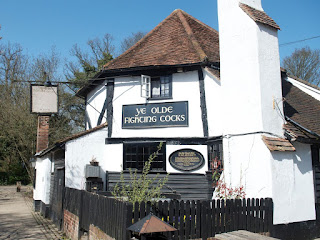
Recently, there has been news of the closure of Ye Olde Fighting Cocks in St Albans, a well-known historic pub that claims, perhaps questionably, to be the oldest in England. So, for example, we have the BBC stating:

England's 'oldest pub' Ye Olde Fighting Cocks closes

While the Times reports that:

England’s ‘oldest pub’ Ye Olde Fighting Cocks closes after two years of Covid restrictions

Both of these headlines have something of an air of finality, but if you read the actual reports you will discover that, while the current lessee has gone into administration following two years of poor trading due to restrictions, the owning pubco are fully intending to find someone else to take it on.

The Daily Mirror was even more definite, stating in its headline:

Landlord forced to close 'Britain's oldest pub' which first opened in 8th century

And going on to say in the meat of the report that “A historic pub which has been serving punters for 13 centuries may have called last orders for the final time.” This report also commits the common error of describing a pubco as a brewery. Surely, more than thirty years after the Beer Orders, journalists should have cottoned on by now that most pubs are no longer owner by actual breweries.

Over the years, I have seen plenty of examples of this kind of alarmist reporting, implying that a tenant leaving a pub, possibly followed by a short period of closure, represents last orders in perpetuity, whereas in fact it is a perfectly normal occurrence. Yes, there are many pressures on the pub trade, and large numbers of pubs have closed, but these reports do not help the situation.

Given the Fighting Cocks’ claim to fame from its age, this story has been interpreted by many as an exemplar of the general decline of the pub trade, often by people who really should know better. For example, there was this tweet from someone involved in the industry for many years which I felt the need to correct.

In general, prominent pubs like the Fighting Cocks don’t just close overnight out of the blue, unless they have been affected by compulsory purchase for redevelopment. Pubs tend to die quietly in a corner, undergoing a slow spiral of decline until the final closure is met with people saying philosophically “well, it was only a matter of time.” Most of the pubs I can think of with a reputation beyond their immediate area that have closed are rural ones in landmark locations, such as the Flouch on the Woodhead Pass, which have been undone by changes in social attitudes over time. More recently, the even more famous Cat & Fiddle in Cheshire only narrowly escaped the same fate.

I’m not really that familiar with St Albans, but I would say the location of the Fighting Cocks is less than ideal, being some way from the city centre streets on the edge of a park. But I would be extremely surprised if Mitchells & Butlers reached the conclusion that it wasn’t a viable proposition in the long term.

I see anti-meat pressure group PETA took advantage of the opportunity to jump on the bandwagon and suggests that the Fighting Cocks should reopen under a new name serving a vegan menu, which I doubt would do much for its future prospects.

A common example of press nonsense that I have picked up before is the tendency to lapse into the lazy journalistic cliché of describing a pub as “popular”, even if it has just closed down and so manifestly wasn’t. And I recently spotted this report about the Poachers in Bollington, which is celebrating twenty-two years in the Good Beer Guide, but the headline refers to the Good Pub Guide, even though the correct publication is identified in the actual text.

I know journalism has been hollowed out by the digital revolution, and there just isn’t the amount of expertise and experience that there used to be. Sub-editors who would pick up on this kind of thing have become a vanishing species, with journalists filing their copy directly without having anyone to check it over. But, even so, surely it would help if they read it over again before pressing the “Send” button.

Tuesday, 15 February 2022

Battered by the storm

It has been only too obvious that the pub trade has been hit extremely hard by the Covid lockdowns and restrictions of the past couple of years, but there has been something of a lack of hard figures to quantify this. Now this has been rectified by the British Beer and Pub Association, who have updated their Beer Barometer statistics to bring them up to the end of 2021.

Unfortunately, they haven’t updated the detailed downloadable spreadsheet to back this up, but the headline numbers are all too clear. In 2020, as shown by the graph above, beer sales in pubs were no less than 55% down on 2019, while in 2021, where pubs in England were able to open without restrictions for the final five and a bit months, the drop had been cut back to 38%, which is still pretty devastating.

In this environment, it is hardly surprising that most pubs have found it a financial struggle, and obviously there is a knock-on effect on the brewing industry which was only partially offset by increased off-trade sales. Beer is proportionately consumed more in the on-trade than other forms of alcoholic drinks, and so a switch to home drinking was inevitably accompanied by a movement to wines and spirits, where duty receipts rose by 8% and 13% respectively.

The removal of the remaining Covid restrictions in England from 27 January gave a positive psychological signal, and hopefully the road is now clear for the pub trade to make a sustained recovery during 2022. But they are certainly not out of the woods yet. Kate Nicholls of UK Hospitality reported yesterday that, even now, 23% of pubs and bars are still trading at a loss, and only 30% are doing any more than break even, so there is still a long way to go.

An important factor in underpinning the recovery will be maintaining the lower VAT rate of 12.5%, which is due to end in April, until at least October. While this does not directly affect beer, it does give a boost to any establishments that serve food.

It’s always hard to generalise from one’s own personal experiences, but I have got the impression that the business in pubs has noticeably picked up over the past three weeks, and in fact my local Wetherspoon’s was pretty rammed on two different occasions. In contrast, last autumn there was always, with few exceptions, the feeling of a slight shadow hanging over proceedings, which was only made worse by the overhyped Omicron scare in December. So there are grounds for optimism, and hopefully we can look forward to a good summer, especially given that a lot more people will be taking holidays in this country.

Tuesday, 1 February 2022

The fickle finger of fate

In 2009, Marston’s opened a new dining pub called the Fallow Deer prominently situated on the A6 Chapel-en-le-Frith bypass in Derbyshire. It was faced with stone to match the local environment, resulting in a more attractive and upmarket appearance than is typical of such establishments. I called in a year or so later to see what it was like, but unsurprisingly found it entirely geared up for eating, with nowhere to just sit down for a drink.

A few years later it was refurbished and renamed the Fickle Mermaid. While Fallow Deer is just a generic “rural name” this did in fact relate to the local legend of the mermaid's pool on the side of Kinder Scout, where allegedly a beautiful mermaid used to lure men and either make them immortal or end their lives. However, it’s doubtful whether many people actually knew of that – I had to look it up – and to most it would simply come across as a rather odd and whimsical name for a pub fifty miles from the sea.

I didn’t really give it much more thought, but was surprised to read a report that planning permission had been granted to demolish it and replace it with a petrol station and takeaway coffee shop. It has to be said that if a large and expensive new-build pub is to be demolished only thirteen years after it opened it is a very poor reflection on the original site selection.

I’ve written before about how these family dining pubs, while they may have little appeal to the beer enthusiast, have been something of a success story for the pub industry in recent years, and Marston’s and Greene King have both invested considerable sums in developing them. Indeed, Marston’s opened a new one in my original home town of Runcorn, the Ten Lock Flight, shortly before Covid struck. I have often noticed when passing how busy they appear to be at teatime and early evening at weekends, a time when I would never really consider going to a pub unless in the later stages of an urban pub crawl.

However, maybe the clue is in the title of that blogpost, “Follow the money to the retail park.” I don’t claim to be an expert on pub site selection, but I suspect an important factor for this type of pub is to have a substantial population within ten or fifteen minutes’ drive, and a further plus point is being able to combine the pub visit with a bit of shopping or another leisure activity such as the cinema or bowling.

The Fickle Mermaid, while it is in a prominent position on the main road heading from the Manchester area into the Peak District, doesn’t actually have all that people living nearby. If people are going out for a day in Peak, they’ll probably not want to eat until they actually get there and, while I can imagine it might become busy with returning trippers in the early evenings at weekends, that isn’t going to be enough to sustain it throughout the week.

In any case, the planning application was rejected on appeal, so it remains to be seen what Marston’s response is. They could try to make another go of it, which has not been unknown elsewhere, or find another pub operator who is interested. I don’t see that a dining pub in that location is inherently a lost cause. Or they could board it up and leave it to rot, and come back with another planning application in eighteen months, by which time it will have become an eyesore.

This prompted me to ask on Twitter for other examples of short-lived new-build pubs, and quite a few were forthcoming. Another in my local area was the Bandstand in Gorton, Manchester, which stood on a small retail park and can’t have lasted fifteen years. And, in the late 1980s, Banks’s built the Springbrook at the A50/A56 junction on the eastern fringe of Warrington, where planning permission has now been requested to redevelop the site into a care home. There were plenty of instances of brand new pubs of various types that had barely lasted twenty years.

I odn’t know how it compares with other types of retail and hospitality business, but pub operators in general seem to have a distinctly patchy record on identifying locations for new pubs. While Wetherspoon’s are not generally in the business of new-builds, they have had their fair share of missteps over the years. One of the worst was the Sir Edwin Chadwick in Longsight, Manchester, where they totally misread the character of the area and the way it was likely to develop. I think it only lasted about five years. Apparently, Tim Martin, on one of his regular tours, walked through the door, took a quick look around and instantly said “Get rid!” Also in this general area, are the Lodestar in Neston, Cheshire and the Red Lyon in Whitchurch, Shropshire, neither of which lasted long under their stewardship and are now closed. One can only assume that Wetherspoon’s misjudged the character of the towns concerned, as they seem to thrive in other places of similar size.

Friday, 28 January 2022

Imitation is the sincerest form of flattery

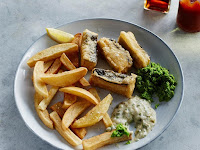
Not content with asking people to avoid alcohol and kill pubs for Dry January, we are also being exhorted to shun any meat-based dishes for Veganuary. Maybe it would be simpler just to rename the month NoFunuary. But, on seeing a recommendation for “Vegan Fish and Chips”, it struck me just how many of the vegan dishes that are promoted to us are actually imitating meat.

OK, if you feel a moral imperative to avoid eating anything that involves the death of animal, you may find ersatz meat a tolerable substitute, but isn’t that effectively an admission that genuine meat is actually tastier and more enjoyable? In a sense that is comparable to alcohol-free beers, which depend on people’s awareness of what normal-strength beer is like. And at least with alcohol-free beers you get the potential advantages of maintaining sobriety and legality, whereas all that imitation meat brings you is a vague sense of moral superiority.

If you want to promote the virtues of plant-based food, surely it would make sense to offer dishes that use fruits, vegetables and grains for what they are rather than pretending to be something else? And the more committed ideological vegans may well take the view that these dishes are in a sense legitimising meat. I’m not sure whether there actually many ideologically committed total abstainers around nowadays, but I doubt whether they drink alcohol-free beer.

It’s not as if imitation meat dishes are a healthier option, either. In fact, they are made in factories from a wide range of heavily processed ingredients and, it could be argued, constitute some of the worst junk food of all. Yes, a low-cost sausage or burger may also contain plenty of additives, but anything that is a recognisable cut of meat or fish won’t.

Tuesday, 25 January 2022

Onwards and upwards

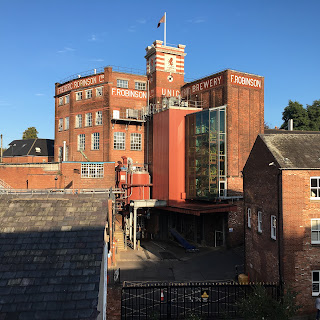
Last week, Robinson’s Brewery announced their intention to invest £12 million to vacate their existing premises in the centre of Stockport and concentrate all their activities on the site of their current packaging centre in Bredbury. While the timing of this news may have come as a surprise, the substance should not have done. The Bredbury facility was opened in 1975 and, as recorded in Robinson’s corporate history,

“...it was recognised that the site was considered to be of sufficient size to enable all of the company’s operations to be housed there at some future time, if this was considered desirable.”
The Bredbury operation has always come across as something that would be fitting for a rather larger company than Robinson’s and, as I wrote five years ago:
This seemed to speak of expectations never quite fulfilled, and I get the impression that Sir John Robinson, who died in 1978 at the age of 82, was a very dominant and ambitious character whose determination was not matched by his three sons, Peter, Dennis and David.
For whatever reason, whether inertia or a change in the business climate, the move never took place, and indeed in the mid-2000s Robinson’s carried out a substantial investment to install an entirely new brewing plant within the existing building. While it wasn’t shouted from the rooftops at the time, this also involved halving the capacity of the brewery to take account of the fall-off in on-trade ale volumes. However, they still lacked a small-scale plant to enable them to make shorter runs of specialist beers, which is something that their local rivals, particularly Hydes, have been able to take advantage of. This was given, maybe rather questionably, as one of the reasons for dropping 1892 Mild a few years ago.

No doubt this will be remedied when the new plant is constructed, and it is also likely to involve a further reduction in the maximum brew length. In the 2017 blogpost I linked to above, I stated that they were then brewing about 30,000 barrels a year, or less than two per week for each pub they owned, and that included a lot of bottled Trooper sold in the off-trade. The figure will surely be less now – in terms of brewing volumes, they’re really not that big a company, and operating from two sites must lead to considerably inefficiency.

They have also not too long ago spent a considerable sum in creating an impressive new visitor centre and shop attached to the Stockport brewery, an investment that will now have to be written off. Bredbury is not as conveniently placed for brewery tours as central Stockport, although maybe they will regret demolishing the Horsfield Arms which once stood just outside the plant and could have served as a brewery tap.

Every brewery attaches its own distinctive character to the beers it produces and, while the beers may be just as good brewed in a new location, they are never quite the same. However, Unicorn is the only beer remaining that has a lengthy heritage with the company, the other main brands such as Dizzy Blonde and Trooper being relatively recent introductions, so it may not be felt to be a significant problem. As a low-volume seasonal product, Old Tom doesn’t really count, and in any case I doubt whether many drinkers could detect a subtle change in character from one year to the next.

This announcement certainly represents a substantial vote of confidence in the future of the company, and the current leading lights of the Robinson family, Oliver and William, have always given the impression of being committed to it in the long term. In recent years, the company has taken a number of decisions that I have found disappointing, such as the axing of 1892 Mild, the severe cull of their pub estate, and the horrible Farrow & Ball style of many of their renovation schemes. But, as I wrote in 2017,

Obviously Robinson’s is a commercial company, and its directors must take the actions they see best to secure its future prosperity, which may need to include grasping nettles and slaughtering sacred cows.
At the end of the day, they are a business, not a heritage preservation body.

It can’t be denied that Stockport’s character will be diminished by the loss of a large working brewery right in the centre, not least by losing that distinctive odour that often wafts over the town. The number of places where this can be experienced is steadily diminishing, although it can still be found in towns like Devizes, Cockermouth and Lewes.

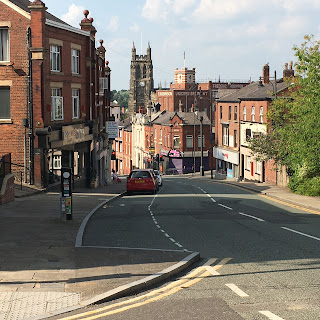
The brewery tower only dates back to the 1920s and, apart from the decoration around the top, isn’t really of great architectural value. To the best of my knowledge, it isn’t a listed building. But it is a very distinctive landmark that adds to the town’s identity, and features in many views of Stockport, so hopefully it will prove possible to preserve it for alternative use, possibly as apartments.

Thursday, 20 January 2022

Freedom restored

There was good news yesterday when Boris Johnson announced that all remaining Covid restrictions in England were to be lifted. Possibly he went a little further than originally intended because the current political turmoil meant that he wanted to avoid another embarrassing backbench rebellion, but whatever the reason the outcome is most welcome. The work from home guidance was lifted immediately and the mask mandates and vaccine passports will go from Thursday of next week.

While the latest restrictions, introduced at the beginning of December, did not directly impact pubs and restaurants, they certainly did indirectly in terms both of reducing footfall in town and city centres and creating a heightened climate of fear that led to mass cancellations of seasonal bookings, as I reported here. While Christmas and New Year normally give pubs a boost, last year this trade was largely wiped out for the second year running.

Hopefully now the removal of restrictions will give the hospitality industry a clear run to recover and rebuild customer confidence during 2022, especially over the vital summer season. It also in political terms looks increasingly unlikely that restrictions will be reimposed. But it is important that pubs contribute to this by abandoning the pointless Covid safety theatre that remains fairly common. If you want a normal trading environment, you need to embrace normality rather than helping perpetuate a climate of fear.

I wrote in December how many of the dire predictions about the effect of Omicron had been greatly exaggerated, and so it has proved.

In the succeeding week, there has been plenty of evidence that the Omicron variant is relatively mild, and the return of restrictions might have been an over-reaction. It seems to conform to the general evolutionary path of viruses that they become more transmissible but less severe. Many media commentators going well beyond the usual lockdown sceptics have suggested that it was a step too far, and that we couldn’t live in a permanent state of fear.

The government have stated they will review the restrictions in three weeks’ time, and we can hope that they will rescind them, although such back-tracking would lead to a lot of egg on face. But, even then, it would be just a week before Christmas, and too late to rescue much of the holiday season.

The pity is that it took them seven weeks to realise this rather than three, but at least they have in the end.

It has been very noticeable over the past few days how many politicians and commentators are embracing the liberalisation and backtracking on their previous support for lockdowns and restrictions. It is going to become like France after the war where it was well-nigh impossible to find anyone who didn’t claim to have been a member of the Resistance.

Scotland and Wales have not followed suit, and in fact never relaxed restrictions to the same extent as England during last year. This has not, however, resulted in any better figures for Covid deaths and infections, and has certainly produced a worse outcome for hospitality. It will be interesting to see how long they persist with this stance while seeing the English tourism and hospitality industries – and indeed the economy in general – forge ahead.

Friday, 14 January 2022

Irish eyes are watering

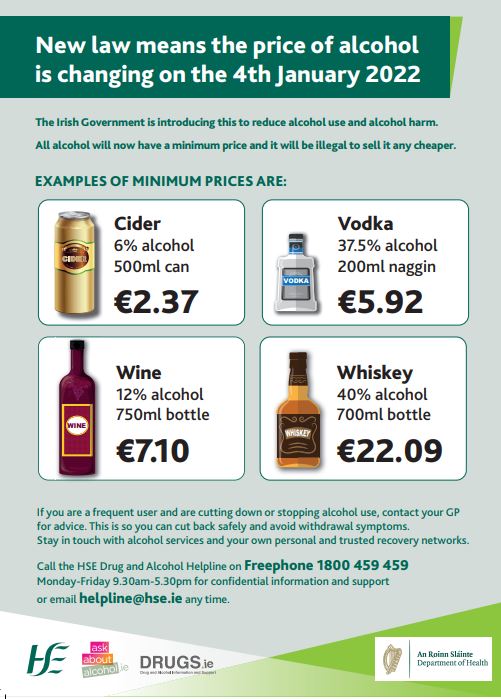
From Tuesday January 4th, the Republic of Ireland followed in the footsteps of Scotland and Wales by introducing a Minimum Unit Price (MUP) for alcohol. There is some confusion about the actual level, as the headline rate is set at €1 per “standard drink”. This is defined in weight terms as containing 10 grams of pure alcohol, but as alcohol is lighter than water it corresponds to a volume of 12.5 millilitres. At the current exchange rate this equates to a price of about 67p per unit as understood in the UK, which is a third as much again as the 50p rate applying in Scotland and Wales.

While the 50p level leaves many popular products untouched, 67p will affect a large swathe of mainstream drinks and leave only high-priced premium products unscathed. A 4x440ml pack of Carling will be £4.72, a bottle of 13% ABV wine £6.53 and a standard bottle of spirits £18.76. Probably 85-90% of all alcohol sold in the off-trade in volume terms will be affected.

50p only impinges on the very bottom end of the UK on-trade, although it does start to affect some of the stronger guest ales sold in Wetherspoon’s for £1.99 when the 50p CAMRA discount is applied. Irish on-trade prices tend to be somewhat higher than ours, and a quick look at Wetherspoon’s website shows that in one of their Irish branches they are selling guest ales at €2.95 per pint (about 25% above the equivalent UK price), including some containing over 3 units per pint. So it won’t immediately affect the on-trade, but it is certainly snapping at its heels. I don’t think the CAMRA vouchers are valid in the Republic.

I’ve discussed before at length the various issues associated with MUP – the creation of a black market, the encouragement of home brewing and illegal distilling, and making illegal drugs more attractive in price terms. The higher the level is set, the worse these problems will become.

Perhaps worst of all is the impact on people’s finances. Although the public health lobby may be reluctant to accept it, alcoholic drinks are a legitimate consumer product that are consumed responsibly by many households. If the price is increased by up to 50%, it will make a huge hole in family budgets, which is made even worse by the fact there are currently inflationary pressures from all sides. Note that the graphic above refers to “frequent users” as if they are discussing illegal drugs.

And it doesn’t necessarily follow that it will lead problem drinkers to cut down. The experience from Scotland has been that, in many households where alcohol represented a significant proportion of weekly expenditure, that share increased, so something else had to suffer. As the old Russian proverb goes, “Daddy, now that vodka is more expensive, will you drink less? – No, my son, you will eat less.”

It is also a manifestation of rank snobbery. If it was decided that increasing the price of alcohol would alleviate drink-related problems, then the intellectually respectable way of doing it would be to raise duty across the board so that the pain was spread relatively evenly. MUP, on the other hand, concentrates the entire effect on the less well-off, while the prosperous remain unscathed. It is, at heart, deeply patronising. As Christopher Snowdon says in this post:

In 'public health', the name of the game is to interfere with people's lives without having your own choices meddled with. This is straightforward with smoking since the philosopher kings of the nanny state don't smoke. Alcohol is more tricky since most of them drink, but minimum pricing - which was introduced in Ireland yesterday - offers the perfect way to penalise ordinary people while leaving fine wine and craft beer unaffected.
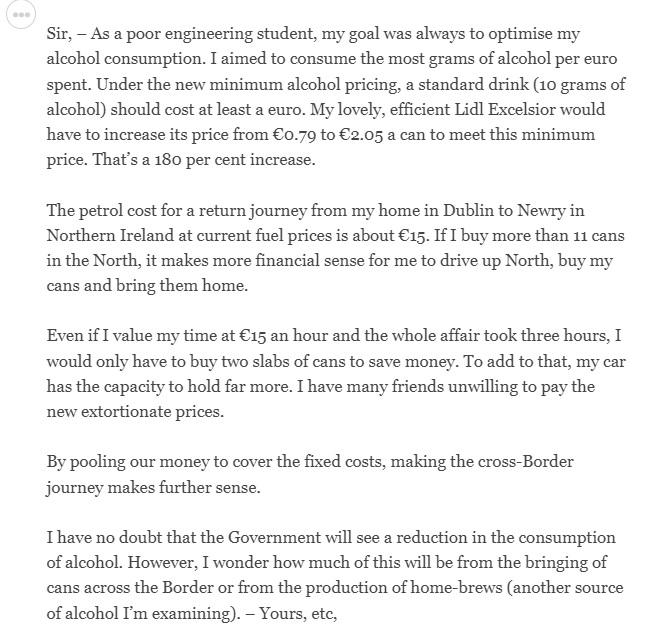
The opportunities for cross-border shopping are all too obvious. About 40% of the Republic’s population lives in the Greater Dublin area, which is just 71 miles, or not much more than an hour, away from Newry along a motorway. This is set out very clearly in this letter to the Irish Times.

Northern Ireland does not yet have MUP, but it is currently being consulted on. If it decided to match Scotland and Wales, the attraction of cross-border shopping would be scarcely diminished, while if it matched the Republic, ironically it could even encourage booze cruises to Stranraer!

Even if MUP did make a significant impact on drink-related problems in society, it is a very blunt instrument that causes collateral damage to many responsible consumers. It is comparable to a road safety strategy of doubling the price of petrol. And there’s little evidence from Scotland so far that it does make much difference. Ireland already has some of the most expensive off-trade prices in Europe yet, as this reformed alcoholic says:

‘Cost has nothing to do with addiction. If the price of drink was the problem, how come all the countries in Europe with cheaper drink don’t have the alcoholism issues we have? I think we’ve an educational problem, not a pricing problem,’
Historically, the Irish have a reputation of being naturally rebellious and distrustful of authority. But, more recently, this spirit seems to have become a thing of the past, as they have meekly submitted to being bled dry by EU-mandated austerity, and accepted one of the strictest Covid lockdowns in the Western world. Pubs are still struggling under an 8 pm curfew and the imposition of vaccine passports. As this article says, We have become the most subservient lickspittles on the planet.

Monday, 10 January 2022

A Worthy alternative?

Late last year, Wetherspoon’s carried out a major revamp of their permanent beer range. The biggest feature of this was ditching their long-standing relationship with Heineken UK, and instead taking a greater number of beers from Molson Coors. This meant that Spoons drinkers would no longer be able to enjoy the likes of Kronenbourg, Foster’s and John Smith’s Extra Smooth, often derided as the favourite of the 9 am crowd.

The replacement is Worthington’s Creamflow, so in the interest of research I thought I would give it a try. The price was £1.99, the same as their guest ales, although in this case there was obviously no CAMRA discount available. It was served in an unbranded conical glass of the kind they use for real ales. It had a dense, creamy but fairly shallow head, so no Guinness-style short measure. The temperature was perhaps about half way between that used for ales and lagers.

Once it had warmed up a little I could detect a little in the way of malt flavour, but little evidence of hop character. It’s a long time since I had any John Smith’s, but I recall it having a slightly soapy character which was absent in the Worthington, which I would say was marginally preferable. Someone said that was damning it with faint praise, which of course it was. But the key point was not that it was actively unpleasant, but that it was very bland. Many of the old-school CAMRA activists fail to appreciate this and continue to assert that mass-market kegs and lagers are foul, which of course they aren’t – if they were, nobody would drink them.

Obviously a well-kept pint of Holts or Lees Bitter, or Robinson’s Unicorn, all of which are available within a short distance, would be vastly preferable. And Wetherspon’s themselves offer a range of cask beers. But, in their outlets around here, apart from Ruddles and Abbot, their selection tends to consist of pale, hoppy beers from local microbreweries, dark beers, and beers over 5% in strength. For anyone just wanting “a pint of bitter”, it’s a choice of Ruddles or Worthington, which may not be quite such a one-sided contest. Personally I’d like to see them offer some of the better-known bitters from other parts of the country that you rarely see around here, such as Butcombe, Hook Norton or Batemans, but obviously they know their market better than I do.

Then there is the question of quality. While their policy is to change sub-standard beer without demur, your chances of getting a duff pint in Spoons do seem to be significantly higher than in a family brewer tied house. And, if you’ve ordered it via the app to be brought to your table, good luck with attracting the attention of a member of staff to get it changed. So it’s entirely understandable that the non-enthusiast drinker who just wants an undemanding, reliable pint may conclude that the Worthington is the best option.

I ran a Twitter poll to ask people which of the four popular brands of “smooth” bitter they preferred (or least disliked). The results were a decisive win for Boddingtons, with the other three trailing in well behind, and Worthington last. But I wonder how many people voting have ever actually tried Boddingtons Smooth, or were swayed by memories of the now-discontinued cask beer which, many years ago, was actually very good.

It’s an interesting thought experiment whether the “real ale revolution” would ever have taken off in quite the same way if smoothflow keg ales of this kind had been available in the early Seventies.

Friday, 7 January 2022

If you don’t get bitter, you’ll just get Boddies

In the US market, several beers that would be called Bitter in the UK are referred to as “Pub Ales” or some similar formulation, as in the Boddingtons Pub Ale shown in the photo. This has prompted another round of discussion on social media about how brewers, in the UK too, are increasingly reluctant to actually use the term “Bitter” to describe their products.

This was sparked off by Gary Gillman in this blogpost, to which Boak and Bailey responded here. It is a subject that I addressed back in 2019 in a post entitled The Beer That Dare Not Speak its Name. The main reason for this in North America is that they have no history of beers actually being called “bitter”, and the flavour connotations of the term are thought to be offputting.

However, in this country, as Boak and Bailey point out, it is more a case of Bitter being seen as something old-fashioned that your dad drank, which is the same problem that Mild experienced a generation before. But, as I argued, it is denying your product’s heritage, and there is no consensus as to what should replace it. “Nobody ever, when asked the question ‘what type of beer do you enjoy drinking?’ replies ‘Oh, I like amber ale’.”

Gary is very knowledgeable about the world of beer, and especially its history, but he is writing from a North American perspective, and I think he rather misses the mark in complaining than many bitters “show excessive caution in their hopping level.” That may be a matter of personal preference, but it does not mean that such beers are not true to style.

The origins of the term are obscure, but it seems to have developed in the mid-19th century as a may of distinguishing the new pale ales from the older mild beers. Yes, it was more heavily hopped than milds, but that didn’t mean it was particularly bitter.

We don’t know now whether bitters from before the First World War were more bitter than they are today (although they certainly were markedly stronger), but that is beyond the memory of any drinkers alive today. And, since the Second World War, it has always been the case that many bitters were fairly sweet, and few could be said to be particularly bitter. The term had become a generic description of a particular class of beer, not a descriptor of flavour.

In the late 1970s I went to university in Birmingham , where the main (indeed almost the only) bitters available were Ansells and M&B Brew XI, both of which are described as “sweet” in the 1977 Good Beer Guide. Brew XI then was probably the best-selling bitter in the country. The brewery section contains a number of similar references, alongside such terms as “light” and “subtle” which indicate a similar lack of heavy hopping.

There were some notably bitter beers around at the time, such as Boddington’s, Holt’s, Yates & Jackson and Youg’s Ordinary, but they were very much in the minority. There is probably some truth in the belief that the bitterness of some beers has been reduced in the intervening forty-odd years to make them palatable to a wider market, but within the memory of people drinking today there never was a golden age when Bitter really was bitter.

And today, if asked to give an example of an archetypal British Bitter, most people would suggest a “balanced” brew such as Harvey’s Sussex Best or Taylor’s Boltmaker rather than one noted for being assertively hoppy. And the current best-seller, Sharp’s Doom Bar, certainly isn’t.

Thursday, 30 December 2021

A taste of freedom – Part 3

This year, I have made 80 posts on my Closed Pubs blog, the highest figure since the early days of “shooting fish in a barrel” and in fact more than I did on my main blog. I have been helped by prolific suggestions from Kyle Reed in West and South Yorkshire, and Dan Bishop in and around Burton-on-Trent. I have never met either of these gentleman, but a pint will certainly be theirs if I ever get the chance. Some of the images extracted from StreetView are surprisingly picturesque, such as the one above of the Bridge Tavern in Southampton which really conjures up the feeling of a bright Spring day.

My total of Twitter followers has gone up during the year from 5,600 to just over 5,900, so obviously plenty of people find my mixture of serious and more lighthearted stuff interesting. Meanwhile, Toady, who says the things about lockdowns and Covid totalitarianism that Mudgie doesn’t, has passed the 4,000 mark. A recurring problem with Twitter is that, no sooner do you add new followers than they purge another bunch for overstepping the mark in some way. After a change in control, they even suspended their own founder Jack Dorsey, although his account seems to have been reinstated now.

The march of the dreaded posing tables in pubs seems to continue unabated. This year, the handsome Cat & Lion at Stretton, just south of Warrington reopened following a takeover and refurbishment by Holt’s. Much of it is given over to dining, but the main bar area is pretty much full of the things, as shown above. And when you walk into Joule’s impressive new Crown Wharf in Stone, Staffordshire, you are immediately confronted with a forest of them, although there are some more comfortable seats elsewhere. If pubs didn’t have any posing tables, would anyone really bemoan their absence?

In his October Budget, Rishi Sunak announced a thoroughgoing reform of the alcohol duty system. Although the absolute level of duty remains much higher than most comparable European countries, this was a sensible move that recast the system on a much more rational basis and eliminated the many inconsistencies and anomalies of the old structure. Inevitably there were complaints from some special interest groups, as there will always be losers as well as winners, and it remains to be seen to what extent these will be heeded. One aspect that hopefully will be changed is setting the minimum container size for the lower duty rate for draught beer at 40 litres, which excluded both the 4½-gallon pins that are increasingly used for cask ale, and the 30-litre kegs that are popular for craft beers.

There was sad news in August with the death just before his 65th birthday of longstanding local CAMRA member Stuart Ballantyne. Stuart was always good company, but unfortunately had to contend throughout much of his life with a couple of serious non-alcohol-related health issues. In the early 2000s he was instrumental in leading a campaign to stop Marston’s replacing their own bitter with Banks’s in their pubs in South Manchester. In 2001 I spent several weeks in hospital with a badly broken ankle and will always remember that Stuart made the effort to come and visit me.

Conscious that I had gone through the whole of 2020 without setting eyes on the sea, I made a point of visiting the nearest expanse, at New Brighton, once I was able. It was a bright sunny day and I had a walk along the promenade, but it still wasn’t possible to go in any of the pubs. I managed to have the holiday in Norfolk that I had cancelled last year, although I wasn’t able to take maximum advantage due to suffering from the dreaded post-Covid cold. You don’t actually see much sea along the North Norfolk Coast, as it tends to be a mile away across salt marshes, so the only actual sight I got was looking west over the Wash at Hunstanton. I took the striking image shown above of the King’s Lynn Conservancy Board building illuminated by the setting sun, with a couple of windows of the Crown & Mitre pub included on the right.

Once everything had opened up again, I was able to get out and visit a number of the historic tourist attractions, although nowhere significant I hadn’t visited before, albeit in some cases over forty years earlier. Probably the most noteworthy was Boscobel House in Shropshire, where Charles II hid in the Royal Oak following his defeat by the Parliamentarians at the Battle of Worcester in 1651. It’s not particularly distinguished architecturally, but it was one place where staff dressed in costume and explaining the story really managed to bring the history to life.

As last year, it’s easy to say that lockdown gives plenty of opportunity to catch up on reading, but it never quite works out like that. But one book I did enjoy was Lessons from History by Alex Deane. This is basically a compendium of short historical anecdotes which are variously inspiring, amusing, poignant, heartwarming or simply jawdropping. It’s presented in easily digestible chunks and so would be ideal for keeping at your bedside and reading two or three chapters before dropping off. It’s a bit late now, but it would make a good stocking-filler for someone with an interest in history.

The episode that made most impression on me, maybe because I had never heard about it before, was Bert Sutcliffe and Bob Blair’s cricketing heroics for New Zealand against South Africa in 1953. Sutcliffe had been hospitalised after being injured by ferocious fast bowling, and Blair’s fiancée had been killed mid-match in the worst train crash in New Zealand history. The rules certainly wouldn’t allow that now!

So we are currently in a situation where pubs in England have been allowed to remain open at least until New Year’s Eve, although there is no guarantee that further restrictions will not be imposed in the New Year, and the general loss of confidence continues to severely depress trade. However, there are plenty of signs that the Omicron variant is nowhere near as severe as many predictions, and more and more politicians and commentators are waking up to the reality of lockdown harms and calling for a more balanced view. So it’s hard to tell which way things will go, but I just hope I’m not here in a year’s time still talking about lockdowns and restrictions on what remains of the hospitality industry.

Follow these links for Part 1 and Part 2 of this review.

Wednesday, 29 December 2021

A taste of freedom - Part 2

At the end of last year, I wrote “Despite the optimism surrounding the roll-out of vaccines, I expect I will still have a long wait before I am once again able to enter a pub unchallenged, walk up to the bar to order a drink, and choose to sit wherever, and with whom, I want.” So it proved, and in fact it turned out to be not until the second half of the year, on Monday 19 July.

In February, the Prime Minister announced a roadmap to reopening the country, which many felt at the time was pretty glacial in pace. However, as I said at the time, if it all went to plan, we might eventually find ourselves looking back on it all as a bad dream. Well, that worked out well, didn’t it?

The first key milestone was allowing pubs to open outdoors only from 12 April, but unfortunately that presaged a spell of wet and windy weather that prevented them taking maximum advantage. I’m never a great fan of outdoor drinking at the best of times, and in fact the sole occasion on which I took advantage of this was a trip to Stonehouse Brewery in Shropshire on a cool but dry day, where I was made very welcome by proprietor Shane Parr.

The next milestone on the roadmap came on 17 May, when pubs were finally allowed to open indoors, albeit under such severe restrictions that, as I wrote, “created a regimented, cheerless experience that largely destroys the pleasure of the swift, casual pint.” A further problem was that it seems that many licensees missed a vocation as a prison warder, and chose to gold-plate these rules and add some extra of their own. Yes, rules are rules, but it is a choice whether to apply them with a light touch or a heavy hand. This attitude seemed to be more common in independent venues than corporate ones.

As I wrote at the time, I don’t go to pubs to be told off, and when every visit involves a potential confrontation I’m really not inclined to bother. One exception was Wetherspoon’s, who don’t have the staff to micromanage the behaviour of their customers, but the amount of atmosphere in a Spoons operating table service only is on a par with that of the celestial body that gives its name to many of their pubs. I did find one local pub that wasn’t laying it on with a trowel, but in general speculative pub visits were off the agenda.

The end of the tunnel was supposed to come on 21 June, and I was looking forward to a birthday pub crawl of Stockport three days later. However, following doom-mongering predictions from SAGE – which unsurprisingly turned out to be wildly pessimistic – it ended up being postponed by another four weeks. But it did happen at last on Monday 19 July, despite warnings from all the usual suspects that opening up would be a recipe for disaster.

So I was in the Boar’s Head in Stockport before noon on that day, and was pleased to see that the normal habits of pub life had resumed. In the following weeks I was able to resume my usual pattern of pubgoing. While a handful of pubs still adhered to the “old religion”, resulting in giving them a swerve, in general pubs seemed to be the area of society where Covid paranoia had most receded.

I was able to have a holiday and go on a number of pub trips, the best of which was a day out in Stockport which involved people travelling from as far away as Kent. While I wouldn’t say that levels of trade reached pre-Covid levels, there seemed to be a steady build-up of customer confidence, which was most marked in the Castle in Macclesfield on 5 November, which was standing room only and absolutely rammed.

However, this was put into sharp reverse at the end of November when concerns about the Omicron variant led to some restrictions being reimposed. While they didn’t directly affect pubs, there was a clear impact on people’s enthusiasm for going out, combined with the reintroduction of the working from home guidance which severely hit pubs in major urban centres. This led to a collapse in business, particularly in organised party bookings, although it seems that trade in community locals has held up better. There is now plenty of evidence that the worst fears about the effect of Omicron were exaggerated, but pubs in England have been left in a kind of limbo wondering whether they are going to be imminently shackled or closed down again.

During the year, I visited 79 different pubs, of which 18 were new to me, almost half of which were on one holiday in Norfolk. While I did have a number of pub days out, they were all to places I had been to before. This compares with 60 and 17 in 2020, when the pubs were open without significant restrictions for perhaps a couple of weeks less. In contrast, in 2019 I visited no less than 111 new pubs, buoyed by four days out in towns where collectively I had only previously visited one pub, and four holidays in places where there was still plenty to explore.

Of the new pubs visited, nothing really stood out as an absolute must-visit. People had spoken highly of the Crown & Mitre in King’s Lynn, but I don’t think I caught it at the best time, and I was feeling a bit out of sorts as well. Probably those that stick most in the mind are a couple of unassuming locals – the Cart & Horses in Astley in South Lancashire, where retired miner Gordon Williams had been visiting four times a week for 75 years, and the Plough in Ashby-de-la-Zouch in Leicestershire, a cosy little Bass pub just off the town centre.

The best revisit of the year was undoubtedly the Anchor at High Offley in Staffordshire. There had been fears that this unique, unspoilt canalside pub might close permanently after the death of long-serving licensee Olive Cliff, but fortunately it has been taken over and reopened by her daughter Elaine. On a sunny Sunday lunchtime in August all the tables in the extensive beer garden were occupied. I ran into members of the Stafford & Stone Branch of CAMRA who were presenting the pub with an award recognising Olive’s long service, including Paul Mudge, who I had not met since our trip to Burton in March 2020.

On a trip to Chester, I called in at the Olde Cottage and had a chat with licensee Trevor, who has chronicled on Twitter the financial and emotional pain so many pubs have experienced during nearly two years of on/off lockdowns. Not a classic heritage pub, but a buzzing local on the edge of the city centre with a loyal band of regulars. I was unfortunate, though, to miss making the acquaintance of their pub cat Arty, who was upstairs enjoying his beauty sleep.

In contrast, I was disappointed by the Great Western in Wolverhampton, a pub that I would have classed as one of my absolute favourites, but which seemed to have been oddly sanitised by a recent refurbishment. Perhaps it would grow on me as it wears in.

I missed Arty in the Olde Cottage, and sadly Felix, the large black-and-white cat at the Boar’s Head in Stockport, had died earlier this year at the age of 16, so I didn’t encounter a single pub cat during the year. However, here’s a delightful picture of Malt and Hops in the Wellington in Birmingham city centre which was posted on Twitter by Jules Saunders.

Follow these links for Part 1 and Part 3 of this review. .

Tuesday, 28 December 2021

A taste of freedom – Part 1

I was originally going to call this review of the past year “A Year of Two Halves”, reflecting the decisive transformation in the prospects of the licensed trade and environment for drinkers that occurred on 19 July. At the time, Boris Johnson stated that these changes were “irreversible”, but sadly this has not proved to be the case, with some restrictions returning from the beginning of December. Although these have not, at least in England, directly affected pubs, they led to a collapse in public confidence with an inevitably disastrous effect on the trade.

During the past year I have only made – including this one – 55 posts on this blog, which is the lowest figure ever with the exception of 2007, which only covered half a year. This wasn’t through lack of interest, but a combination of the lack of source material due to the prolonged closure or restriction of the pub trade, and a wish to avoid turning it into a general blog about Covid-related issues. I have commented on subjects directly relevant to hospitality, such as masks and vaccine passports, but tried (generally successfully) to steer clear of the wider politics, and indeed on occasions have consciously bitten my lip.

I have discussed more general topics including asking Why does nobody just go for a drink any more? and how over the past couple of decades the business of pubs has noticeably moved outdoors. Some posts have received over 2,000 page views, with the highest figure being recorded by this post about craft beer hypocrisy. There continues to be a healthy level of comments, more than on some supposedly more prestigious blogs, with a number of regular contributors, although unfortunately there remains an undercurrent of trolling and personal abuse.

As last year, I will salute the work Kate Nicholls, Chief Executive of UK Hospitality, who has been a strong and outspoken voice for the industry, and even gained the honour of a profile in the Guardian. I will also praise the efforts of Essex licensee Adam Brooks who has consistently been prepared to question the rationale and essential unfairness of the lockdown policies.

I don’t intend to go on about Covid beyond saying that it has seen around the world a disturbing slide into totalitarian policies. While there has been much to criticise in England, up to now we have not gone as far as many other countries. One of the most relevant comments about the whole business is Oscar Wilde’s saying that “Selfishness is not living as one wishes to live, it is asking others to live as one wishes to live.”

I probably never thought I would be praising the work of someone responsible for a film entitled “100 Vaginas”, but strange times make strange bedfellows. So I would strongly recommend A State of Fear by Laura Dodsworth, which looks at how behavioural psychology has been used to create a state of fear and control people’s behaviour during the Covid crisis. And, of course, having created that fear, it is very difficult to unwind it.

She makes the point that the evidence that masks make any significant difference to transmission of the virus is extremely weak, and that they were basically introduced to create and maintain a feeling of crisis. Which of course is why they were brought back in shops and on public transport at the beginning of December this year. Laura is also an insightful commentator on Twitter on issues relating to Covid and lockdowns.

I have split this review into three parts to avoid it becoming too cumbersome, so please follow these links for Part 2 and Part 3.